
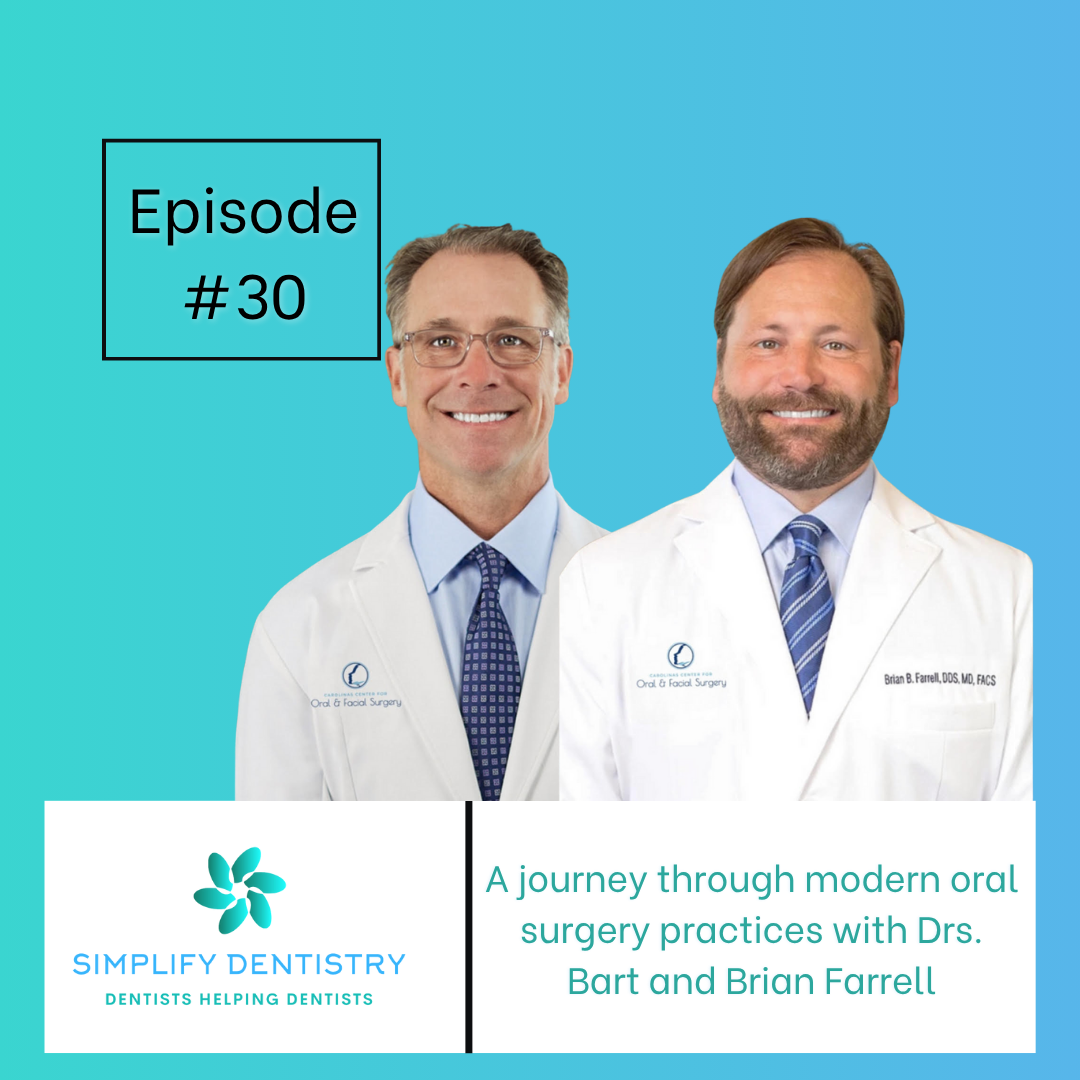
The Oral Surgery Brothers: A Journey Through Modern Oral Surgery Practices with Drs. Bart and Brian Farrell
Episode Description
Join our hosts, as they sit down with Drs. Bart and Brian Farrell to discuss their journey into oral surgery, practice growth strategies, and insights into modern surgical techniques. The Farrell brothers share valuable perspectives on leadership, practice management, and the evolution of oral surgery in today’s healthcare landscape.
Episode Navigation
00:00 – Introduction and welcome
01:07 – Path to dentistry and oral surgery
03:02 – Evolution of surgical techniques
11:31 – Impact of technology on practice
18:43 – Practice growth and equity partnerships
27:53 – Leadership lessons learned
40:52 – Discussion on dental education future
Key Takeaways
Practice Evolution
Transition from traditional surgical methods to digital planning and virtual surgery
Implementation of therapeutic dressings and Exparel for better patient outcomes
Importance of collecting and analyzing practice data for improvement
Focus on doctor-led leadership in growing practices
Technology Impact
Digital planning replacing traditional articulators
Integration of CBCT and STL files for precise surgical planning
Improved anesthesia delivery systems
Enhanced surgical efficiency through technology
Meet Your Guests
Featured Oral Surgeons
Dr. Bart Farrell: Experienced oral surgeon following in his father’s footsteps, focused on patient care and practice growth. Leader in implementing new surgical techniques and practice management strategies.
Dr. Brian Farrell: Innovator in oral surgery techniques, particularly in orthognathic surgery. Frequent lecturer and educator, sharing expertise in modern surgical approaches and practice development.
Featured Discussion Topics
Evolution of oral surgery techniques
Practice growth strategies
Technology integration
Leadership in healthcare
Equity partnerships
Future of dental education
Connect With Simplify Dentistry
Website: simplifydds.com
Podcast: Available on major platforms
Topics: oral surgery, practice management, dental technology, healthcare leadership, dental education, practice growth, surgical techniques, dental practice acquisition, dental anesthesia, orthognathic surgery
Transcript
00:00 Dr. Murtuza Shah-Khan Welcome back to the Simplify Dentistry podcast. I’m Murtuza Shah-Khan. I’m here with my co-host, Dr. Mustafa Shah-Khan and our guests today are Drs. Bart and Dr. Brian Farrell, the brothers Farrell oral surgeons. We’re here to talk to Bart and Brian about their careers, how they got into dentistry and oral surgery and go from there.
00:21 Dr. Mustafa Shah-Khan And once we’re done, we’re going to go outside and play two on two and see who’s better.
00:25 Dr. Brian Farrell I got a bad knee.
00:27 Dr. Bart Farrell Dentistry exemplified right here.
00:29 Dr. Murtuza Shah-Khan We’ve got two guys that can, well, maybe still play basketball and two guys that definitely can’t play basketball, two guys that can play golf, and two guys that can’t play golf.
00:39 Dr. Mustafa Shah-Khan I’m trying to figure out which one of those I’m in.
00:42 Dr. Murtuza Shah-Khan Yeah.
00:45 Dr. Brian Farrell Totally.
00:46 Dr. Murtuza Shah-Khan Guys, thanks so much for joining us.
00:48 Dr. Brian Farrell Thanks for having us.
00:50 Dr. Murtuza Shah-Khan Obviously, we’ve all known each other for a long time, so this is a very familiar conversation that usually happens in other settings, but thanks for joining us for this.
00:59 Dr. Mustafa Shah-Khan Except we don’t talk dentistry at all.
01:02 Dr. Bart Farrell Dentistry.
01:03 Dr. Murtuza Shah-Khan We have to. We have to talk a little bit and write everything off..
01:06 Dr. Mustafa Shah-Khan Yeah, something.
01:07 Dr. Murtuza Shah-Khan Yeah, I mean, you have to talk a little bit. Correct. Yeah. So similar things for all four of us. You know, Moose and I, both our parents were physicians, got us into healthcare. We ended up choosing dentistry, which was a much better decision than, you know, being a physician, especially these days, your dad’s an oral surgeon. You know, talk about how that impacted y’all, how that got y’all to, you know, either run away from that profession or obviously run towards it now.
01:34 Dr. Mustafa Shah-Khan I mean, was that the path that took you down it?
01:36 Dr. Brian Farrell Yeah, I mean, I think it’s a great story. So I think, probably always felt like I wanted to do health care and in college, running around, having fun, playing sports. And then it was like spring of the senior year and you’re like, holy hell, I got to make a decision of what I’m going to do. And so I tell everybody I went and interviewed at medical school in Iowa and the dental school, and when I went to the medical school, they were like, oh, hey, welcome, and we’ll try and find someone to show you around. And I felt it was very stale. I went to the dental school. They were open, welcoming. By the way, we’re having a gathering tonight. Come on over. It’s an upside down margarita party. Come on.
02:21 Dr. Brian Farrell I’m pretty much sold there was the path that went that way, but I think Bart will probably say the same. The cool thing about Charlie Farrell is Charlie Farrell didn’t say a word of go this way or go that way.
02:35 Dr. Mustafa Shah-Khan He.
02:36 Dr. Brian Farrell He let us kind of struggle and figure it out. And ultimately, once went into dentistry, then sort of always had that philosophy that was going to head. Continue to head toward oral surgery, but stayed quiet throughout all of dental school and truly try to see it all, learn it all, do it all. And then, you know, ultimately, the. The draw still kind of pulled us that way, but that was my kind of take.
03:02 Dr. Murtuza Shah-Khan So you weren’t the guy that walked into dental school the first day, like, we all had in our class, like, what are you. What are you here for? I’m going to be the oral surgeon. I’m going to be the radiologist.
03:10 Dr. Bart Farrell Yeah, no, were prepped. We were prepped. That’s not what you do. You’re a team player. You’re a team player. You go in there. We were friends, and I’d be honest with you, I’ve got the greatest friends from dental school. And talking about our dad, he was a good dude. He didn’t push us one way or the other, but he led by example, just like your Dad probably did. He was a good dude. We liked how he lived. He showed us what family was all about. Family was first, career was second. And, you know, he just exemplified what I think we should be.
03:42 Dr. Mustafa Shah-Khan You know, my Dad was different in the whole thing. My Dad’s an md, and I got.
03:50 Dr. Murtuza Shah-Khan That’s a.
03:51 Dr. Mustafa Shah-Khan That might be a different podcast. We said we’re brothers.
03:58 Dr. Brian Farrell But.
03:59 Dr. Mustafa Shah-Khan But it was one of those things where, you know, I got in medical school and dental school, and he was like, well, you know, only the special people can be MDs, you know, and I was like, really? You know, and, you know, they said, basically, when I decided to go to medical to dental school instead of medical school, his staff said he was just pissed for, like, weeks, you know, and then you. You get down the road and you kind of see what. What we’re doing and kind of how life is versus, you know, he was working 80 hours, 100 hours a week, and he’s kind of. He’s finally like, you know, you did make the right decision.
04:35 Dr. Mustafa Shah-Khan But I think MDs look at it, you know, I think they think that their thing is so special, and only the top of the top can be that. How many times have you had your friends be like, well, I mean, you’re not really a doctor. And I’m like, man, I don’t give a shit what you call me.
04:51 Dr. Brian Farrell Yeah. And so we’re. We’ll go to the hospital and we’ll sit in the doctor’s lounge with all the doctors. And it’s crazy. A lot of the physicians are telling their kids to go to dentistry because they realize that it’s a great gig. It’s a. It’s a. Your own small business. You have autonomy. Eight to five, it’s autonomy.
05:12 Dr. Murtuza Shah-Khan It’s a quality of life gig.
05:13 Dr. Brian Farrell Yeah, it’s a quality of life that’s. That’s very big. But in terms of kind of where I kind of realized that I wanted to do surgery was my college roommate had jaw surgery. And it was our freshman year of college, and I observed our dad doing jaw surgery on my roommate. And I always tell people what I remember about recovery was the blender pureeing food. Because back then they wired people together. And then the second thing is no telling what the hell was growing on the inside of his mouth. Cause you couldn’t get a toothbrush to the inside. I just was in Palm Springs this weekend lecturing to a big group of orthodontists, and they asked me, you know, how’d you get down this path? And funny thing that. That was kind of popped into my head.
06:08 Dr. Brian Farrell Like I said, I always kind of thought healthcare. But, you know, to. To actually, you know, 25 years later, to actually, you know, do jaw surgery now we’re certainly much better than we used to be. But I mean that. I kind of think that was kind of a sentinel thing where I’m like, holy hell. We. We saw our dad treat one of our buddies, and he guy got through it and it, you know, turned out.
06:30 Dr. Mustafa Shah-Khan So when you talk about you were lecturing to a bunch of oral surgeons, I mean, a bunch of orthodontists on jaw surgery, you know, I mean, you used to have a. A population of orthodontists that were like, you know, the last thing you ever want is jaw surgery. You know, and anybody steering you down that path just doesn’t know what they’re talking about. You know, it’s. It’s quackery. I came to one of yalls ski trips one time, and, you know, Myron was talking about jaw surgery. And I remember the one thing that he said is, nobody wants jaw surgery. Surgeons don’t want to do it. You know, the patient doesn’t want it. But it’s kind of one of those things where you look at kind of what the case is, and that is what needs to happen.
07:15 Dr. Mustafa Shah-Khan Is that kind of the direction that you were taking with the orthodontist or what. What was this interaction?
07:21 Dr. Brian Farrell And not to dominate it from Bart. But, yeah, I think that ultimately what happens is, you know, in today’s world, gone are the days of, like, someone telling you what you need or what you should do. The answer is, I think we have to back up and say, here’s where you are and here are the three paths in front of you. And that’s all, I caution anyone in the business, is just to make sure that if they’re in fact options, then they need to be educated on those options.
07:51 Dr. Mustafa Shah-Khan Sure.
07:52 Dr. Brian Farrell Meaning a person that has a big discrepancy between the top and the bottom jaw, if they truly decide to be camouflaged. But they’ve only heard from our orthodontic colleagues. They haven’t been educated.
08:06 Dr. Murtuza Shah-Khan Right, sure.
08:06 Dr. Brian Farrell So, in fact, in our practice, we do not charge for consultations to talk about jaw surgery. Simply, we want them here in front of us to be able to explain it to them. But I think we all pride ourselves, Bart and everyone on the team pride ourselves. Here’s where you are. Here are your three options forward. This is surgery and record scratch. Eyes open up. You sit back in your chair, like, holy hell, I don’t want to do that. Well, the answer is sometimes it’s actually the best grade aesthetically, the best grade functionally for someone who’s going to chew at those teeth for 75, 80 more years. And then the other thing, it’s becoming hugely popular. Jaw surgery is huge because obstructive sleep apnea is raging right now. And I always tell people, listen, we’re number two on the success list.
08:58 Dr. Brian Farrell And they’re like, oh, well, let’s talk about number one. And I’m like, well, number one’s a hole in your neck. And they’re like, okay, let’s talk about number two. I’m like, oh, you’re right. Let’s talk about number two. That’s us. And so, yeah, not only are we there to treat bad bites, but we have a huge place at the table for those people that have obstructive sleep apnea.
09:20 Dr. Bart Farrell I too agree. If you. If they get in front of you and you educate them, you’re not selling surgery, but you’re explaining what they’re at, where they’re at. You show them videos, you explain surgery, you explain recovery. A lot of people sit back and go, oh, my God. I was thinking the worst. I was thinking I was wired shut. I was thinking I was debilitated. I was thinking I couldn’t walk, couldn’t do anything. It’s not the case at all.
09:41 Dr. Brian Farrell In fact, I’m not trying to interrupt, but that’s the most amazing thing to me these days. Everyone has done research, right? Everyone’s online doing research. The one thing that hasn’t dropped out of the jaw surgery realm is people still think they’re wired together. We haven’t wired people together for 20 years, but for some reason, everyone walks in and says, oh, I’m not wired together. I’m like, how has that not made it to the social media? But everything else is.
10:07 Dr. Mustafa Shah-Khan Maybe everybody watches Sixteen Candles before they come.
10:11 Dr. Bart Farrell I got my headgear. Exactly. But I think once people, they. They come in, they get educated, they’re like, man, this is the easiest appointment you’ll ever go to. You. You’re just here to make a decision. We’re here to answer all your questions. And they sit back, they see our videos, and sometimes they sit back and they get to look at themselves. Software is improved. It’s not perfect, but it’s improved. So you could actually take great photographs, put them on there, and just simulate surgery to someone who’s got a big discrepancy and really no projection of chin or even nose. You can actually see them when their jaw comes forward and their teeth together, and they sit back and they’re going, damn, this is incredible. This is life changing. This is what we’re kind of picturing. And so Brian’s right.
10:57 Dr. Bart Farrell A lot of people think surgery’s bad, but it’s not bad. I mean, I’m speaking from a person who’s, you know, child had jaw surgery, and I watched him recover from it, and I know it can be done, and she’s better because of it. So it’s a great thing.
11:12 Dr. Murtuza Shah-Khan One thing, like, you know, along those lines, you know, no one’s getting their jaws wired shut anymore, which is great, but yet still people think about that. And you’re mentioning the way technology has changed. How has that over the last 20 years or even shorter amount of time, how’s that made it easier for y’all change your like?
11:31 Dr. Mustafa Shah-Khan For us, I mean, we’re, you know, we’re obviously CAD cam users. So a lot of the dentistry we do is all digital, you know, So, I mean, how does that impact oral surgery, you know?
11:40 Dr. Brian Farrell Well, just on the, on the side, remember, it used to be taking several impressions.
11:47 Dr. Bart Farrell Face bow transfer.
11:48 Dr. Brian Farrell Face bow transfer. Remember that articulator? The challenge with the articulator is you totally lost perspective of the face. And so now you were taking measurements from casts to fixed points on the articulator, making an estimate of what you thought you needed. To do change, breaking it off, re measuring it, looting it back together. I mean, it was like hours and hours.
12:09 Dr. Mustafa Shah-Khan You mean you actually turn some of those dials on those things?
12:13 Dr. Murtuza Shah-Khan The custom guide pin?.
12:16 Dr. Bart Farrell Yeah, you hinge and you’re like, this is not a dog.
12:18 Dr. Brian Farrell But nowadays, obviously we can take the cone beam CT scan, we can merge it with IO information, STL files. So DICOM and STLs come together and you can now put it together where you can actually see the dental facial deformity. You can see the malocclusion in multiple dimensions. Now we can digitally determine those osteotomies and reposition it. So truly we have the understanding of where we start and where we want to go. And so when we go to the room, we’re just carrying out the instruction manual. It guides us to where we. So it’s huge. Anesthesia is better. You know, we do most, we do actually almost two thirds of our jaw surgery cases are now office based. And listen, going back to my roommate, the roommate, Scoop, big class three underbite. We called him Scoop.
13:15 Dr. Brian Farrell And by the way, we probably need to, we should have trademarked that because Tostitos have it right? But yeah, so, you know, he, it was like three days of hospitalization. Now, I mean, we do this procedure and because of good anesthesia, not because of surgeons, but because of great anesthesia delivery, safe, rapid recovery, and these individuals are going home the same day. And that’s helped keep costs contained and so forth. So that was simply a very long winded answer to what technology’s done for us is anesthesia is better. Digital planning. Plates and screws are smaller. I always use the iPhone analogy. Remember, it’s gone from flip phone and big heavy rolling that you cranked like in the military, down to small cool ass stuff. It’s helped us make surgery much more smooth, efficient, accurate, and outcomes are better.
14:11 Dr. Bart Farrell Well, just like dentistry, though, virtual surgery is amazing. It’s amazing. When we used cast, we used to hold these casts up and yeah, if there’s a little light breeze, you might move it a little bit farther forward or farther right. But man, with virtual surgery, it is incredibly accurate. There’s no can’t, there’s no yaw. We’re putting faces online, we’re doing what should be done and they get a good glimpse of what really should be done. Just like dentistry. So, you know, the funny thing is that’s the only way we’re taught, but now that’s the only way to do it now is virtual surgery.
14:47 Dr. Mustafa Shah-Khan So, you know, talking about you got to do a lot of jaw surgeries. And I assume you guys, if you’re not the biggest ones in the Eastern seaboard, you’re one of the biggest now yet you have a group like yours, and then you have kind of the really small groups that are doing a few jaw surgeries. I mean, is it. Is there. Do they have the same level of competence, or should people be looking for guys that do as many as you guys do and have the experience and have the resources and have all these things? I mean, I would think the answer is yes, but, I mean, not to pat yourself on the back, but what’s the difference?
15:22 Dr. Murtuza Shah-Khan I can pat Brian on the back for what another guy’s told me, but that could be.
15:25 Dr. Brian Farrell Well, no, but to that point, and I think we all appreciate this, you train and you have a big scope, and then you get out into practice, and then, unfortunately, life tends to sort of narrow the walls. And that comes down to, you know, what’s going to allow you to be profitable, but also feel good about how you practice. And what I mean by that is, remember the removal of wisdom teeth, the teeth, the placement of dental implants. I mean, that’s very bread and butter. Oral surgery, the stuff like cosmetics or jaw surgery or TMJ is something that we’ve all been trained to do, but I think you have to do it repetitively. And what I simply mean by that, the difference in our practice versus an individual who does it less than five times a year, I’d call that dabbling.
16:17 Dr. Brian Farrell And what oftentimes that means is they’re taking a day out of the office to go to the hospital to do it. And as opposed to doing it in expedient time, because you do it all the time. We can get in and get out and do it. And I’m making up a number, you know, two hours of anesthesia time, as opposed to a person that’s dabbling. It takes five, sure.
16:41 Dr. Murtuza Shah-Khan Yeah.
16:41 Dr. Brian Farrell Which means longer hospitalization, less accuracy, less understanding of outcome. So with that being said, if I’m a family in this region in the Southeast, and truly medical tourism now, I used to tell people, it used to be like the Verizon map. Everyone was doing this 20, 25 years ago. Now it’s at night with the lights on from space. You need to go to this center. You need to go to this center. You need to go to this center because it’s the model, and it’s the same every time, which means accuracy, efficiency, et cetera. So not saying anyone can’t do it. But you’re probably better off served going to a. Places that, I mean, listen, think about something completely different. A knee, a rhinoplasty.
17:31 Dr. Bart Farrell Rhinoplasty. Are you going to go to some.
17:33 Dr. Murtuza Shah-Khan Guy who’s done two noses versus, you know, Lasix?
17:36 Dr. Brian Farrell Yeah. A heart transplant? The answer is. Whoa, whoa. I’m not going to the county doc.
17:42 Dr. Murtuza Shah-Khan Yeah.
17:43 Dr. Brian Farrell I’m going to go to the people in the center that does it all the time. So, yeah, that’s. Listen, we can say that Bart and I can say that because we’re in the place that does it all the time. But at the same time, I’m not saying those can’t do it, but just understand where the differences are.
18:00 Dr. Mustafa Shah-Khan But you know, jumping around like we’re. One thing we’re going to talk about is kind of what you guys are doing now. But, you know, so you guys have been fortunate to have grown your practice and had multiple locations and now have kind of grown it exponentially with acquisitions and different things like that. So through that you’re able to see differences in practices. So when you’re acquiring practices, are you acquiring practices that are more in your model or are you acquiring just general oral surgery practices that may be different? And you know, you guys have enough knowledge that you’d be like, well, the oral, the orthogonal surgery, instead of being here, should go over here or, or kind of. What are you guys seeing as far as the breadth of the practices you’re getting?
18:43 Dr. Bart Farrell I think most people are enamored with what we have going on. That was the initial draw. And I can tell you there’s a lot of people out there that were probably not my age, but a little older than me that can really see the future ahead of them. They really want, they really want to join something to have stability, to have value of their practice down the road. So when we started to grow our practice and then we moved toward an equity type thing, you could really see people who wanted what we had. And it was kind of a draw because it’s nice because they liked how we did things. They think we can make them more efficient. Bigger practices can get bigger insurance reimbursement. We can navigate bigger costs through practices. Hopefully we’re better at HR purchasing. Hopefully we’re better at HR.
19:28 Dr. Bart Farrell Hopefully we’re better at a lot of things that, you know, a small person can’t. So, you know, we really realized that there was just a few growing pains getting bigger and bigger. But as we got bigger, we realized this is the platform that you need. This is what needs to be done. Everything needs a little tweak here and there. But, you know, I think they kind of were enamored of what we’re doing. I think that was the initial draw.
19:49 Dr. Brian Farrell Yeah. And I can expand on a bunch of that in multiple different places to kind of think about it. Yeah, we, for years, I think were very fortunate that we got a lot of the major stuff. We thought it was very important to sort of line the clock face with oral and maxillofacial surgery practices to do the dental of Ehler, because people would travel quite a ways to come talk about the major stuff. But if it was a wisdom tooth case, they’d be like, well, go right down the street to this individual. So we, for the past 10, 12 years have essentially worked hard to identify growth areas of town and. And would build offices, which ultimately began the kind of the expansion of CCOFS. It got to a point where we’re putting a lot of financial strain on us.
20:44 Dr. Brian Farrell We were taking less money because we were basically building internally. And so we chose to listen to equity and truly put a book together and shopped it. And it was crazy. We had 88 individuals that had interest in looking at CCUFS. We scalped it at the top eight. And some of them were already in the oral surgery space. Some of them were in ophthalmology, Some of them were in other types of spaces that wanted to listen. And we ultimately vetted everybody and chose to use equity, but not to join something, but to get behind us. So equity is behind us to help CCFS move forward. So that’s kind of a different thought process regarding joining something. The last thing, just real quickly on what Moose was kind of alluding to, like, who are you looking for?
21:39 Dr. Brian Farrell Well, it kind of comes down to the hub and spoke. If it’s a. If it’s a spot in town or a region that’s very popular, that may be great to kind of bring them under the umbrella to, as BART mentioned, improve insurance reimbursement for that individual. But it becomes the hub and spoke model, meaning I mentioned we do a lot of surgery in the office. Well, not. Not every office needs an or.
22:03 Dr. Mustafa Shah-Khan Sure.
22:04 Dr. Brian Farrell But hey, let’s. Let’s get this rotation to where you get the office or get the or every other Tuesday you get the OR every other. So forth. But in terms of like pushing the scope, we have now taken former fellows,we are very fortunate to be in our 19th year of our fellowship and have 23 individuals that have spent a year with us that are now out in the region. But we can have a hook our wagon to someone going to Greenville, South Carolina. Well, that makes sense. Someone going to Raleigh, North Carolina, that makes sense. But they’ve spent a year underneath us not only understanding the clinical side, but the model of anesthesia billing and all that stuff that makes the machine work. Columbia, South Carolina. So we’re expanding throughout the Southeast, spreading the model that is just, it’s already in place.
22:58 Dr. Brian Farrell It’s just more gas for the model.
23:00 Dr. Mustafa Shah-Khan Are you able to control the consistency across the offices and the deliverables?
23:06 Dr. Brian Farrell Well, I think that’s great. And that comes down to, remember if it’s a former fellow, they’ve essentially had a year interview. So we know that they’re our breadth and our character and our, you know, they’re going to go out and truly do a lot of it very similar to us. But yeah, to that point we were talking about this briefly before we turned the microphone on. We now have the very fortunate ability to collect data on everybody. And what we mean by data is the coding of wisdom teeth, the coding of implants, alveolar issues, but also just to use one or two brief examples, therapeutic dressings. We are now, in fact Bart and Waheed at the Billingsley the office were one of the first people that began to use therapeutic dressings within CCFs.
23:57 Dr. Brian Farrell A therapeutic dressing, meaning taking some foam, gel foam, putting doxycycline on it and putting it down into extraction sites. Why? Because you’re trying to help a clot form, you’re trying to prevent alveolar, osteitis, you trying to prevent post operative visits. Why? Because post operative visits in the afternoon mean you’re not seeing more consultations. And so that’s important. But the other big thing is you can bill for it. There’s an ADA code for therapeutic dressings. We can take that information and say this subset’s using it, this subset’s not. Why are you using it? Why are you not? And we can distribute that to the practices, to all the surgeons underneath the umbrella Exparel, which is becoming very popular. And Exparel is something that we now can inject adjacent to extraction sites.
24:49 Dr. Brian Farrell And it’s basically obviously extended release bupivacaine, but it gives 72 hours of numbness to the surgical field. We can explain to families that listen, it doesn’t take discomfort down to a zero, but it can take it to a one. That means it’s a weekend of Advil and not using prescription medicine. And so you can look at mom and dad and say, hey, we get a chance to avoid prescription medicine, narcotics, and moms and dads like that because they get to keep someone opioid, naive. Well, now you can spin your chair and look at the individual that’s in the chair getting ready to have wisdom teeth taken out or some other procedure and say, well, we get a chance to. Well, no one wants to hurt. Like when the. When the diffuse numbness wears off, you don’t want to hurt.
25:33 Dr. Brian Farrell But the next big thing is you can say, listen the next day. So your wisdom teeth are out on Friday, it’s now Saturday, and friends want to go to a movie or a show or a game uptown. Yeah, listen, if you’re on prescription medicine, you’re certainly not driving. You may not be going. But if the next day is an Advil thing, you’re gone. And my two older kids, I’ve had taken out wisdom teeth and putting Exparel in. And I’m not kidding, it’s like two, three doses of Advil. Wow. It’s unbelievable stuff. Point of this. Long story. Point of it is you can.
26:06 Dr. Mustafa Shah-Khan Now can you put it in my knee?
26:08 Dr. Brian Farrell Yeah, exactly.
26:09 Dr. Mustafa Shah-Khan Me too.
26:10 Dr. Brian Farrell I said the same thing. But the point is you can. You’re not going to force anyone underneath the umbrella.
26:15 Dr. Bart Farrell I don’t think you tell people how to practice.
26:17 Dr. Brian Farrell Exactly.
26:17 Dr. Bart Farrell You’re not tell people how to practice. What you do is you give them the data, tell them best practices. And again, if people don’t want to change their ways, you don’t. You’re not. You’re not. You can’t walk up to someone and tell them how to practice.
26:30 Dr. Brian Farrell Yeah, you’re not going to force them to do it, but you can.
26:32 Dr. Bart Farrell They can hopefully see the writing on the wall saying, man, I’m. This guy’s more efficient. I’m going to do what he does.
26:36 Dr. Murtuza Shah-Khan Like, we’ve talked about all these great things and the good stuff with y’all growing, you know what hiccups along the way have there been. And there been any of them that have been, like, have been a great learning process for all through this. Like. Like a good.
26:48 Dr. Bart Farrell I actually think that number one, let’s put this gradient was. Was leadership early on. And if you find you don’t have the right leader, I really think the rest of the troops falter, the ground gets shaky, everyone starts to question our moves. We. We’ve lost momentum. We do this and that. If you don’t have that alpha dog or that leader on top, it’s tough. It’s very tough.
27:17 Dr. Mustafa Shah-Khan It’s hard to grow any business, any m. Anything you’re trying to do, whether it’s healthcare or selling widgets, is if the leadership structure is not sound.
27:27 Dr. Bart Farrell We’re not strong early on, and I think it kind of hurt us a little bit because we had been doing oral surgery for whatever, 20 something years, and then went to equity, and then they actually brought some new people in, and maybe they weren’t our guys, but it kind of showed that, man, leadership’s of premium.
27:43 Dr. Mustafa Shah-Khan So do you feel like leadership, is it more clinical leaders? Is it guys like you guys coming in as the leaders, or is it kind of a third party?
27:53 Dr. Bart Farrell Doctors need their voice. You have to have their voice because the original leaders, and I’m going to say this was our problem. Original leaders were anti doctor. They were all business, and it was going to be their way of the highway. And I really think their path had no experience behind them. They didn’t have any knowledge. We had all this knowledge built up and they really didn’t want our input. But since then, we’ve learned that problem. Now we realize doctors have been there, done that. We have a voice, and you work with, you know, a business partner and be like, man, this is great. Yeah. This is how we. We work together and we make it great.
28:27 Dr. Mustafa Shah-Khan Yeah, yeah.
28:27 Dr. Brian Farrell And we realize this is a family podcast, so we won’t use bad language. I agree with what Bart said. Listen, it’s. This is a tremendous business. Dentistry and oral surgery, et cetera, orthodontics. No matter what specialty you’re in, there’s nothing better than the doctor and who sets the culture for the. For the practice. And I agree with what Bart said. We, for a year, were like, oh, this is the way it’s supposed to be. And it got. And not saying it got a little too corporate, where it was almost like, you know, you were going the wrong direction. And yeah, we’ve pivoted and kind of gone back and made sure that it was very doctor led. But the leadership is huge. Having that CEO that’s overseeing it all, the CFO that’s overseeing it all, that truly is like, remember, we work for you.
29:20 Dr. Bart Farrell Yeah.
29:20 Dr. Brian Farrell Work for you.
29:21 Dr. Bart Farrell They are there to support doctors because they realize that doctors are the engine.
29:26 Dr. Murtuza Shah-Khan Yeah.
29:26 Dr. Bart Farrell You know, if you don’t sit there and push the engine, you’re not going anywhere. You’re right.
29:29 Dr. Mustafa Shah-Khan I mean, it’s funny, I’ve done different things. And you’ll see, for whatever reason, right or wrong, you’ll get a lot of these MBAs who think they’re just smarter than us. You know, for some reason they think dentists, doctors, whatever, they’re not on that same intelligence level. So they’re like, you know, well, I know you’ve done this for 20 years, but you don’t know what you’re talking about. This is what you’re supposed to do. And they don’t take your opinions and it doesn’t succeed in the right manner. So I think kind of you guys being able to have enough control to identify that those might not be the right people. And putting the right people in places, I think is a testament to how your growth trajectory should probably go and.
30:07 Dr. Murtuza Shah-Khan How your partner understands that and understands, you know, through.
30:13 Dr. Bart Farrell Correct. Think of trying to recruit talent and new talent that’s really kind of not impressed with your hierarchy or your plan of action. But man, if you’ve got a go getter in front of you and you know they’re pumping you up and building you up, it’s nothing but, you know.
30:30 Dr. Mustafa Shah-Khan So Brian, you guys were touching earlier on, like, you know, what we’re doing obviously with our community is we’re trying to be able to pull opinions together and have best practices. So, you know, let’s say you have, we have 250, 300, 500 people that can all communicate and share ideas and best practices. And you hope that they’re able to, you know, Mort is able to take an opinion that heard here and kind of build on it and say, well, these five guys are doing it this way, so maybe that is the way I do it. You were talking a little bit about how you guys are able to use your population and best practices. Touch on that a little bit.
31:07 Dr. Brian Farrell Yeah. Well, listen, I think that like this Delphi method, which is what we expanded our understanding of the Exparel and therapeutic dressings and we put it into what’s called a Delphi method, which was basically you send out a questionnaire to all your professionals and you explain, listen, this isn’t the sat. This is not an exam. I don’t want you to answer it the way you think you’re supposed to answer it, but answer it realistically. And now you guys begin to collect data on how, you know, how long, not just clinical, but administrative. How long would you schedule a, you know, a D444? How long would you schedule that and what would you charge for that? And now there’s the ability to sort of appreciate that. Globally, over 200 people, 250 people. And now hey, this person’s doing it this way.
32:01 Dr. Brian Farrell This collection of people is doing it this way. And that data is huge to understand how people practice. But not only do you get the data, but it’s important to now appreciate the data and put the pros behind it, the cons behind it, and now farm it back out to those 250 people.
32:20 Dr. Bart Farrell It’s about the conversation.
32:21 Dr. Brian Farrell Yeah, collaboration. The conversation for sure.
32:23 Dr. Bart Farrell Because you just collect the data without any type of discussion afterward. It doesn’t serve.
32:28 Dr. Brian Farrell We took, and we took all this information together and we presented at the ski meeting last year. Bart presented a couple other partners and it was fantastic to just like I said, if it’s 90% do it this way, and 10%, do it this way. The answer is the 10% are probably, you’re probably close to retirement or you’re not smart or not doing it the right way. But when you get that kind of 50 split or 60, 40 split, it’s like, now wait a second. I mean, how can there be that much difference for the same damn code, right? How can there be that much. You know, I think I’m right and you think you’re right when it’s the same damn thing were taught in dental school.
33:06 Dr. Bart Farrell Correct. Or even anesthesia techniques. I mean, how times have changed and the type of anesthesia administered, the different kind of cocktail of drugs used, it’s amazing. And the spectrum was big. And if you realize people are saying, oh my God, I’m really passionate about this drug, other people are like, well, that drug causes this and this. And you know, you can really kind of squeeze your practice down and really make it efficient, really make it easy.
33:33 Dr. Brian Farrell This goes back to like maybe the supply thing that we’re talking about. I mean, like in our world, literally about once or twice a year, you’re going to be faced with some supply issue. The demand’s high, but there’s no supply. Why are we out of ketamine? Well, now it’s been used for psychiatric medicine. So now everyone’s ordering ketamine. Or you get, unfortunately, the hurricane that comes and gets rid of IV fluids. You know, now that market. And so, you know, if you think ahead, there’s people that do third molar cases that will actually hang fluids to try and rehydrate individuals because they are npo.
34:15 Dr. Murtuza Shah-Khan Yeah.
34:16 Dr. Brian Farrell Not nothing after midnight. At the same time, in our practice, we are very comfortable right out of the gate letting people have some sugar free Gatorade. Or black coffee up to 90 minutes prior to a procedure. That’s not going to cause any problems regarding the NPO status. But that way you’re keeping a person a touch hydrated. But now you can avoid the need for IV fluids when there’s supply issue. There’s also an advantage if you truly use this data year in and year out. And this is kind of going back to your guys, thought is, listen, if you year in and year out kind of understand what your model is, you’re building in a little growth. Hey, in March of last year we used this much IV fluid. Why wouldn’t we be ordering three or four months ahead of time?
35:02 Dr. Mustafa Shah-Khan Sure, yeah.
35:03 Dr. Brian Farrell No. And we would be able to avoid these big peaks and troughs with supplies.
35:07 Dr. Bart Farrell Yeah, exactly.
35:08 Dr. Brian Farrell Yeah.
35:09 Dr. Mustafa Shah-Khan So kind of with what you guys are doing, obviously y’all on the surgical side of it and. But you’re participating in, for lack of a better term, the DSO type of aspect. You see a lot of general practices doing this. The surgical side is definitely different, but there are some similarities. Like what would you tell a doctor listening to this to look for in a partner? I mean, should it be a single doc looking for somebody bigger to partner with, or should it be a single doc looking to partner with other single docs before they kind of enter into something like this?
35:47 Dr. Brian Farrell I believe that the model has changed and I think you all will appreciate this. And nod. Remember, the concept of dentistry was always, you know, join a practice, work hard, an associate. They lurk, you know, they like you like them, you bought in, and then you’d practice for 30 years and 30 years later, you’d hand in your keys and hopefully you built it to a point where it was more valuable and that individual began to buy you out. I do think that the equity thing is big because there’s an opportunity to get some money earlier in your career. So as opposed to getting it when you’re 60 or 65 and now trying to take that money and let it.
36:35 Dr. Mustafa Shah-Khan Grow to the time value of money.
36:37 Dr. Brian Farrell Of money to have compound and diversify and, you know, not only are you doing it in dentistry, but maybe you’ve got real estate or maybe you’re doing it in, you know, a different thing that you’re knowledgeable about, like you’re knowledgeable in dentistry. Where else can I begin to make some money that isn’t necessarily just the delivery of dentistry and that time value of money is huge? Again, that may be a little off topic of what you asked, but in terms of, you know, A person joining or thinking about it. Listen, autonomy’s number one. We would always say you got to make sure you’re joined in something that’s not going to tell you how to practice and how to do things. And then I think they’re looking for support.
37:22 Dr. Bart Farrell They’re looking for. Yeah, they’re looking for camaraderie.
37:24 Dr. Murtuza Shah-Khan I think that’s right.
37:26 Dr. Bart Farrell Looking for community. They’re looking for. Yes, they’re looking for future.
37:30 Dr. Brian Farrell A lot of it, a lot of it’s warm fuzzies. And what I use that little global reference to mean is, listen, if I’m coming in and joining a practice and they’re putting me next to Dr. Mort, how do I have warm fuzzies with Dr. Mort. And if I can have great warm fuzzies with Dr. Mort, guess what, that’s a good deal. Because, you know, I can at the end of the day or in between cases, I can say, oh my gosh, listen what just happened? And you can bounce it off a trusted person. If they’re putting me with someone, I’m like, holy hell, I don’t know. If this is the, I’m not getting the warm fuzzies here, then that’s going to be a revolving door and you’re not going to have continuity.
38:10 Dr. Bart Farrell You got to want it. You got to be open to it. I think for a while there, people weren’t interested in the big long term equity. I think they were just in there for paychecks. But I think it’s kind of reverting back. I think people want a stake in the game and, you know, they want something to call their own when they get, you know, when they get up there in age and they’re ready to retire. They would like a little bit of retirement left in the can. You know, I mean, I think the.
38:36 Dr. Brian Farrell The market is definitely cooled.
38:38 Dr. Mustafa Shah-Khan Oh yeah.
38:39 Dr. Murtuza Shah-Khan It’s all sorts of factors of.
38:42 Dr. Brian Farrell And by the way, dentistry was in it much, much earlier than the oral surgery side. And they say, they say the oral surgery side’s like in the third or fourth inning. That’s what we’ve been told. But it definitely is calmed. You know, everyone has, we all have this ego sense that our practice is worth much more than sure. When you truly look at EBITDA and, you know, blah, blah and all that sort of stuff. So it’s, it’s softened a little bit. It’s not quite as hot. But I do agree with what Bart just said. It’s going to Survive. And it’s gonna not only survive, but it’s going to be again that collaboration, it may be collaboration outside of specialties to where we all have a common theme and everyone’s mutually beneficial or getting benefits from it.
39:31 Dr. Bart Farrell That’s right.
39:31 Dr. Mustafa Shah-Khan Is. Is the goal world domination?
39:34 Dr. Brian Farrell Always world domination.
39:38 Dr. Bart Farrell Is there another goal?
39:42 Dr. Brian Farrell Actually, there is. I don’t know this world, we need to. Need to implode it and start over.
39:46 Dr. Murtuza Shah-Khan So let’s get a new one. Earth Two will be great.
39:51 Dr. Mustafa Shah-Khan I just hope it’s not all underground.
39:55 Dr. Murtuza Shah-Khan I don’t know where the golf course.
39:57 Dr. Brian Farrell Yeah, Y.
39:59 Dr. Bart Farrell You see dentistry though? Do you see it in dentistry?
40:01 Dr. Mustafa Shah-Khan Dentistry is cooled way off.
40:03 Dr. Murtuza Shah-Khan Yeah, it’s. It’s so weird. But, but then you’re having other. You’re having these bigger groups, you know, these monoliths kind of still doing it and growing and coming into, you know, newer states, newer regions.
40:15 Dr. Mustafa Shah-Khan But you’re.
40:16 Dr. Murtuza Shah-Khan But they’re doing de novos, you’re saying.
40:17 Dr. Mustafa Shah-Khan De novos.
40:18 Dr. Bart Farrell Their ability to attract young talent, though, is impressive. That’s a good growth model. I mean, just cracking, but with the.
40:26 Dr. Murtuza Shah-Khan Cost of school, I mean, if, you.
40:28 Dr. Bart Farrell Know, people have big debt, they. They want pay and they want it early, right?
40:33 Dr. Murtuza Shah-Khan Yeah.
40:33 Dr. Bart Farrell And their ability to attract young, aspiring young talent is impressive. Man, that’s a great growth model. That’s a great model.
40:40 Dr. Murtuza Shah-Khan It’s a lot easier for a gigantic company to write off student loans than it is for a single doctor.
40:46 Dr. Bart Farrell Amen.
40:48 Dr. Brian Farrell What do you guys think about like the high point model, this apprenticeship model?
40:52 Dr. Murtuza Shah-Khan It’s going to be interesting. I mean, what, so they just had their first class? I mean, I think there’s so many interesting things. And we’ve all probably talked about it with our peers, we’ve talked about it with other general dentists. You know, no admissions requirements, which is eye opening crazy.
41:06 Dr. Bart Farrell No dat crazy.
41:08 Dr. Murtuza Shah-Khan No standardized testing, nothing. You know, it’s just, I mean, so.
41:11 Dr. Bart Farrell The wild west is.
41:12 Dr. Murtuza Shah-Khan And then, you know, I mean, I don’t know what the numbers are on their classes and stuff and I guess we’ll see, but you know, they’re huge on technology. Yeah. I mean, it’s crazy, you know, I.
41:25 Dr. Mustafa Shah-Khan Mean, we try to have the best and the brightest. On this podcast today we have the Ferrell brothers. Last Friday we had Rick Workman, who is who High Point is the Workman School of Dentistry and kind of his take on the whole thing. Because we talked about this a good bit. He said when they were talking to him, they were like, you know, what do we really need? How do we really need to train dentists? And they’re like, who better to advise us on training a dentist than the person who’s probably hired more dentists than anybody in the country? And I think that’s what their model is supposed to be based on. So, I mean, maybe that is the apprentice.
42:04 Dr. Murtuza Shah-Khan And he talks about how, he talked about like. And y’all touched on it with your group. There’s a, you know, doc, a heartland dental text message thing that goes out. So every doctor they have is on that thread. You have a question, you know, you can post it to, you know, their 1400 docs.
42:24 Dr. Brian Farrell Yeah.
42:24 Dr. Murtuza Shah-Khan And start getting that data and getting that, you know.
42:27 Dr. Mustafa Shah-Khan But you wonder if that model is going to change dental education, is it going to change? I mean, are guys going to come out more in a. Looking for larger group practices or. I mean, are we at the end. I mean, are you sitting with two dinosaurs? You know, I mean, we’re solo practitioners and I think we are dinosaurs.
42:45 Dr. Brian Farrell Yeah, well, I mean, yeah, to that point, you know, you think about, you know, our education and the fact that, you know, you’re in a giant classroom and there’s 100 people and I mean, do we need to know organic chemistry inside now? I mean, I don’t know what the high point.
43:01 Dr. Murtuza Shah-Khan I mean, the Krebs cycle helps me every day.
43:04 Dr. Brian Farrell ATP. Yeah.
43:05 Dr. Bart Farrell So totally.
43:06 Dr. Brian Farrell Yeah.
43:07 Dr. Mustafa Shah-Khan The answer is 36. ATP.
43:10 Dr. Brian Farrell Yeah. The. Who knows? I mean, can you. I mean, you’re going to weed it out. And I suppose the, maybe the only thing that ultimately matters is when they’re sitting in front of the North Carolina Dental Board. Did they pass the boards?
43:25 Dr. Bart Farrell That’s right.
43:25 Dr. Brian Farrell Did they teach them how to clinically pass the test?
43:28 Dr. Bart Farrell I want to see the numbers.
43:30 Dr. Murtuza Shah-Khan I mean, yeah, it’s the great experiment in dentistry right now.
43:33 Dr. Brian Farrell Yeah. I guarantee though, people will sign up to go, I’ll let this guy who. Or gal who. It’s first day.
43:41 Dr. Murtuza Shah-Khan Yeah, let’s go.
43:42 Dr. Mustafa Shah-Khan Well, I feel like if you, let’s say from a general dentistry perspective, if you cut 100 crown preps when you’re. We’re in school versus eight, I mean, you are going to better. That’s, that’s bottom line.
43:52 Dr. Murtuza Shah-Khan There are, there are literally I was on this thing looking at. Now there are some schools where the requirements are, you know, eight. Eight crowns.
43:59 Dr. Mustafa Shah-Khan Yeah.
44:00 Dr. Bart Farrell It’s not enough.
44:01 Dr. Brian Farrell That’s not proficiency.
44:02 Dr. Murtuza Shah-Khan No, that’s like, you know, we joked about it. I’m, I’m younger than you guys. I Came out later, and, you know, Moose would tell me, he’s like, you come out of school dangerously competent, like you don’t know what you don’t know. You think you can do everything.
44:15 Dr. Mustafa Shah-Khan You have enough knowledge to be dangerous.
44:16 Dr. Murtuza Shah-Khan Yeah. I saw Bart the day before I started my first day at work, and he was like, hey, man, goal for tomorrow is not to call me 2:30 that day. I call bar. I was like, hey, man, I’m trying to take this tooth out that I don’t really want to take out.
44:31 Dr. Bart Farrell Yeah, man. I tell you what, though. We’re all the same, you know, we’re. We’re built on hard work. Hopefully, you know, they come out there proficient in everything.
44:41 Dr. Brian Farrell Right.
44:41 Dr. Bart Farrell You know, just like you when you got out. Just like us when we got out.
44:45 Dr. Murtuza Shah-Khan Yeah.
44:45 Dr. Bart Farrell We searched for numbers.
44:46 Dr. Murtuza Shah-Khan Yeah.
44:47 Dr. Bart Farrell And. And when were building a practice, we wanted to get in there and grind. And we worked on sweat equity, worked hard to get our practice going. First few may not have gone great, but guess what? We. We worked and we had pride in what we did.
44:58 Dr. Murtuza Shah-Khan Yeah.
44:58 Dr. Bart Farrell And we made it better and better. So hopefully these. These kids at High Point are just as driven as were when went to school.
45:05 Dr. Murtuza Shah-Khan Yeah, hopefully.
45:06 Dr. Brian Farrell I’m sure they are.
45:08 Dr. Murtuza Shah-Khan All right, well, guys, thanks so much for joining us. This has been great.
45:10 Dr. Brian Farrell Appreciate it, guys. So listen, Bart and I will fill in when you guys are traveling. Sounds like the Farrell brothers.
45:17 Dr. Mustafa Shah-Khan Pretty good.
45:18 Dr. Bart Farrell You guys in this podcast. Listen, you can’t see inside the studio, but it is a one.
45:24 Dr. Mustafa Shah-Khan This is video, too.
45:28 Dr. Brian Farrell The keys. And I. I tell you what, for the next guest that. Come on, Bart and I’ll have a beer or two.
45:33 Dr. Murtuza Shah-Khan Maybe we need to make that, you know, cocktails with the ferals.
45:36 Dr. Mustafa Shah-Khan We could.
45:37 Dr. Murtuza Shah-Khan Yeah.
45:37 Dr. Mustafa Shah-Khan Cocktail hour with the ferals.
45:39 Dr. Bart Farrell Hate to see this. My living room’s not this nice.
45:43 Dr. Murtuza Shah-Khan Don’t tell Jen that. She’ll make it that.
45:46 Dr. Brian Farrell Yeah. Well, thanks for having us, guys. I appreciate it.
45:48 Dr. Murtuza Shah-Khan It was fun.
45:49 Dr. Brian Farrell Good.
45:49 Dr. Murtuza Shah-Khan One big thing. Yeah. We always talk about, you know, dentistry can be hard. Hopefully through these type of conversations, we can simplify it. So thanks again for joining us.
45:56 Dr. Bart Farrell Absolutely.
45:57 Dr. Murtuza Shah-Khan And we’ll catch up in. In other spots as well soon.
46:01 Dr. Bart Farrell Sounds great.
46:02 Dr. Brian Farrell Thank you.
46:02 Dr. Mustafa Shah-Khan Thank you.
46:03 Dr. Brian Farrell The theme song.