
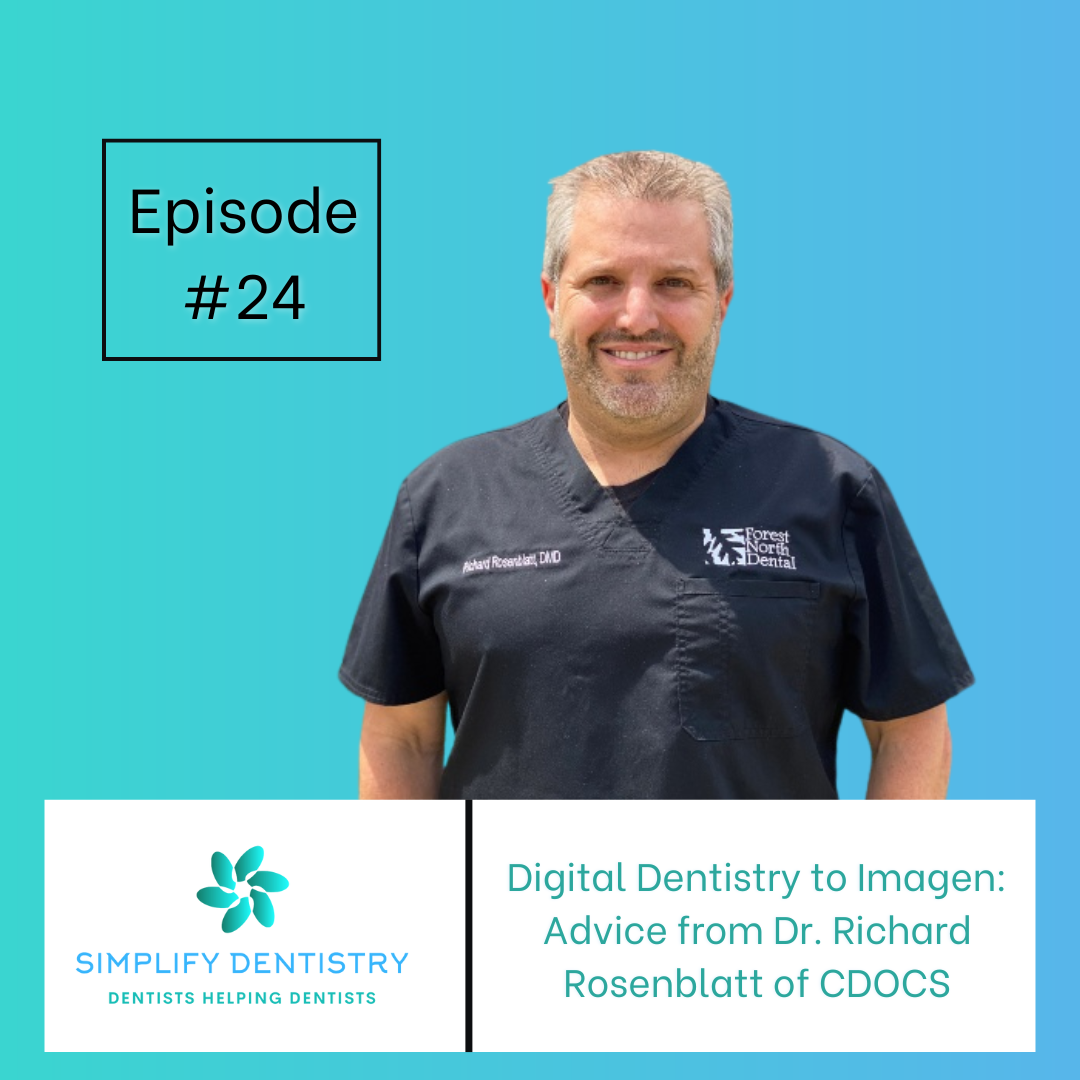
Digital Dentistry to Imagen: Advice from Dr. Richard Rosenblatt of CDOCS
Episode Description
Join us for an insightful discussion with Dr. Richard Rosenblatt, a leader in CAD CAM and digital dentistry. Dr. Rosenblatt shares his journey from New Jersey to becoming a prominent educator at CDOCS, his experience growing a successful practice, and valuable insights on practice leadership, mentorship, and maintaining work-life balance in dentistry. Learn practical strategies for practice growth, team building, and implementing effective bonus systems.
Episode Navigation
00:14 – Introduction to Dr. Richard Rosenblatt
00:51 – Personal background and early career
02:25 – Lessons from mentorship
04:27 – Finding your “why” in dentistry
06:36 – Journey into CDOCS education
25:31 – Practice structure and management
38:11 – Bonus system implementation
42:23 – Learning from mistakes
44:57 – Tips for simplifying dentistry
Key Takeaways
Leadership and Mentorship
Focus on developing team members and providing growth opportunities
Create a positive practice culture that team members will defend
Invest in continuing education for yourself and your team
Prioritize being a leader rather than just a boss
Practice Management
Implement engaging bonus systems to motivate team members
Conduct proper due diligence before practice acquisitions
Focus on demographics and market analysis
Balance clinical excellence with business acumen
Meet Our Guest
Dr. Richard Rosenblatt
Practice owner in Lake Bluff, Illinois focusing on CAD CAM and digital dentistry. Faculty member for CDOCS since 2008, alpha and beta tester for multiple dental companies, basic trainer for Patterson Dental, and clinical leader for Imagen Dental Partners. Built and operates a 7,300 square foot, 17-operatory practice.
Featured Discussion Topics
Digital dentistry evolution
Practice growth strategies
Team development and culture
Bonus system implementation
Work-life balance
Mental and physical health in dentistry
Industry Experts Mentioned
Sameer Puri – CDOCS leader and mentor
Imtiaz Manji – Dental industry thought leader
Bruce Baird – Productive Dentist Academy founder
Connect With Simplify Dentistry
Website: simplifydds.com
Contact Dr. Rosenblatt: RichRosenblatt@gmail.com
Topics: digital dentistry, practice management, dental leadership, team building, dental education, practice growth, dental technology, mentorship, bonus systems, work-life balance
Transcript
00:01 Dr. Richard Rosenblatt Welcome to the Simplify Dentistry Podcast. Join us as we discuss clinical, operational and financial aspects of your practice, help you enjoy life and dare to simplify dentistry.
00:14 Dr. Mustafa Shah-Khan Welcome back to the Simplify Dentistry podcast. I’m Dr. Mustafa Shan-Khan along with my co host, Dr. Murtuza Shan-Khan. We want to welcome today’s guest, Dr. Richard Rosenblatt. Dr. Rosenblatt presently owns a practice in Lake Bluff, Illinois focusing on CAD CAM and digital dentistry. He is part of the faculty for CDOC since 2008 and has been an alpha and beta tester for multiple dental companies. He’s a basic trainer for Patterson Dental and is now also a clinical leader for Imagine Dental Partners. Welcome Rich, thank you for joining us today. Pleased to have you with us and you know, love to just kind of hear a little bit about your journey.
00:51 Dr. Richard Rosenblatt Awesome to be on the podcast. I think you guys are doing a terrific job with your page and everything about this podcast. I’ve, I’ve watched a bunch of them since you’ve done them, so it’s been great. So thank you for having me on. It means a lot. I appreciate that. About Me let’s see, I’m a 55 year old dentist who lives in the northern suburbs of Chicago, Illinois. I grew up in New Jersey. I’m east coast at heart. I’ll be a Jersey kid till I die. Although I’ve lived here probably almost as long in Illinois as I have from New Jersey. But you just can’t, I can’t shake the accent or my affinity for the F word, those two things. And my team always tells me that their family asks, why do you curse so much?
01:31 Dr. Richard Rosenblatt Now they’re like, it’s my doctor, he doesn’t even know it. And so my apologies on that. I’ll try to keep it clean for the podcast, obviously.
01:38 Dr. Murtuza Shah-Khan And oh no, I’m right there with you.
01:41 Dr. Richard Rosenblatt You’re good with the beat, you’re good with the button, you know. So I, I’m a second generation dentist. My dad was a dentist and we never worked together, but I did. But at 8 years old I kind of thought I wanted to do ortho and that was my dream until I got into dental school and then tried to bend wires on the first day of dental school. That didn’t go so well. I basically model across the room and I was like, okay, I guess the general practitioner is going to be what I’m going to be. And so here I am. And since then moved out here in 99, end of 99, was an associate for 10 years for the most incredible mentor I maybe have ever had. For me, terrific dentist, ran a big practice.
02:25 Dr. Richard Rosenblatt Never very tech forward back even in 99, he was all digital X rays, all digital charts that you didn’t see that a lot in 99. Intraoral cameras in every room. And I just under. He really helped me to understand the art of, you know, having tech and letting that set the standard for your practice. The other thing he taught me was how to be a mentor. I really learned. I mean, I learned a lot from others down the way, but he was the first one. He was the most selfless guy when it came to sending me to CE and doing things. And it was a big, busy practice. And I. I said to him one day, I’m like, you’re sending me to all this stuff. We didn’t even have a contract. We were like handshake, kind of. Exactly.
03:05 Dr. Richard Rosenblatt And I said, what happens if I decide. Like, I was. I was producing 900, like, I was producing a lot of money for him a year. And I said, what happens if I decide to open up next door? And he goes, rich. And this is before, like you, there was Internet marketing and things like that. He said, open up the Yellow Pages for me. Like, yellow and post have to. What the hell is the yellow Pages? But we’re in. We’re in downtown Chicago, and I open up page one of the yellow pages in dental, and he’s got a double truck ad. And he goes, it’s a $14,000 a month ad. We get 100 new patients a month. You could move next door, it wouldn’t even feel it.
03:40 Dr. Richard Rosenblatt He said, he’s like, my goal is to get you to be a great dentist, hopefully great dentist with me for the, For a long. For the long haul. And if it doesn’t work out, at least you’ll go out and be a great dentist. And you’ve done great dentistry for me. He goes, I promise you, whatever you’re going to learn in those classes, I’m going to make way more from it than you will in the short term. So he goes. And so he did. And so even now, as somebody who has a bunch of associates, that’s how I live my life with my team, is just getting them to be great, getting them to love dentistry and train them up the right way. And, you know, I always speak into existence that they’re going to take over from me.
04:18 Dr. Richard Rosenblatt But whether they do or don’t, that’s not my why. My why is just to, you know, be a great Mentor, just like I was, and paying that forward.
04:27 Dr. Mustafa Shah-Khan Yeah, you know, I think that’s. That’s interesting what you said. You know, we had one of our first podcasts with Kiera Dent, who I think is. Is a great consultant. And, you know, one thing that she said is, you know, understand your why in dentistry. So was that. Is that your why? Is. Is being a mentor giving back, paying it forward? Or is your why to excel at digital dentistry? Or is it all of it?
04:49 Dr. Richard Rosenblatt No, you know what? I. I know my why isn’t money. Like. I’ve never been driven by money in my life. So that definitively is not my why what. My now the what comes from how hard we all work and do what we do. Great. It’s a. It’s a side effect of that, and that’s fine. But I’ve never been driven one second of one day by what I earn in my practice or what I earn in lecturing or any of that stuff. It just isn’t. But I think my why my. My love language is community. My love language is. Is like helping other. I just. I love it. You know, it’s something that I’ve loved doing with my team. I’ve loved. And I’m not talking just. Even my dentist is inspiring. I have. I have one assistant. My chairside lead assistant is.
05:33 Dr. Richard Rosenblatt Just took her hygiene boards and my goal is, you know, I want her to get into hygiene school and help her there. I have another of my lead assistants who is applying to dental school, and she’s going to be an outstanding dentist and just being mentors to those kind of people and, you know, and even on the teaching side of things, it’s. It’s, you know, that those random emails that you get from people talking about what kind of impact you’ve made on their practice and doing that is. Is like jet fuel to me. You know, it just hits me in such a spot.
06:05 Dr. Richard Rosenblatt It’s such a rush to feel like something that I’m so passionate about and whatever I’m teaching about resonated with at least one person sitting on the other side of that room from me having to listen to this voice for two days. I mean, that. That’s only right. You get. I don’t know. I. I think that’s more my why. You know, I love doing this. I really love doing what we do.
06:27 Dr. Mustafa Shah-Khan Was that kind of what got you into the, you know, obviously wanting to contribute? Is that what got you into the CDOCs world, or is there a different path into that? Yeah.
06:36 Dr. Richard Rosenblatt So you know, I, I, I tell this and it’s, and like Samir, I was on the podcast a couple weeks ago and did a great job as he always does. And, and when I talk about like Mount Rushmore of mentors, for me, he is my Mount Rushmore for sure. Sam is giving me more opportunity that I know. And you know, now that I’m at the position that I’m at and doing this for 18 years, I try to do the same thing to the, like our visiting faculty and even some of the faculty that’s above me now, I trained a lot of them and so getting them to better than me is always my, I don’t care about being the best. I just want people to love this as much as I do because that’s what puts things in great hands.
07:13 Dr. Richard Rosenblatt And so when I did, when I joined CDOCs, Sam asked me to join CDOCs back in 2008. So I’m 20, I’m 18 years this year with them. And we all met on Dental Town. I mean that’s how a lot of us started out back in the day. And so myself, Sam, Todd Ehrlich, rest in peace, Armin, Scrammy, Phlegm, like were the ones putting out cases and getting like arrows shot at us every day of like how crappy a dentist were. And this dentistry looks like pimps and oh, I hear you. You know, we saw that beyond what the software was limiting us to, we just realized that this is where it’s going.
07:56 Dr. Richard Rosenblatt And so when Sam started CDOCS and was like, hey, I want you to become, we’re going to start a faculty with me and Scrammy and Flem, Pete Cardell, a couple of others that are no longer kind of really in the game that way. That was kind of how I got into it. And at that point I had just bought my practice in 07, it was right before the stock market crash of 07. So I went in, spent, I had no money. I, I spent all the money I had. I’m a self made guy. I didn’t get help from my family in that way. So, and I was hemorrhaging money. I mean I thought I was going, I could have gone bankrupt four or five times.
08:37 Dr. Richard Rosenblatt I mean I was like, was able to pay the team, had to kick some bills down the road a little bit. So I read the posts all the time about these people who struggle and then they see people like us doing these podcasts and doing it. I want Everyone to know out there. And I’m just talking frankly. I mean, it is. We do is hard. We’re not business people. I’m tooth mechanic. I, I drill a hole in your head and fill it up, you know, I do. I’m more of a pothole filler than.
08:59 Dr. Murtuza Shah-Khan I am educated ditch diggers.
09:02 Dr. Richard Rosenblatt Yeah, for sure. But I’ve, you know, I’ve learned a lot about being a leader. I’ve learned over time about being a business guy, but I didn’t know how to do that. That was not what I did. And so I, when this kind of fell in my lap and there was not a salary, by the way, for a faculty member, they basically, Sam basically said, I don’t want to be on the road anymore and be careful what you wish for. I’m going to keep you really busy because I don’t want to travel on the road. And he made me his road donkey for like, you know, five years. And I took anything he would give me because I was going under and that and I didn’t, I mean, I wanted to, I thought I wanted to educate.
09:36 Dr. Richard Rosenblatt I just was never formally trained like most of us. And I just kind of learned it on the road as we did it. And that was kind of how CDOCs kind of happened. Out of desperation and being somebody who loved the digital and was into the kind of social media stuff like I guess you can call Dental Town social media, you know, So I was just like, wow, there’s a lot of people and I’ll put some stuff out there and good or bad, let’s see what happens. And it was fun, you know, enjoyed it.
10:02 Dr. Mustafa Shah-Khan You know, it’s funny you say that, you know, about, you know, posting cases and getting arrows shot at you. You know, I tend to post the majority of the clinical cases for our group and, you know, I’ll post things out there just to see what people say. And you know, it’s amazing the arrows. People will shoot at you, but then you’ll be like, all right, I’m a post this one out there because I know this is an all star case and nobody say a word.
10:23 Dr. Murtuza Shah-Khan Yeah.
10:24 Dr. Mustafa Shah-Khan And it’s. Social media is amazing.
10:26 Dr. Richard Rosenblatt You know, I hate it. It’s. I mean, I don’t even go like, this is no disrespect to Dental Town, but it just became pretty toxic and I just got tired of the fighting. So I just, I, it’s. When you meet me as a person, like, I’m very sarcastic and snarky. And, you know, love to bust balls. It’s like one of my favorite things to do. It’s the jersey in me. But. And that is not sort of my mentality. I’m very much more like helpful because I just, I hate the trolls. I hate all that crap. If I’m going to sit there and spend the time to do something, I’m going to try to make it meaningful just for myself.
11:00 Dr. Richard Rosenblatt First and foremost, I don’t want to waste my time, but, you know, I don’t want to waste anybody else’s who wants to spend five minutes reading something that I may have wrote that can hopefully help them and you know, down the line. Yeah.
11:09 Dr. Mustafa Shah-Khan And, you know, that’s kind of why we did what we did with starting Simplify is you do look at a lot of these things and you’re like, you know, I, I just don’t want that toxic environment. I don’t want people talking shit about you for this, that and the other. And then I don’t want your politics.
11:24 Dr. Murtuza Shah-Khan No, that was the biggest, you know, we started when we talked about it from the beginning is like, leave that at home or you won’t be a part of this.
11:31 Dr. Richard Rosenblatt You’ll laugh that you say that because, like, I teach the 90 minute crown course at CDocs. That’s kind of my me and Chevy Shivi teaches the west coast and I do the east coast and that we. The last topic is bonding. So we’re talking about how to bond in all these restorations that we teach at a mill for the last two days. And I tell everybody, the bonding slide comes up, it says bonding. And I’m like, all right, here we go, everybody. I said, there’s four topics I don’t talk about in public. I don’t talk about politics, I don’t talk about religion, I don’t talk about occlusion, and I don’t talk about bonding because we’re going to fight. Okay, so that makes a lot of sense.
12:09 Dr. Murtuza Shah-Khan So is that where your focus is on at CDOCS now? Is that course, Are you doing more stuff with that? How’s it evolved for you?
12:17 Dr. Richard Rosenblatt I am doing more. And mainly because Dan Butterman, who took over Sam’s role, he became faculty chair when Samir came over to Imagine.
12:26 Dr. Murtuza Shah-Khan Yeah.
12:26 Dr. Richard Rosenblatt And Dan is just outstanding. And he really, you know, besides being an all world kind of beta tester kind of a guy, and he’s just got great relationships with everyone behind the scenes and all of the people, but he’s just got a good even head on him and he just, it’s, he’s, he’s a solid choice. So. And then, you know, January 1st, he got promoted to the chief dental officer. Spear. So that job comes. I mean like work really. You know, myself, him, Mina, who I know is going to be on super bowl, which. Thanks for inflating his head just that much more.
13:00 Dr. Murtuza Shah-Khan Wait till you see the outfit.
13:03 Dr. Richard Rosenblatt I’ve been in his closet. I know what, I know what some of those outfits look like. Scary as hell. So, yeah, he’s got glow in the dark sneakers and tracksuits and crazy stuff. So yeah, we’re a little too close of friends, so. And, but you know that me, him, phlegm should be. We’re so close. We’ve been teaching together for so long that there’s this brother and sisterhood and Dan, I just, you can see why as we’re talking about all the stuff that’s kind of hitting them in the face in this position. I, you know, he, I know he can’t do the same amount of stuff. So I actually stepped up last year to take level three and four, which is our implant and our anterior, you know, four unit anterior static kind of stuff.
13:46 Dr. Richard Rosenblatt So I took that so Dan could get a little breather and they could launch PS2, which was him, Shibby and Mina. And then I’m like, well, I’ve already, you know, I already spent the time studying and making sure that I know the slide decks and stuff to bring, you know, I don’t want, I didn’t want the level of education to drop with me there. So. And it hasn’t, it’s been really great. So now I think Dan feels pretty good and we’re starting to build up the bullpen, so I’d like to stay there if I could because my schedule, between that and my office and mentoring my team and you know, all the stuff I’m doing with Imagine, it just doesn’t leave a lot of free time in my world.
14:21 Dr. Mustafa Shah-Khan Yeah, you’re kind of talking about Imagine when we talked, you know, several weeks ago, you talked about, you know, I’m 54, you’re 55. We’re kind of, I’m at kind of a similar place to you where you were back before you jumped in with Imagine, you know, the whatever, the million and a half dollar practice, four ops, that sort of stuff. What led you to Imagine from that point in time?
14:48 Dr. Richard Rosenblatt Yeah, well, what led me to them was it was an interesting start because I remember you know, Imtiaz Manji’s been, you know, somebody who’s been a great influence on me and a good mentor also, and just has taken me under his wing, you know, early on in the day. I mean, I remember he can be a pretty scary guy when he wants to be, at least intimidating. That’s scary. And when I met him, you know, were talking, lecturing, and he puts his arm around me. He goes, I don’t know what the f you’re doing in this room. It was like sam and. And scrammy and all him. He goes, and I’m about to give you, like, how to lecture and do all this.
15:26 Dr. Richard Rosenblatt He goes, I’m doing this because Sam’s spe for you, and I love Sam, and if Sam trusts you, I trust you. And that was eight, seven, whatever, many years ago. And I just. And. And he has been such a great mentor to me. And he. And he had heard one of my good friends was going. Had sold his practice to a dso. And he’s one of the most brilliant like. Like, leadership and. And owner minds that I’ve ever met in dental. Like, he just gets numbers and PNLs and systems, like, better than anyone. And so when he did it, I was like, well, if he’s doing it, I should probably look into this. It probably makes sense.
16:02 Dr. Richard Rosenblatt I’ve always done that with my life, with finding people better than me, latching on the coattails and riding that pony, as long as they don’t kick me off, you know, I mean, poor Sam. I mean, his shirts are so much longer from me hanging off the back of them, you know, for all these years. And so said, that has something to.
16:20 Dr. Mustafa Shah-Khan Do with your height.
16:21 Dr. Richard Rosenblatt It would be his collar. It would be the collar drag down, but I can’t reach up that high, so I gotta grab, like, his pockets or the back part of his shirt. So I started to look into it, and I was looking into a couple of different places, including this guy that his. And none of them made sense to me because it was like, I’m giving away everything, and then I got to stay there for a bunch of years. And I just didn’t get that kind of shared mentality of, like, what being a partner was. So I had skin in the game. And then Kia said to me, I can’t tell you anything other than do not sign anything with anybody. And we’re gonna have a. We’re gonna have a talk in January.
16:53 Dr. Richard Rosenblatt And In January of 2020, before COVID we had about 15 of us that went out to this envisioning session. And he brought out some trusted people both on the Sarek and Spear side that, you know, because it was Michael Oggins from Sirona and Rezwan Manji from the president of Spear and they kind of brought in people that had helped both of their tasks to grow their businesses. And that was, you know, when those people, you know, when I’m running around 40 weekends a year making the likes of Samir and Rez and Michael, like you know, all of that money, you know, I’m getting paid for my lectures. That’s great. And I’m getting paid. No complaints on what I’m getting paid. But you’re watching like what equity or what pieces, what owning, getting stakes is.
17:39 Dr. Murtuza Shah-Khan Yeah.
17:39 Dr. Richard Rosenblatt And it’s a different level, you know, it’s a different level I wanted. It was the first time I talked to. Money doesn’t drive me. But when you’re not driven by money and you realize you’re getting closer to the end of your career and you don’t think you have enough to be able to make sure that you’re going to live the way you want to live. Yeah, you know, I got to start making a better plan and a better exit plan. And when you have two people that you have worked your tail off for that you trust with every ounce of blood that you have in your body. And they say that, you know, they’ve left their companies and like we think this is one of the best, most important things we’re ever going to do business wise in our career.
18:12 Dr. Richard Rosenblatt They start throwing out legacy and things like that. I’m like, they when you ask me to be a founding member of that, how do you say no? At least how do I say no when I told you community, my dental community, my dental family is my why. Those guys have been my why and had saved me in my darkest times. Like, let me at least hear your story and let me hear your why of why you’re doing this. And when it made sense, there was no proof of concept at all. It was me, Meena and Michael Snyder. Michael was number one and then I was number two in theory. Like me and Meena were two. But, but I am ahead of him. And it’s one of the funniest stories in our, in the history of our company. But, but I am.
18:50 Dr. Richard Rosenblatt And I even make, I remind him of that all the time by the way. And he said, yeah, Sam Bowie was number two and Michael Jordan was number. That’s always come back. I’m like, yeah, whatever you can’t play in the NBA, neither can I. So that doesn’t. But yeah, so that’s how I ended up really deciding that I’m. I trust in them enough and they were putting enough their own personal stake in that I was willing to. To do that with mine and I did. And I mean I’m four and a half years in and when I say I have zero regrets in where I’m at.
19:22 Dr. Mustafa Shah-Khan So something that resonated with me when you, when were talking about this is how did it actually impact the practice? You know, you were sitting at this one place and now you’re sitting at somewhere else. Kind of tell our listeners about that.
19:35 Dr. Richard Rosenblatt Yeah, it’s, you know, when you start talking about, you know, again and this is not here, there’s some really good DSOs out there. So I’m not here to like and there’s certain private equity that’s good. But in the grand scheme of things they’re trying to aggregate it, they’re trying to flip. It’s a different animal. Yeah, we don’t have any of that stuff. So it’s just the partners of the private equity, so to speak, you know, where the. We fund it with a couple of. With the monies from the original founders and stuff. But that’s about it. And so. And you’re thinking like I want to grow. I think, I mean if I can’t grow physically because I’m sure I stopped growing in fifth grade. So I want to, but I want to.
20:11 Dr. Richard Rosenblatt I envision myself in a much bigger practice than what I was sitting in even from a square footage wise. And this one of you know, you’re. You get out there in the world and you meet a lot of people when you do what we do. And I just. One of my good friends in my town was losing his lease and came to me and he said, hey, I’m losing my lease. I’m not ready to retire yet. He’s about 10 years older than me and we do want to merge practices. Now. We didn’t have enough time with the. You only had a couple of months until the lease was up. So I said, well, I don’t know how long you’re going to be working.
20:43 Dr. Richard Rosenblatt Why don’t I just give your exit number now and you can work and do that and you can leave literally whenever you want. But if I’m figuring if I make a great environment for him and make it still feel as if he’s my partner, which that’s how we look at things, I mean, where he’s a seasoned, tremendous dentist and an even better guy. I just figured that let’s see if we can go that route. And that’s what we did. We emerged. I say we emerged. I bought him out. But we, I, you know, people look at us as partners and that’s how I look at it. And because were, he was losing his lease and my Square footage was 1200 square feet. Imagine, help me buy the practice. So we did that. They went through all the due diligence and the financing.
21:23 Dr. Richard Rosenblatt We did all that. And then we needed to look for a space. So they put somebody on the task for me while I was working full time and lecturing full time, and we found a space, got a great lease. They, they hired somebody to negotiate it for us. When I tell you I didn’t have to really do anything except sit with my designer and kind of pick out what I wanted and make sure the architect layout was how I wanted it, after that, it was really not a lot in my hands. I just could kind of do my thing. And when I needed to be there, I was. But a lot of it, we had somebody handling it for us, which was amazing. And then we put, we built a 7, 300 square foot, 17 op practice that we equipped 12 for right now.
22:00 Dr. Richard Rosenblatt And we’ll be, every other year, we’ll equip two more for the next couple years and then hopefully, you know, my associates will take that over and it will be theirs and they’ll take the practice from me and take it into a much different strata than even I have. And we’ve grown it almost, you know, two and a half, almost three times since from when I sold or. So it’s a big, and it’s only four years. I mean, when I think about that kind of growth, it’s insanity.
22:28 Dr. Mustafa Shah-Khan Well, and it’s amazing that you say that. Yeah. Because I think about, you know, how would I do it? And you start looking at, you know, do I acquire a practice, Do I find a practice now? Do I find a facility? Do I do X, Y and Z? For you being able to say that, you know, basically you walked in and you went to whoever it is and they did it. Yeah, that’s kind of the amazing piece of it.
22:45 Dr. Murtuza Shah-Khan Yeah.
22:46 Dr. Mustafa Shah-Khan If it, if it makes financial sense and it makes, you know, long term career sense and somebody else does it, that’s fantastic.
22:53 Dr. Richard Rosenblatt I figured that, you know, when I partnered, I was 50 years old. I just. 51, maybe somewhere. So let’s say I partnered in 2020. So, yeah, I was just about to turn 51 when I partnered. It was like a week before. So I knew that I had 10 years in me. Even with. With our. The way our thing is created, you get your maximum multiplier on your EBITDA at 10 years. So I knew I was giving it 10 years because I wanted the max money on what I was going to do. That was for sure. And so I was about three years in when I built this. Now I’ve pushed back my 10 years to the. I just want the note on this practice paid off so I don’t have any debt on me. So I’m going to go until I’m 64.
23:34 Dr. Richard Rosenblatt So I got. I got eight and a half years left. But to be able to have, like, I certainly have vision and I have drive, I will try to outwork anybody, including anyone on my team. I’m try. I try to set the standard there, but I just want to be able to have somebody in the background that’s way smarter than me that can look at those numbers, see if buying that practice was a smart move. I came up with the idea in my head, gave it to one of our VPs, and she’s like somebody that I. I look at Alicia Kiefer as somebody that I. She’s one of the most incredible minds that I’ve ever been around in. In dentistry, yet also fun as hell, and just one of my closer friends. And I just believe in her always with.
24:20 Dr. Richard Rosenblatt I can come to her with something, and she’s mathematically gifted like that and understands how to set up a practice. So she’s like, this is not a dumb idea. Let me. Let me dive into this a little bit more. And within a couple of days, they’re like, let’s bring him in and let’s try to get this going. And within a couple of months, it was done. And I was like, oh, my God. I just went from having a $1.9 million practice to a $3 million practice overnight. This is crazy, you know, and trying to figure out the logistics of bringing two teams in together and how to make that harmonious and doing that. And that’s where I think doing it at the age I did, I was such a better leader.
24:57 Dr. Richard Rosenblatt Even four years into my imagine or three years into my imagine, I was such a better leader than I was even before partnership, because I can get all of the busy work out of my way and focus on leading people rather than Managing a business, which I still do to an extent, but great office manager, great imagine team. Lets me kind of focus on the things I like to cherry pick and not the things that I can’t stand, like QuickBooks and Payroll and all the shit that drives me crazy.
25:25 Dr. Murtuza Shah-Khan Yeah. So you know, what’s an average week like for you in the practice now?
25:31 Dr. Richard Rosenblatt I’m there three days a week. So it’s. I. There is. I have four GPS that are there. Me and the guy whose practice I merge with are three days a week, Monday through Wednesday. My associates split a half day on Monday, and then they work Tuesday through Friday. And then the. The guy who I merge with, his wife works one day a week. She also teaches at the hygiene school, so she’s there one day. Loves aligners. Really, like super gifted and talented with aligners. So that’s kind of what she focuses on in the practice. And then we have an endodontist one day a week. So we’re. So it’s. And I have two surgical suites, so I bring in outside surgical people if we’re doing all on fours with anesthesiologists and stuff. So it’s just a busy. I mean, we have. There’s.
26:13 Dr. Richard Rosenblatt Including all the docs, there’s 26 of us, including me. So it’s humming, it’s always run around. There’s always music playing. There’s always laughing in the office. You know, I tell my team that I’m. When I interview them, that I’m 96% fun and 4% asshole. And just. And here’s. And here’s what makes me tiny angry. And so when. So they. I list. There’s really only two things I don’t do late, and I don’t do drama. And when there is drama, we try not to go home angry. So I try to fix things. And now I have, like, an absolute people whisperer as my office manager, who’s my fixer for everything. And so we just have this really wonderful, harmonious family For a big practice like that, you don’t generally see the culture that we have.
26:57 Dr. Richard Rosenblatt And I focus on that pretty heavily to make sure that my team feels heard, loves coming into work every day and wants to grow. I mean, that’s an important part of what we do is, you know, I need some worker bees in there because the place needs to be fed. Yep.
27:11 Dr. Mustafa Shah-Khan So Sam made a statement when we had him on that, you know, you got to surround yourself by people smarter than you, and if you do that, then you’re forced to. To rise to the top, you’re forced to be successful. You’ve kind of alluded to that in this, that you did the same thing. If you’re a doc who’s been out for five years, 10 years, whatever, how do you tell a doc to do that? How do you find that?
27:36 Dr. Richard Rosenblatt Yeah, I tell people, even in my lectures at CDocs, I talk about the importance of getting on the boards and finding all those people that speak the same language you do. You’re making this big investment. You might as well surround yourself with people who are where you’re at or even hopefully for you, way better than where you are. You’re going to find mentors right there at your fingertips, at your computer. And then when you come back to campus, you’ll find them or when you come to events, you’ll find them. And there you already have your built in community. So I think a lot of it with all of these, you know, don’t be afraid to post, don’t be afraid to ask questions. That’s how you’re going to meet people.
28:15 Dr. Richard Rosenblatt And I think putting yourself out there, it’s a hard thing for people to do, but that’s how you’re gonna find those. Like that’s, I’m social as hell, so I don’t, you know, for me it was always pretty easy. But I also think that people have to want to be mentored and that’s a big thing. You know, if you are somebody that thinks you know it all. I mean, one of my favorite lines, when people come in and they’ve been doing CEREC for 12, 15 years and they leave my class two days, I just had it happen this past weekend saying I can’t believe how much I learned in two days when I thought they were. We, we basically make people try to go through level two.
28:49 Dr. Richard Rosenblatt If you haven’t been to a course before, even if you’ve taught, because you probably taught yourself bad habits and we have all this, that’ll make it easy for you, so let us do that. So when you take our other courses, you’re not like left behind because you think you only know what you know.
29:03 Dr. Murtuza Shah-Khan Right.
29:03 Dr. Richard Rosenblatt You know, and that goes for young dentists too. And I think with all of this information at your fingertips, you think that you know it all. But reading and then performing are two different things, you know, and sometimes just having conversations like we’re having today is such a more granular way to sort of be able to acquire. Maybe it’s just the way I learn and I shouldn’t speak across the board, but I find that it just, you know, it feeds something for me specifically. But I think if, if young dentists would learn to sort of take a little constructive criticism. You know, Safa, you saw that post that I put on your site today when I was watching espn. I thought that was a. Good. Watch it. Yeah, yeah, I thought it was a great clip.
29:45 Dr. Richard Rosenblatt When he talked about kind candor, you know, a way to talk to people in a way. I, I’m from the East Coast. I call that a sandwich, which is, you know, you say something nice about them and then you pound them in the, with the meat of the sandwich and you with something really nice. So you, they walk out of there like a, like, I don’t know if I got slapped in the face or kissed, you know, and maybe both of them were needed, you know, So I think that’s the important thing. And that’s, I think, what he was talking about. And I think what a lot of business people don’t understand, you know, how to run an office properly and be able to resonate with your team or your, your, your other docs.
30:24 Dr. Mustafa Shah-Khan I agree. You know, so kind of one thing that we always search for. How do you guide people? You know, so I’m asking a few different questions. What’s your advice for a doc who’s been out for five years?
30:39 Dr. Richard Rosenblatt My advice for a doc who’s been out there five years is listen before you talk. You know, I think that’s an important one for a lot of people because those of us that have been doing it a long way, I just, you know, I haven’t. I have two associates that have been out less than five years. I have one who is way more confident than the other. They’re both. I, I mean, I can’t tell you how much I love my two. So I’m very blessed to have these two because they care so much about their patient pool and they’re so good about taking constructive criticism. One is a little more passive, I’ll say, than the other, but not in a bad way. Just, you know, she just has. She just needs a little bit more confidence.
31:21 Dr. Richard Rosenblatt He’s got it kind of built in to his DNA, you know, but they both. I, we had a key, had a tough case the other day that I end up having to redo, and he was beating himself up. And I just told him, I said, I have screwed up more cases than you’ve actually done in your career. So, you know, you’re at the beginning part of what you’re doing.
31:46 Dr. Richard Rosenblatt They, you know, I always, you know, we hear the thing, they call it the practice of dentistry for a reason, you know, so listen to that and you know, listen to me when I’m trying to walk you off the ledge a little bit to make you know that, you know, we’re luckily for the, in the grand scheme of what we don’t generally do anything harmful to patients that is going to do something like traumatic like death and things like that. I mean, listen, there’s always crazy stuff, but in the grand scheme of things, we’re pretty safe profession and so, but we can really change lives a lot. But you know, you got to be careful with what you’re doing because you can get yourself in a really tough spot.
32:22 Dr. Richard Rosenblatt And so you got to learn, you know, so five years out, be listen before you talk sometimes and learn how to take constructive criticism because you know, it is, that’s where you need to learn it. The humility and those words of wisdom are paramount in those five years.
32:38 Dr. Mustafa Shah-Khan So let’s go to the more seasoned doc. You know that the doc has been out 10 years now. They think they know everything. What’s your advice for that?
32:46 Dr. Murtuza Shah-Khan I feel like that’s a targeted question being the guy who’s been out 10 years.
32:51 Dr. Richard Rosenblatt Yeah, I don’t know. I’ve been out a whole hell of a lot more than 10 years.
32:55 Dr. Murtuza Shah-Khan Yeah, no, for me, no.
32:57 Dr. Richard Rosenblatt Yeah, you’re out 10 years.
32:58 Dr. Mustafa Shah-Khan I’ve been out hella longer than that. Yeah.
33:01 Dr. Richard Rosenblatt So for, I would say for the 10 year once I’m there at that point, you either are on your own at that point or you’re working for someone. You at that point should find the person that you want to mentor you. That gives you the opportunity to lift you up into where you want to be. And my suggestion, you started making money at that point just like we start talking about saving money. Like I love Sunny’s, you know, Dell Investment Group. You learn a lot from managing money and other things. And I talk about budgeting.
33:32 Dr. Richard Rosenblatt And not only should you budget for your savings and your retirement and all the things you’re doing, but you should be budgeting for education and trying to take, I mean I teach hundreds of hours of education every year, but I probably take 75 plus hours a year also on top of doing it because I love what I’m doing and I want to be great at it and I want to be able to pass that knowledge down to whoever’s behind Me. And So at that 10 year, you should be really trying to figure out what do you love doing and how much are you willing to invest to be the best at that for your patients, you know, your community, that kind of stuff. So that’s where I would be in the tenure for myself.
34:14 Dr. Mustafa Shah-Khan I think the age that I call decision time, 20, 22 years out. You know, you’ve had your, your run for building your practice. All that stuff’s going on. Debts, retired, all that stuff. What’s your advice there? What is your advice at decision time?
34:31 Dr. Richard Rosenblatt Oh, see, for me that’s kind of easy because it’s the part of my life that I’m the most proud of out of everything that I’m doing with education, with partnership, with imagine, with. It’s just be. Learn how to be a great leader. You know, a great leader isn’t somebody. And I learned this a couple of months ago, really hardcore when I finally got like, you know, I’ve had some office, I’ve had office managers in my office and they’ve all been fine, you know, but as my practice has gotten bigger, the amount of people who can run what we are building and continuing to grow, is that you’re looking for like a unicorn type of a person to be able to do that. It’s not somebody that is a great assistant or a great front desk person that you think you’re just gonna promote up.
35:18 Dr. Richard Rosenblatt You know, you gotta find that right person. And we found. We. I mean, I found my unicorn, you know, for sure. And I think having that person, that right person to be able to help you and learning how to be a leader and that, you know, again, that means taking stuff off your plate and trusting the people, training up the people around you to be great, to take over the things that you think only you can do. The only thing in your office that you’re the only one that can do is the dentistry, especially if you’re a single practitioner. Other than that, everyone can do everything in your office. Everyone. You know, so get them. You know, they. People in your office want to do more, they don’t want to.
35:58 Dr. Richard Rosenblatt As my cousin, my assistant Connie, way back in the day, you know, use the phrase, you know, when we started doing CEREC and doing things, she was polishing and staining lace. She goes, I don’t feel like a glorified spit sucker anymore. And you know, you don’t realize what you bring to the table to these people, from a job satisfaction standpoint, Everyone talks about hygiene and the amount of money you have to pay everybody. And I’m not saying you don’t. People don’t deserve what they deserve. But sometimes the ask is out of control and just because it says it on the Internet doesn’t make it true or that you’re doing. And I have found through leadership that people are willing to take a little bit less what I would call a reasonable salary.
36:38 Dr. Richard Rosenblatt When you offer great leadership, a great home for them to work in and the opportunity to bonus up to hit those numbers if you’re performing. We share, you know, that kind of a thing and learn just that great leader that you know, where everybody wants to train themselves up to be great and not just me. I have to set the standard. But you know, I always say when it comes to culture in your practice, I set it, but my team defends it to the nth degree. And that’s where, you know, at our age that’s what we should be doing is like you know, planning your exit a little bit. But, but learning how to be an incredible leader instead of a boss.
37:19 Dr. Mustafa Shah-Khan So I’ve always had a, I’ve always something you said. I’ve always had a bonus plan in my office and you wanted to do it to incentivize people. What would you say is a good. If you’re going to advise a doc. Tenure doc. What’s a good structure for a bonus?
37:34 Dr. Richard Rosenblatt Oh so I mean we have one that we use with our company which I think is okay. I don’t love it. I, I actually help bring our original bonus system which is my favorite one honestly. We have one where we just have our number, our like our growth numbers for the year. We figure out how many, we figure out what the monthly goal is. We figure out how many days we’re going to work. So we break it up by weekly. And if we hit weekly goals, everybody gets let’s say $100 every week you hit it and then at the end of the month if you hit it, you get another so they can make some decent money doing that. We have separate hygiene goals for that kind of stuff. But the system that I got was from Productive Dentist Academy.
38:11 Dr. Richard Rosenblatt I’ll give the Chris when Chris un who is, what was my coach, she was outstanding. Gave me the poker chip bonus. You guys ever use that one?
38:22 Dr. Mustafa Shah-khan I have not.
38:23 Dr. Richard Rosenblatt Yeah, it’s so much fun. So you figure out how many employees you have, you get like nice poker chips and a non see through bag. So it’s got to be like A jet black bag that nobody, you know, a hard one that you can shake around. And so you put 80% of the chips are ten dollar chips, 15 or 25 and 5% or $50. So depending on how many people you have will determine how many and how many days a week you’re working. So let’s say we have 25 people. If everybody was going to pick, let’s say Everybody worked for four straight days. I have to have, you know, 25 times four. I have to have 100 chips in there. So I have, you know, 75 or 80% of them would be tens. 15% would be that.
39:07 Dr. Richard Rosenblatt And so let’s say our goal, you know, my goal right now for my office is 16, 800 for this month a day. So let’s say that’s my goal. If we hit it, you know, with the, if we did the old bonus, everybody that worked that day reaches into the bag, like during the morning huddle and picks out their chip and they have no idea what they’re getting. And we record it. So if you get a 10, everyone’s like, oh, 10, you get a 25. Everyone can say you get a 50. You thought you just won the billion dollars. They go wild. Okay, now let’s, so let’s so day two, same goal. Okay, let’s say we hit it. We have a great day. You’re, you hit it, you know, 20 grand. Okay, awesome. End of the morning huddle.
39:46 Dr. Richard Rosenblatt We everybody who worked that day, if you work both days, you pick two chips. If you only worked one of the, that second day, you pick that one chip. So you see them work Monday, but you work Tuesday, you pick one now because we’re tying it to streaks and we, it goes up to four days. So on day three, when you start getting, you know, you look at the morning huddle, we always talk numbers. So let’s just say we’re only scheduled to 16,9. We’re only $100 over that. Well, if anybody doesn’t do a fluoride, let’s say that, like we got fluoride on the schedule or somebody’s supposed to do sealants or whatever, and they’re like, oh, I don’t want to do that well, or I got to cancel the appointment. They want to pick three chips.
40:22 Dr. Richard Rosenblatt So they’re doing everything in their power to try to keep those people on the schedule. So, you know, or the team’s like, hey, this person, last time they’re here and during the morning huddle was really talking about whitening. Maybe we talk about whitening again to them and see if they’re interested. And we can take scans and do that. So we’re trying to find same day treatment. Then all of a sudden you hit day three and you pick it. Now you pick a 50, a 25 minute. Now all of a sudden we’re starting to talk good money every day.
40:46 Dr. Murtuza Shah-Khan Yeah.
40:46 Dr. Richard Rosenblatt So it’s really fun. And then at the end of four days, if you hit it four in a row, you go back to one chip. And then a three month span, if you hit that, then your goal number is too low because it’s too easy to hit it more than 50% of the time and you have to put the number up a little higher. And so as you continue to grow and do it, your number continues to escalate as the office continues to escalate. And it just makes it fun for everybody. I love that. It’s a great system and I credit Bruce Baird and all the guys at PDA that came up with it. It’s, it’s terrific.
41:14 Dr. Mustafa Shah-Khan That’s pretty fun. It’s not like gambling on the golf course.
41:17 Dr. Murtuza Shah-Khan Yeah, exactly.
41:17 Dr. Richard Rosenblatt Yeah. And it’s. And like, I know Mina, I like, I gave Mina that bonus. His team, he just, they pick out one for the whole team. He said, doesn’t your team get mad if one gets a 10 one? Like that’s the fun of the pick.
41:30 Dr. Murtuza Shah-Khan That’s right.
41:31 Dr. Richard Rosenblatt Is like, you know, or whatever. And you’re waiting to see. And, and then at the end of those two weeks, we write on a calendar or a sheet and we add it up and then they get a paycheck and then they get a separate bonus check. So this way, when they are trying to figure out, you know, hey, I want to raise or this and that, and they’re just looking at their number, I’m like, this is profit sharing. Let’s see what your hourly really was. And I can show them, hey, you made four, eight hundred dollars last year in bonus like this, you’re like five dollars an hour, whatever it is, you know, so that way the separation of it allows you to help with them seeing the trueness of what you’re trying to do for them.
42:06 Dr. Mustafa Shah-Khan I’m gonna ask you a couple last questions. If you had to describe a mistake that, you know, we always make mistakes, and I think that’s the introspection of that is what makes us better. If you had to describe a mistake that you made that you learned from that advanced your career, what would that be?
42:23 Dr. Richard Rosenblatt So the mistake, I’ll call it a mistake in the. In hindsight it wasn’t. But my biggest mistake was buying my first office. I came from a practice that did. I did wisdom teeth, I did endo like even second molar upper endo. I play. He taught me to place implants. I did invisalign like. And I moved to the wealthiest suburb in Illinois and somebody was. Had an injury. I bought the practice for what I thought was pennies on the dollar. And I did not do my due diligence to understand that there were no homes to. There was no land to build in this place, no homes to be built and basically eight to 10 new people a month moving into this town that had already had 18 or I think we had 19 dentists and there were 17,000 people in my cabin own. So.
43:14 Dr. Richard Rosenblatt And then if you combine the town that I’m in now, which is Lake Forest, Lake Bluff, say there’s 23000 and we probably have 20 something dentists in there. There is. So every half the people who buy houses there already live there. They’re just buying a bigger house. So my mistake was not doing enough due diligence to realize the expense it would take to get me where I needed to be. And demographics is key. I’m right up against Lake Michigan. So half of my radius to market was fish and they don’t exactly, you know, come in and pay anything. So that was hard. So I think my biggest mistake was not spending the money when I was making one of the biggest investments in choices in my life on somebody that understood transitions and, and demographics and stuff.
44:00 Dr. Richard Rosenblatt I should have hired an expert and I didn’t. It ended up working out, but it took nine years of like financial turmoil and me working 40 weekends a year on the road to rob Peter, to pay Paul, to make it work.
44:12 Dr. Murtuza Shah-Khan So that’s when CDOCs kind of came into the fold for you as well.
44:16 Dr. Richard Rosenblatt CDOCs came in at the beginning of the fold for me. So it was like when I was really dying on the vine fast, Sam started giving me all his lectures. So like in 2008 I did maybe three or four. In 09, I probably did 10. By 2010 I was probably up to like 30. And then from that point forward, you know, with Ivaclar and three, I’m doing all in. In C docs. I mean I was doing somewhere between 30 and 40 weekends a year around the country.
44:41 Dr. Murtuza Shah-Khan Oh, wow.
44:41 Dr. Richard Rosenblatt Yeah, it was brutal.
44:42 Dr. Murtuza Shah-Khan Well, Rich, thanks man. Thanks so much for joining us. One Thing we always like to talk about and kind of end things on is, you know, dentistry is a hard profession. You know, how would you try to simplify it? What’s, what’s a take home from you for our listeners?
44:57 Dr. Richard Rosenblatt Okay, so I like it. I’m going to do this because it’s the most current thing on my mind. Okay. We talk. I think mental health and physical health, when I talk about is. Is really important. So, you know, people, we have a hard, you know, we have high suicide rate and addiction rates and all that. So people should not fear talking to somebody professionally to be able to get them into a more healthy state mentally. When you’re, when you’re healthy there, you’re in a great space. The other thing that I think are to simplify dentistry is taking care of yourself. I am right now, just before I came on this podcast, I’ve been having an issue with, like, radiating nerve pain down my right arm from in.
45:43 Dr. Richard Rosenblatt If I put my, if I put my head between the, like 1:00 and 4:00 position, I can make my fingers numb. And so ergonomics and taking care of your body and your core and doing all these things will simplify a lot of things for you. I, I laugh because, you know, I always make the joke. I’m so short that I go from neck to ass. I don’t even have a back, so I can’t come out. But, but take care of yourself. You know, make it a point early, because when you’re 55 and you’re trying to deal with it. I got to go pick up a prescription for gabapentin today to take the off before my MRI in a couple of weeks. Like, I wish I would have done a better job of simplifying.
46:21 Dr. Richard Rosenblatt That would have simplified a lot of things for me if I would have thought about the core of who I am, which is making sure my mind is good and healthy because it’s gonna leak into your family and your kids and all your relationships and making sure your body is healthy so you can do what you’re doing at a high level for a really long time. I think it’s. I think we lose sight of that a lot, and I think it’s something that we should focus on. And I think dental school should make a more important part of focusing on that because it will simplify a lot of other things for you going forward.
46:49 Dr. Murtuza Shah-Khan That’s great. That’s, I mean, so timely and a great thing to think about that none of us, you know, we all Think about the other things about dentistry, the work stuff. We don’t, you know, practice owners and practice builders, we’re terrible at taking care of ourselves and all the other stuff. So that’s great. It’s a great reminder.
47:06 Dr. Mustafa Shah-Khan Well, thank you very much. You know, the big Punjabi I would like to call Sam was saying that what I needed to give you grief about is your height, but you jumped right into it yourself.
47:19 Dr. Murtuza Shan-Khan You take that one off the table.
47:20 Dr. Richard Rosenblatt Here’s the thing. So I’m smart because they do like the bus balls. I told you that. So what I do is I cast the first thing, number one. What that does is diffuses the situation because if I’m willing to make fun of myself, you have to find something else to make fun of me for. That’s the second thing is if you bite, that just opens the door to give me permission to come at you. Everything I have. And you don’t really want that. So I’m testing the waters with that first one to see where it is. And I always say I laugh with Sam. Like Sam, whenever I’m in Scottsdale and I’m teaching there, Sam will pick me up, we’ll do dinner or something like that. So he’ll lift up, he’ll come up, he’s like, are you ready to go?
47:56 Dr. Richard Rosenblatt I’m like, oh my Uber Brown is here. I gotta go.
48:02 Dr. Mustafa Shah-Khan That is hilarious. Thanks again, Rich. We appreciate you spending some time with us. Hope our listeners get as much out of this as I did. You know, we look forward to you guys all being a part of simplified dentistry.
48:16 Dr. Richard Rosenblatt Hey, I, I appreciate it a lot. As I said, Sam said it on an earlier when on the earlier podcast. I really enjoy the, the tempo and the sort of the cadence of what you guys do and how you look into this stuff and all the pre interviews you do. I think it’s great. You bring great topics to it and you know, I, I, the fact that I’m on here shocks me. So I appreciate, thought it was worth the while to do it. Yeah, I mean I’m always around and you know, for between Imagine and cdocs, I look forward to seeing some of the folks that listen to this.
48:47 Dr. Richard Rosenblatt And if you have questions, you can always hit me up at Rich Rosenblatt at Gmail, you know, with any questions of stuff we brought up alongside that you may have a question on bonus systems, anything, you know, I’m here to chat if anybody needs it. Thank you very much, Rich guys, thank you so much. It was a real absolute pleasure and honor.
49:06 Dr. Murtuza Shah-Khan All right, thanks again.