
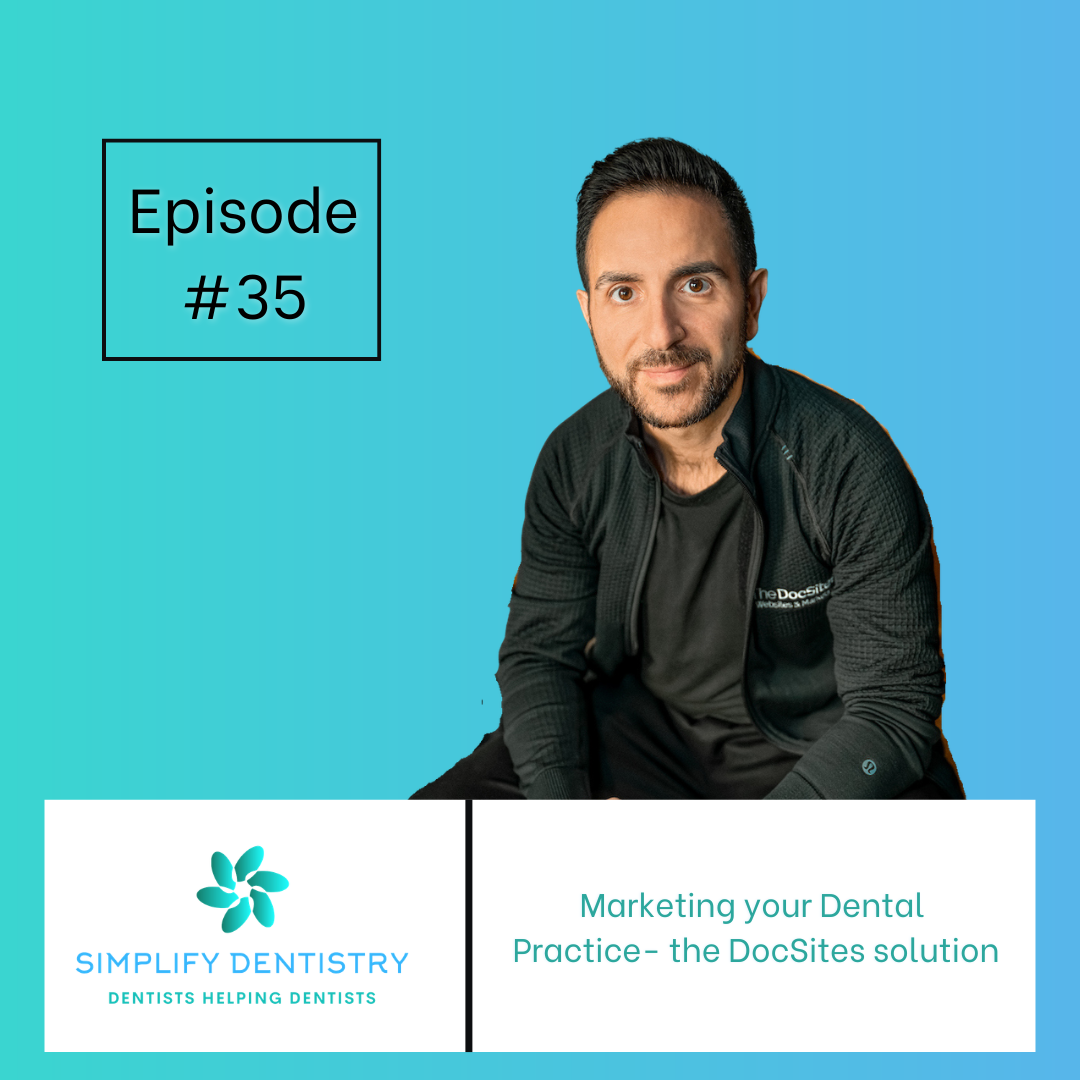
Our guest today is Parham Nabatian, co-founder of DocSites and a 17-year veteran of dental marketing. Parham joins Dr. Mustafa Shah-Khan to share how DocSites was built specifically around the needs of dental practices and why a strong, well-maintained website is the single most important foundation for attracting quality patients.
The conversation covers the difference between organic marketing and paid ads, what dentists must have in place before spending a dollar on advertising, and how AI is beginning to reshape the way patients find their next dentist. Parham also shares practical, low-cost strategies — from iPhone videos to local Facebook groups — that any practice can implement immediately to grow a more consistent, loyal patient base.
Episode Navigation
02:07 – Why DocSites: No contracts, low overhead, and deep dental expertise.
03:57 – Website + Marketing: Why quality patients research before they call — and why your website must be ready.
05:14 – Ads vs. Organic: The case for consistent, organic content over price-shopping ads.
10:17 – What’s Missing: The ten elements most dental websites are getting wrong.
14:13 – Before You Spend on Ads: The internal foundations every practice must build first.
16:45 – YouTube as a Search Engine: How video content compounds into long-term ROI.
19:12 – Top 3 SEO Metrics: What dentists should actually be tracking.
23:49 – AI Support Suite: After-hours answering, webchat, and direct scheduling with your PMS.
25:54 – AI and the Future of Dental Marketing: Why a thorough website is your best hedge.
27:56 – Top Marketing Mistakes: What to avoid before spending on ads or SEO.
What You’ll Learn in This Episode
✅ Why organic content and before-and-after documentation can outperform paid ads for attracting high-value patients.
✅ The foundational steps every practice must take — reviews, phone answering, team alignment — before investing in marketing.
✅ How to leverage YouTube and iPhone video to generate long-term patient trust and search visibility.
✅ What the top three SEO metrics are, and how to use them to drive specific treatment growth.
✅ How AI phone answering and webchat can capture after-hours leads and book appointments directly into your schedule.
Key Takeaways
Your Website Is Your Foundation: Ads and SEO only work when your website has the right photos, metadata, call-to-actions, and location signals. Missing any of these means leaving production on the table.
Build Before You Spend: Before running a single ad, you need a vision, a phone-answering strategy, a patient experience plan, a review system, and clarity on your insurance mix.
Reviews Are the #1 Driver of New Patients: Consistent Google reviews — five per week, not fifty all at once — are the most powerful tool for local visibility and patient trust.
Video Doesn’t Require a Budget: An iPhone, an Amazon stand, and a consistent effort uploading to YouTube with proper titles and location tags will generate ROI over time — no videographer needed.
Know Your Area Before Investing in SEO: In saturated markets, SEO takes years. Understand your competitive landscape and insurance mix before committing to a monthly SEO spend.
Featured Discussion Topics
dental marketing | dental websites | SEO | Google Ads | organic content | Google Maps | YouTube marketing | AI in dentistry | patient reviews | practice growth
Meet Our Guest
Parham Nabatian is the co-founder of DocSites, a dental-focused digital marketing company serving over 1,000 practices nationwide. With 17 years of experience in dental marketing, Parham and his team specialize in websites, SEO, Google Maps optimization, Google Ads, and an AI support suite that includes webchat, phone answering, and direct appointment scheduling. DocSites operates with no long-term contracts and a hands-on, collaborative approach to helping practices grow.
Connect with Parham Nabatian / DocSites
Website: docsites.com
Email: parham@docsites.com
Connect with Simplify Dentistry
Website: simplifydds.com
Podcast: Available on all major platforms
Topics: dental marketing, dental websites, SEO, Google Ads, organic content, Google Maps, YouTube marketing, AI in dentistry, patient reviews, practice growth, new patient acquisition, dental technology
Transcript
00:00:01 — Intro: Welcome to the Simplify Dentistry Podcast. Join us as we discuss clinical, operational and financial aspects of your practice. Hope you enjoy life and dare to simplify dentistry.
00:00:14 — Sponsor: Simplify Dentistry wants to recognize our sponsor DocSites. DocSites helps dental practices attract quality patients and grow their online presence with affordable and effective websites and online marketing. With more than 17 years of serving practices, DocSites focuses on increasing online visibility and engaging the right patients without long term contracts. In addition to website development and SEO, they also offer practices Google Maps optimization, Google Ad services, and an AI support suite including webchat, phone answering, and AI scheduler. Check out DocSites at docsites.com.
00:00:59 — Dr. Mustafa Chacon: We want to welcome today’s guest, Parham Nabatian. Parham is a co-founder of DocSites, and for the past 17 years, he has collaborated with dental practices to help them achieve a successful online presence. Over the past decade, his company has been retained by more than 1,000 dental offices of all shapes and sizes to help implement a successful web presence and achieve their respective goals. Welcome back to the Simplify Dentistry Podcast. I’m your host, Doctor Mustafa Chacon, and today we’re fortunate to have Parham Nabatian from DocSites. Welcome to the show.
00:01:35 — Parham Nabatian: Thank you for having me.
00:01:36 — Dr. Mustafa Chacon: We appreciate you being here. DocSites is definitely a company that we have interest in. Obviously, with Simplify, our philosophy on approaching the practice is: what are the things that we can do to simplify clinical, financial and operational aspects for doctors to make their lives easier? We feel like DocSites addresses some of those operational aspects and some of the marketing things. Tell us a little bit about DocSites.
00:02:07 — Parham Nabatian: So, DocSites was started as a need for dentists. We were doing agency work, marketing agency work, and we noticed a lot of dentists were getting different approaches from their marketing, and they weren’t really getting what DocSites is doing.
For example, we have no contracts — 30 day notice. Two, we’re very low overhead when it comes to your marketing. So if you’re going to do a full ads campaign and a starter SEO campaign, you’re all in at like $800 a month. You’re not spending a ton.
And then three, we’re very knowledgeable in dentistry. My history is that I helped my friend — and same with my partners, they were involved — we helped my friend grow to ten offices. We actually flew to his practices. We learned his operations. We learned what works in terms of bringing new patients in. And because of that, we were able to systematize.
And then the other thing that we did, because we were very hands-on with dentists, we learned customer service for some reason is lacking.
00:03:22 — Dr. Mustafa Chacon: Lacking in the profession or lacking from vendors?
00:03:26 — Parham Nabatian: From the marketing vendors. Thank you for clarifying. They kept telling us that. So we just felt if we could give really good customer service, it would help the dental offices grow. Because the truth is, it’s got to be a collaborative effort for a dental office to grow.
00:03:49 — Dr. Mustafa Chacon: Sure. So DocSites is a company that builds websites and provides marketing solutions. How does a practice’s marketing go hand in hand with their website?
00:03:57 — Parham Nabatian: Well, the reality is if you want quality patients, they’re researching. Think about it — we learned earlier that you play golf. So if you’re buying a golf club, you’re not just going to the first website and clicking to buy your driver. You’re actually researching.
That’s the same thing with dentistry. If I’m picking the dentist for my family, I’m going to read — because I’m actually very knowledgeable about dentistry. I’m going to read bios, I’m going to look at photos. I want to know if the office is clean and comfortable.
So a lot of times a website gets neglected and it’s just about running ads, ads, price ads, price shopping ads. But the truth is, if a dental office spends time consistently and persistently — persistence — on promoting the office in an organic way, the quality patients will start coming. And they’re the type of people that will spend more with you, and they’re going to refer more of their friends to you.
00:05:01 — Dr. Mustafa Chacon: So just to back up — you said it’s all about ads. Are you talking about a marketing company that’s all about ads to the practitioner, or the practitioners thinking it’s all about ads?
00:05:14 — Parham Nabatian: I think in general, what’s gotten lost is that a lot of marketing for dentistry has started to focus on ads. How can we run an ad to bring people in? Whereas I feel like that works — and we have a lot of clients doing really well with ads. But if you actually spend the time as an office and create organic content and update it to your website, that can start drawing really quality patients.
So if you’re doing case work like clear aligners and you’re not documenting it and adding it to your website, you’re missing a really big opportunity to get patients who will spend the money on clear aligners. We charge $79 a month to manage your website and you get free updates with us. So let’s say you do a before and after — you send it to us. We’ll crop it. We’ll put it on the site. We’ll put a description. We’ll add a tag to it so it’s good for SEO. You can’t beat that value.
00:06:21 — Dr. Mustafa Chacon: So just looking behind you — DocSites, websites and marketing. Do you do marketing for someone without being involved on the website?
00:06:31 — Parham Nabatian: No, because what we’ve learned is that if we can be involved in the website, the results will be significantly better.
00:06:40 — Dr. Mustafa Chacon: So what if a doc tells you that he or she would like to do marketing, but just recently built their site? They don’t want to redo their site.
00:06:50 — Parham Nabatian: We spoke about this and the reality is, yes, that happens often. We’re going to do an audit and see how we can improve the website. We’re not going to just say, “Hey, you got to do a new website.” We’re going to look at the ways they can improve the website. We’ll make a plan with them. I’m going to be involved with you. We’re going to sit. We’re going to make a plan. Here are the ways to improve it. And they could do it with us, or they could take it to the next company.
We — ten years ago — used to take on other sites. We just realized, it’s like, let’s say you do Invisalign and someone comes to you with Clear Correct or one of these other brands and says, “Hey, take over my clear aligners with this other brand.” The results just never are the same. We have to clean up a lot of work.
00:07:43 — Dr. Mustafa Chacon: So when you say you do an audit and they can either do it with you or take it to somebody else — if you do an audit of my site and you find that there are just minor tweaks, do I take that to my web designer and do the minor tweaks? Or do we have to redo the website?
00:08:00 — Parham Nabatian: My recommendation always is take it to your current web designer. If they’re not getting the job done, then call us and it’s time to invest in moving to our platform. Because then when you get the results, the migration of the site — the cost of it — is not going to matter because the results are going to outweigh the cost significantly.
00:08:24 — Dr. Mustafa Chacon: So it is hand in hand. You have to do both to have a successful marketing campaign with DocSites, correct?
00:08:33 — Parham Nabatian: Yeah, it’s the reality because we can then work on the site.
00:08:38 — Dr. Mustafa Chacon: Okay. And you said you try to make it kind of an economical option for docs redoing the site — $79 to manage the site on a monthly basis. What is the approximate cost to redo a site?
00:08:55 — Parham Nabatian: Our top tier site, we have promos throughout the year. If you’re doing marketing, it’s usually around $3,000 to start.
00:09:05 — Dr. Mustafa Chacon: And do you guys view a difference in — I’ll show you my lack of knowledge on things like this — so my site is a WordPress site. Are you guys building a WordPress site or is it a template type site? What do you actually do?
00:09:23 — Parham Nabatian: So we use HTML, CSS. That’s like the original version of code. We created a template, a system with it. So it comes with all the metadata, the titles, the alt tags. We add schema for the marketing — so that’s code that Google reads on your website. We do all of that for you. And WordPress isn’t bad — I’m not bashing WordPress — but we’re not relying on the WordPress plugins.
00:09:54 — Dr. Mustafa Chacon: So as an end user kind of looking at it, when you initially say, “Well, you have to redo your site to do this” — to me that kind of hits me a little odd. Why would I want to do that? But then as you explain it and you start talking about what you’re putting into the site that affects the marketing, that resonates a little bit more to me. Explain that a little further.
00:10:17 — Parham Nabatian: Well, today I had a call where someone had a website built, and it was missing like ten very important things. If you just start fresh with us — and if you want me to get specific, it was missing photos, call to actions, code, metadata. For us to go in there and clean up that work, it leads to extra work for us. Whereas our program has all of that.
00:10:49 — Dr. Mustafa Chacon: It has metadata. You mentioned something about Google aspects.
00:10:54 — Parham Nabatian: The H1 — and this is all code. It’s nerd language, you know.
00:10:58 — Dr. Mustafa Chacon: But it’s not — I think dentists, I mean my advice would be, as a dentist, as a science guy, I’m a nerd. So explaining it to me as a nerd is going to make a lot more sense to a dentist than going from a 30,000 foot view.
00:11:14 — Parham Nabatian: Yeah. So let me do two things. Let me explain it as a human behavioral thing. One thing I’ll talk about is — you want more production. You want more money. You want your practice to make more money per hour, per day. If you’re missing before-and-afters on your case work on your website, you’re leaving production on the table.
Like today’s call I had with someone — none of his web pages, none of his implants, his clear aligners, his emergency had anything that would get a patient who is looking for that service to call him. It was just the words “we do emergencies” and four paragraphs that no one will ever read. It was just “we do dental implants” and not one photo of a dental implant. And I asked him, “Do you have before and afters?” He’s like, “I have a ton and I’m really good at it.” I went and asked and he showed me, and I said, “You realize your website has none of this, right?”
So human behaviorally, our program at DocSites understands dentistry on a human behavior level. What we ask you in the setup, what we help you market — we’re not going to let you go to market without all the elements. For example, if you do emergency dentistry, the average patient wants to know what the cost is to come in. And if your emergency landing page for your ads and your SEO is missing that, or the option for financing, you lost the patient because they’re going to click the next website. It’s a commodity at that point.
And then in terms of the metadata and the descriptions, we’re seeing a lot of sites where it’s missing the city. So you’re paying — like this guy was paying $1,000 plus dollars a month on blogs. I said, “What are you getting for your monthly marketing?” “I’m getting blogs.” He’s getting blogs on “five dental myths debunked.” I still remember the headline. How does that help a dentist to have a blog like that on his website? It’s not drawing anyone. Google doesn’t even care about that blog. It’s not even going to read it.
Ours is — our article is “cosmetic bonding and how it fixes your teeth in the city.” Google loves that because cosmetic dental bonding is a keyword someone searches. So that’s the title and it’s got the city. So if someone searches those terms and the city, now the website is showing up higher.
00:14:04 — Dr. Mustafa Chacon: Sure. Makes sense. You talk about docs not spending money on marketing until they cover these bases. What are the bases that they need to cover?
00:14:13 — Parham Nabatian: Oh, this is my favorite thing to talk about. Number one is your staff and yourself have to have a vision. What are we really good at? What can we do better than everyone else? What are we — where do we stand out amongst our neighbors? And from there, that’s where some of your marketing has to go.
Then it comes to phone answering and front desk. Are we answering the phone? How are we answering the phone? And how are we getting them in our office? And from there, when they come to the office, what the experience is going to be.
Then it goes to: what’s our plan to get reviews? Google reviews right now is going to be the number one driver of new patients in a lot of ways. So whether people want to agree with that or not, it’s the truth right now. If your Google reviews are consistent — not just 50 at one time, but if you’re getting five a week — you’re going to get higher visibility on Google. So you should have a plan internally: how are we going to get reviews from every new patient and how are we going to get referrals?
If you spend $200 per new patient — that’s how it is in a city like LA, it’s $100 to $200 — if you and your office don’t have a strategy to turn that new patient into two new referrals, you’re paying a lot per new patient. It’s going to be hard to be profitable.
And then my other item that I really find important is what type of insurances do you offer? Because if you start doing ads like Google ads and in your area a lot of people have Delta and you don’t offer Delta, you’re going to miss out on a lot of people who call you. So Google ads may not be the right fit for you. Your investment may be way better to go and spend money running local ads in an auto dealership or something like that.
00:16:33 — Dr. Mustafa Chacon: So tell me — obviously Google’s the number one search engine in the world, YouTube is the number two search engine in the world. Should docs be looking at marketing on YouTube? Does DocSites help them in that?
00:16:45 — Parham Nabatian: Absolutely. So two things. I’m going to share a quick old story. My first client, one of my good friends — I said, “We got to do videos. We got to do videos.” He’s like, “No, I don’t want to spend the money on videos.” I said, “You’re in Vegas.” I was young at the time, 25. I’m like, “I want to come to Vegas, anyways. I’m going to bring my friend who’s a videographer. I’m going to pay for your video.”
We did it. The video turned his conversions like ten times higher. We did optimization on YouTube. We put in the keyword like “Las Vegas dentist accepting new patients with a special offer” — that was the title. And then his website backlink in his description. And for the next ten offices, he paid full price for the video each time because he saw the value.
What we’re seeing though is that you don’t need to spend big costs on videographers. It’s good — do it if you have the money. However, if you make a consistent effort with just your iPhone and an Amazon stand, and you film yourself in front of the scanner or talking about how you do veneers or talking about your staff, just like how we’re doing right now with the light, with the microphone in front of the iTero — you send it to us. We’re your marketing company. We can upload that video to YouTube. We can put the title tag, add it on your website.
So again, you want to do more clear aligners. Guess what — let’s say in your area you want to get a lot of younger people. Imagine making a couple videos with younger people — or even people in their 50s, people are doing clear aligners. My parents did it in their 70s. You get some video testimonials. They sign the release for it. You send it to us. We upload it to YouTube. We put the full description, the city, the location, the link back to your website, then put it on your website. Over the years, no matter how you slice the cake, you’re going to get an ROI on that. People are going to find it. They’re going to trust you more.
00:19:06 — Dr. Mustafa Chacon: So what are the top three SEO metrics that actually matter to a dentist?
00:19:12 — Parham Nabatian: One is the number of new visits that are coming from Google. So you could see there’s an acquisition chart. It’ll tell you how many people are coming from Google and which pages they’re going to — all from your Google Analytics.
Number two, your Google Maps. Within Google Maps there’s a performance portal, and you could see which actual keywords were visited to your Google Maps. You could see how many people clicked to call. You could see how many people clicked for directions and all of that.
And then the third one that I like — this doesn’t exactly pertain to SEO — I like to know which pages on a website are visited and how many visits. Because I just did — someone the other week is like, “I want to sell our membership plan more. We just added this and I’m focused to push this.” We did a banner at the top. The membership plan page was only getting like five visits a month before we did the banner at the top, because we weren’t doing any ads to it or any full focus marketing. We added the banner to the top — it’s now getting 40 to 50 visits to the page.
So those are things that I like. If someone says, “Hey, I want to do more clear aligners. What cost can you do it that is still valuable to you that will generate leads?” Let’s add a banner to the top. Let’s make a page with the video testimonials and some before and afters. And guess what — you’re going to get a couple more cases a month than you were now doing that.
00:21:04 — Dr. Mustafa Chacon: That sounds great. I listen to a lot of these things and I’m like, I could probably do some of those things. They make a lot of sense to me and how they resonate with the public — getting more patients, doing more things. It’s kind of what you want.
So it kind of comes back to me like, you got a successful practice, I’ve got a great practice, but I would like to grow a little bit more. I’m not trying to get high dollar treatments. I’m not trying to do all-on-fours and things like that. I just want more bread and butter patients. How does DocSites help me get more bread and butter consistent patients?
00:21:40 — Parham Nabatian: One thing that we would do is we would start focusing on articles and keywords on your website that pertain to those treatments. When you say bread and butter, you mean like dental fillings, teeth cleanings and exams?
00:21:56 — Dr. Mustafa Chacon: Bread and butter dentistry — you obviously want people coming in for their regular periodic exams. We do a lot of single crowns, single unit crowns, two crowns, fillings, restorative aspects. Bread and butter dentistry.
00:22:10 — Parham Nabatian: Right. So we would list all the keywords. We make articles, pages on that. We focus on your Google Maps as well, posting about that. And the other thing that we would do is Google ads. But one thing I’ll tell you is you’re going to have to have some kind of offer that is going to be cutting your new patient earnings a little bit just to get a taste.
For an office like yours — what’s your exam and cleaning fee right now for a new patient? Let’s say it’s $200. I want to tell you to go to like $149 for new patients. So you want to test that out, see how that’s generating new patients.
And then the other thing — although we don’t do this — one of the things we give you is feedback on how to get those types of new patients. One is going into your local community groups online and posting about your office. You got to do that in this day and age, because just like how you started a Facebook group for your dental community, people are in their Facebook groups all day and night looking for what dentists use, what — you know, like heart doctor — I see that in these groups too. Not everyone that moves to an area has a ton of friends that could refer them.
00:23:41 — Dr. Mustafa Chacon: Sure. AI is everywhere. Let’s talk a little bit about AI. DocSites has an AI support suite. Tell me a little bit about that.
00:23:49 — Parham Nabatian: Yeah, so it’s a support suite. It’s not to replace people. There are a few things that I love about it and why we picked this as a solution.
Number one, we saw a lot of missed opportunities in the after hours answering. So if you are running ads or you have inconsistent staff support, the AI answering is pretty good. It’s better than voicemail in my opinion. If I really do want an appointment with your office, the support suite that we use will directly book an appointment with Open Dental, Dentrix and Eaglesoft right on the phone. So you could say, “Hey, I want an appointment next Thursday at 2:00 PM” and it’ll book it for you with those three patient management systems.
00:24:44 — Dr. Mustafa Chacon: So obviously your AI support suite integrates with certain practice management softwares.
00:24:49 — Parham Nabatian: Yes. And then it’s got a chat. We have a chat on your website. You use the chat, you say, “Hey, do you accept my insurance?” “Yes we do. Tell me your insurance.” The chat replies. Then it says, “We have open” — then it says, “I want to book an appointment next week.” It takes your info and then it books the appointment for you directly.
00:25:10 — Dr. Mustafa Chacon: And then does it transcribe all this information and send you a report?
00:25:13 — Parham Nabatian: Yeah, there’s a portal and it’s going to get you all that info as well.
00:25:17 — Dr. Mustafa Chacon: Would it put it in a patient’s chart? Let’s say a patient’s calling in and having an interaction with the AI — would it put that in their chart or just put it in the portal?
00:25:27 — Parham Nabatian: Right now it’s in the portal. But I think it’s something we’re working on. We could do a deeper dive demo on it too. It’s got everything there and they could copy it in once it becomes a patient.
00:25:42 — Dr. Mustafa Chacon: Continuing down AI a little bit — how is your marketing company, your website company, how is AI going to impact dental marketing and a company like yours significantly?
00:25:54 — Parham Nabatian: I think people are going to start using AI more for getting it as your personal assistant. So now that you know me and what kind of person I am — “So-and-so AI, ChatGPT, tell me which dentist in my area I should go to that is offering these treatments.” If your website is not thorough, then again you’re going to miss out.
So you should audit your website and see, does it include everything about me, my insurances, all my services? And then is the website being updated regularly? Then number two: are the directory listings accurate? That’s going to become more important. We’re aware of that. It’s something that, although we don’t do directory listings now, it’s something that we’re supporting you on, giving you options.
So yeah, it’s definitely going to become — but right now it’s not there yet. It’s like 1%. But you better have a thorough website. That’s the one thing I’m going to say, because that’s the heart.
00:27:05 — Dr. Mustafa Chacon: Yeah, I think AI is so robust and it grows and evolves every day. I told you one of the next things that we’re getting ready to launch is a product called Axis powered by the Simplify Engine. It’s basically a dental specific search where people can use AI in a dental manner and can explore very dental related things. We’d love to have information on DocSites, dental marketing, dental supplies and all of that sort of stuff in there. We are building that database. I think it’ll be a pretty interesting thing. We’d love to have you guys be a part of it as well.
Kind of as we wrap up — what are the top mistakes that you see docs make with marketing and with their websites?
00:27:56 — Parham Nabatian: The number one mistake is spending on ads before understanding how it works. I get this call all the time from people who work with reputable companies where they’ll say, “I spent $5K a month on ads and I didn’t get one new patient.” And it’s kind of like there’s something not adding up there. So that’s the one mistake I say — always figure out your stuff before you spend on ads.
Number two is investing in SEO in a very saturated area and hoping that you’re going to get results in six months. Here in LA, people have been spending on SEO thousands of dollars a month for decades now. I’ve been around for 17 years. Someone new that opens up an office, all of a sudden it’s like, “I’m going to spend $500 a month on SEO” and they’re not getting results in six months. That’s not how it works.
We all want the magic pill for our businesses. I want to go in a dental Facebook group and out of the thousands of dentists, I want 50 of them to sign up in one day. But I know that it’s going to take a great reputation.
00:29:18 — Dr. Mustafa Chacon: Absolutely.
00:29:19 — Parham Nabatian: I think that if I were to shift the conversation of marketing for younger dentists and even older dentists — because we get a lot of calls from dentists that have been around for ten years plus, and you go to their Google profile and there’s only like 50 reviews on there. We get shocked. We’re like, “How do you only have 50 reviews? What are you guys not doing?”
00:29:46 — Dr. Mustafa Chacon: If you call a dentist who’s been around for ten years an older dentist, then I must be a dinosaur.
00:29:53 — Parham Nabatian: Well, my thing is, ten years is a long time in business. And if you only have 50 reviews when you’ve had thousands of patients — and I know that hundreds and hundreds of them have been very happy with you — you guys would be surprised. I know a lot of the convo online is like, “Old patients write how they dislike their dentist.” A lot of people love their dentist. The way people talk about it in my circle, like, “This is my dentist, you got to go see him.” So you guys got to get those reviews up. That’s the game, because people want to see that they could come to you and trust you. Nothing against corporate dentistry, but not everyone can run their business like a corporate dentistry.
00:30:44 — Dr. Mustafa Chacon: Thank you again for being with us. As we wrap this up — Simplify Dentistry is obviously geared on simplifying practice for the practitioner who’s been around for whether it’s five years, ten years, 20 years. What’s your advice to simplify dentistry?
00:31:04 — Parham Nabatian: Wow. That’s a really good question. I would say one is just be on the same page with your team and create a nice plan for the year, and don’t overdo it at once. And then from there, talk to marketing companies — more than one. Get to know the reputable ones. They’re not going to push sell you for marketing. And then pick our brains. I talk to a lot of dentists. I never force sale anyone. And I know a lot of my colleagues that are similar to me. From there, pick the right company that you want to work with. Don’t rush the sign up. Get to know what you need first.
00:31:45 — Dr. Mustafa Chacon: That’s great advice and thank you very much for being with us. I know I’ve picked up some tidbits just during this conversation. I hope our listeners have as well. If they want to reach out to you and connect, what’s the best way for them to get in touch with you?
00:31:57 — Parham Nabatian: The best way to get in touch is my email. Or you could call our office. If you go to docsites.com and ask for me and you say you saw this podcast, they’re going to connect me directly with you. Or you could email me — parham@docsites.com — and connect from there. We’re very good at getting in touch the same day and helping you out.
00:32:20 — Dr. Mustafa Chacon: So it’s parham@docsites.com.
00:32:23 — Parham Nabatian: Exactly.
00:32:24 — Dr. Mustafa Chacon: Well, I encourage our listeners to check it out and just get some information, see if it helps you. Thank you again. We really enjoyed having you with us, and we look forward to working more with you guys.
00:32:35 — Parham Nabatian: Thank you so much.