
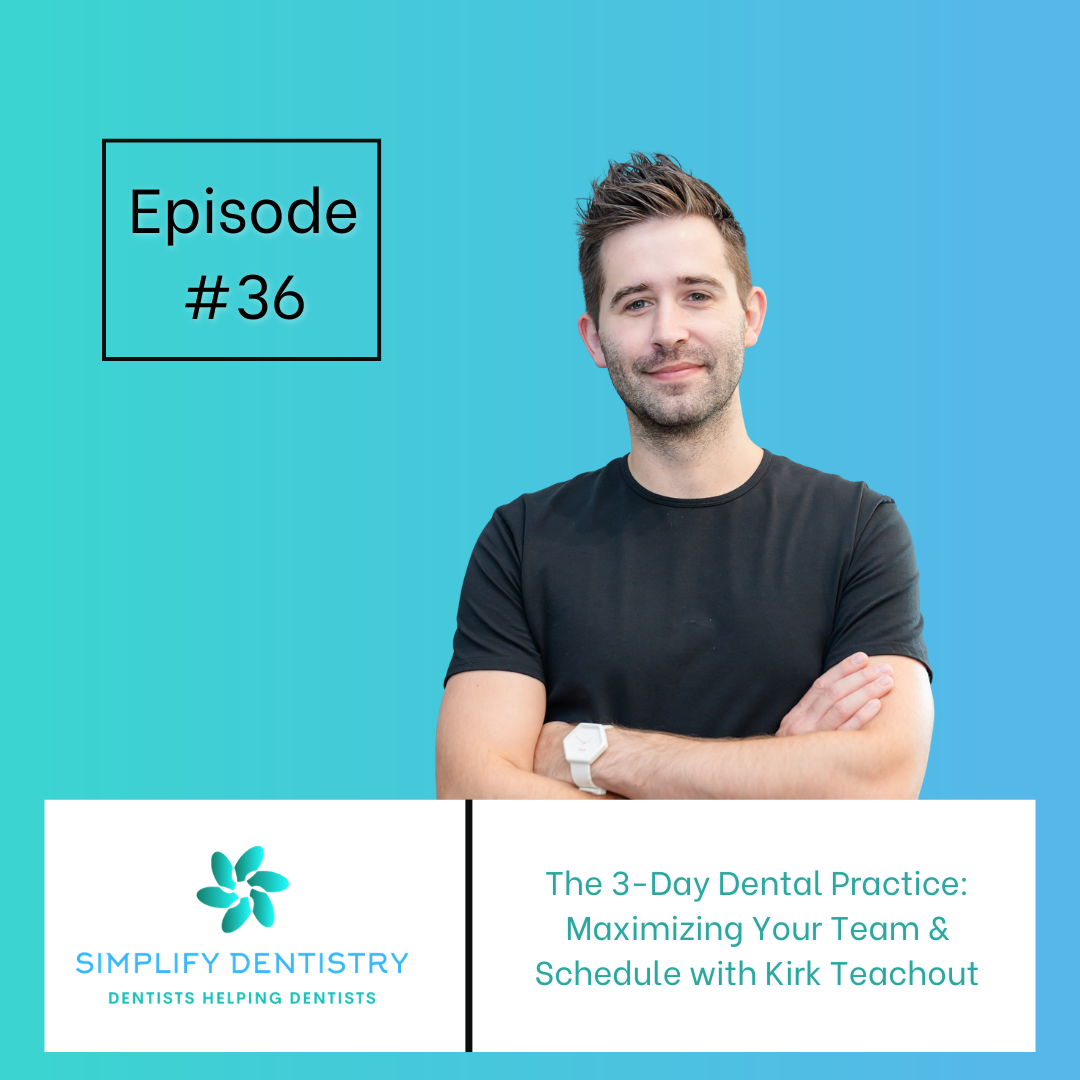
What if you could achieve seven-figure production while only working three days a week? Kirk Teachout, bestselling author and dental business coach, joins Dr. Mustafa Shah-Khan to reveal the operational architecture behind the three-day dental practice. Drawing from his background as a touring musician and music producer, Kirk brings creative industry thinking to challenge the “we’ve always done it this way” mindset in dentistry.
This episode dives deep into the systems that make peak profitability possible—from three-column schedule structures and hygiene production targets to the art of patient handoffs and building a team of “missionaries” who stay for the mission, not just the paycheck. Kirk demonstrates how the right organizational approach can transform chaos into consistent high production while giving doctors more time freedom than they ever thought possible.
Episode Navigation
02:59 – The Snow Day Analogy: How a two-week shutdown proves you can compress your schedule
04:18 – The First Bottleneck: Why schedule organization is the key to working fewer days
05:57 – The Three-Column System: Structuring high production, fill-in, and assistant-driven procedures
09:17 – The $2,500 Hour: How to duplicate a productive block throughout the day
11:30 – The Dean Smith Method: Breaking your production goal into manageable daily blocks
16:33 – Educating Patients: Why treating your practice as an education platform changes everything
22:49 – The Five-Minute Hygiene Check: How hygienists can do the heavy lifting before the doctor arrives
25:55 – The Handoff System: A three-part script that keeps treatment from falling through the cracks
30:33 – Morning Huddle Done Right: The “huddle before the huddle” and how to actually maximize the schedule
34:57 – Hiring for Personality: Why hospitality experience beats dental experience every time
37:54 – The One KPI to Track: Treatment dollar acceptance percentage and why it tells you everything
40:16 – Missionaries vs. Mercenaries: How to find team members who stay for the mission
40:26 – The Music Connection: How a touring drummer found his way into dental coaching
What You’ll Learn in This Episode
✅ How to structure a three-column schedule that maximizes doctor time without adding chaos
✅ Why hygienists should be doing the bulk of patient education before the doctor enters the room
✅ A simple three-part handoff script that dramatically reduces treatment drop-off
✅ How to run a morning huddle that goes beyond reviewing the schedule to actually optimizing it
✅ The one metric that reveals whether your education and case presentation systems are actually working
Key Takeaways
Start With the Goal: Before restructuring anything, reverse-engineer your production number into a daily target—then build the schedule around hitting it.
Three Columns, Every Day: Separating high-production, fill-in, and assistant-driven procedures creates a natural flow that reduces chaos and increases output.
Education Is a Team Sport: Hygienists can present options and plant seeds without diagnosing—so the doctor only needs minutes to confirm and close.
Simplicity Scales: Whether it’s the handoff script, the morning huddle, or the hiring process, the most effective systems are the ones simple enough for the whole team to execute consistently.
Culture Over Compensation: Team members who are aligned with your vision will outlast any mercenary hire who leaves for a dollar-an-hour raise.
Featured Discussion Topics
three-day dental practice | schedule optimization | team empowerment | treatment acceptance | morning huddle | patient handoff | dental coaching | practice management | hiring | production goals
Meet Our Guest
Kirk Teachout is the founder of Seven Figure Dentist and a coach at Fourth Quarter Coaching. A former touring musician and artist manager, Kirk applies creative industry thinking to dental practice management—helping practices grow to seven figures while operating just three days a week. He is the co-host of Management Unfiltered with Zach Shelley and the author of a bestselling book on dental business strategy.
Connect with Simplify Dentistry
Website: simplifydds.com
Podcast: Available on all major platforms
Topics: three-day dental practice, schedule optimization, team empowerment, treatment acceptance, morning huddle, patient handoff, dental coaching, practice management, hiring, production goals
Transcript
00:00:01.880 — 00:00:13.720 · Speaker 1
Welcome to the Simplify Dentistry Podcast. Join us as we discuss clinical, operational and financial aspects of your practice. Help you enjoy life and dare to simplify dentistry.
00:00:15.080 — 00:01:27.460 · Speaker 2
We want to welcome today’s guest, Kirk Teachout. Kirk is a best selling author, podcast host of Management Unfiltered with Zach Shelley and a dental business coach known for helping practices grow in new and creative ways. Drawing from his background as an artist, music producer, and manager of artists featured on American Idol and The Voice, Kirk brings out of the box thinking to dentistry through his latest venture, Seven Figure Dentist.
He combines creative strategies with proven business systems that have allowed practices to grow to seven figures and operate in only three days. We’d like to thank our sponsor, NSK dental. Founded in 1930, NSK is the world’s largest manufacturer of rotary instruments for the dental professional, which includes air driven and electric hand pieces specially.
Hand pieces, electric motors and hygiene maintenance systems. Kay is passionate about creating innovative products that deliver outstanding service and value. Almost all parts are manufactured in-house to guarantee the highest precision, reliability and performance. NSK is the only handpiece that I’ve ever used in my office.
Please visit NSK Dental Com for more information.
00:01:28.980 — 00:01:47.860 · Speaker 2
Welcome back to the Simplify Dentistry Podcast. I’m Doctor Mustafa Shah-Khan and I’m your host today. Today we have Kirk Teachout from the seven figure dentist with us. I’m really glad to have Kirk with us. I’m on the first episode of the new season of 2026. Kirk, thank you for being with us.
00:01:48.260 — 00:01:49.500 · Speaker 3
Yeah, thanks for having me.
00:01:49.540 — 00:01:52.380 · Speaker 2
You’re you’re the star of the season so far.
00:01:52.780 — 00:01:54.500 · Speaker 3
Oh. That’s fine. Oh, before.
00:01:54.500 — 00:02:58.330 · Speaker 2
We get here, before we get into it, I do want to thank a couple of our sponsors. I’m a in the trenches dentist. So kind of two things that I work with every day are hand pieces. And I’m a crown and bridge kind of guy. So a lot of, um, restorative materials. So Kenton Bach USA is kind of a company that I use their Vesalius Corps almost every day.
And NSK in my opinion, is the finest handpiece company there is. I use the the Z series, the Z 95, Z 99 L’s every day, and they’re great. So, you know, encourage everybody who’s listening to take a look at those things. So let’s get to it. Um, Kurt seven figure dentist. Um, you know, philosophy is built on the pillars of high efficiency systems, team empowerment and the radical idea that a thriving dental practice can operate at peak profitability in three days.
I think we all want to operate in three days. Most dentists think that working less means producing less. Um, how do you how do you guide a dentist into getting into maximum efficiency in three days.
00:02:59.010 — 00:04:17.820 · Speaker 3
So I, you know, I was just talking with somebody about that. You know, we had this snowstorm go through. Right. So like, we’re in Memphis, Tennessee. So our, you know, we were shut down for almost two weeks here because we have one snow plow for the whole county. So, like, we’re anything like that. It’s just like we can’t do anything.
But ironically, somebody in Charlotte, you know, they were closed on a Monday. Two weeks in a row. So two Mondays in a row. And and I was like, you know, that’s perfect because that’s the analogy I use when it snows on a Monday. Where do you have to put those patients? You have to get them rescheduled. And most of the time you fit them in throughout the rest of the week.
And you know, if you’re able to do it once, why can’t you do it again and again and again? So that’s all it is, is you get really creative on where to put people throughout the rest of the week, every single week, and then you just refine it over and over again. Um, because I would argue that most people feel like they’re busy, but they’re really not truly as productive as what they could be.
Sure. On, you know, four days a week, five days a week or whatever. Because I’ve taken several people now from 4 or 5 days a week, down to three, and it’s not that difficult once you break it down the way that I do.
00:04:17.859 — 00:04:30.580 · Speaker 2
So if you’re cutting a doctor’s hours by 30%, 40%, um, and not trying to drop any revenue, kind of what’s the very first operational bottleneck that you think needs to be on clogged the schedule.
00:04:31.340 — 00:04:33.540 · Speaker 3
The organization of the schedule? Yeah.
00:04:33.540 — 00:04:42.660 · Speaker 2
So so if you gave if you gave me a bit of advice, said, hey, you know, Doctor Khan, let’s let’s get you down to three days. This is the first thing you got to think about.
00:04:42.940 — 00:05:57.500 · Speaker 3
Yeah. So when we got to figure out where you want to go, so I, I everybody has bells and whistles, coaches and consultants and, and that’s cool. And we know which levers to pull. But at the end of the day, you’ve got to know that whatever levers we pull is going to give you the outcome that you want. We’ve got to figure out where you want to go.
Let’s just say for easy numbers, right. Million dollar practice. Okay. We’ve got to be able to break that down. Let’s say you work four days a week. We’ve got to be able to break that down to the amount of weeks you work. Let’s say you want to take five weeks off this year and that, you know that’s what you want to do.
You’ve got X amount of days to be able to do that. So we divide it the amount the $1 million by the days that you’re going to work. Which leaves us typically around 62, $57,500, depending on what, you know, what you’re doing per day, UCR fees. Yeah. So really, let’s just again, for easy numbers, if you have to collect 6250 with insurance, maybe 7500 is your number, right.
With the adjustments, sure. That you have to produce not collect produce to get there. So then you got to see like how many? How many hygienists do you have?
00:05:57.540 — 00:05:58.260 · Speaker 2
I have two.
00:05:58.300 — 00:06:19.580 · Speaker 3
Okay, great. That’s two. Right. And I want our hygienist on a simple day to be able to produce 1500 each. So that’s $3,000 off of that 7500 that we’re looking at. Right. So all you have to produce now is $4,500 a day. Do you think you could do that?
00:06:19.620 — 00:06:21.140 · Speaker 2
Sure. All day long.
00:06:21.180 — 00:06:27.660 · Speaker 3
Yeah, right. All day long. That’s a couple crowns and a handful of fillings. Right? It’s like nothing crazy.
00:06:27.700 — 00:06:28.940 · Speaker 2
It’s less than that.
00:06:29.260 — 00:09:16.980 · Speaker 3
Right. It is, it is. But. But still, let’s just say. Let’s just say a crown and a bunch of fillings. Right. Sure. Very simple that you can hit those numbers and it’s going to get you the outcome that you want. But we’ve got to get the schedule lined up to where it makes sense for that to work properly. Because it’s one thing to be able to hit our goals.
It’s another thing to have less chaos during the day to actually hit those goals. So what I do is I typically, even if you have two chairs or three chairs, I break every doctor up in three columns, regardless of if you have the chairs or not, because you can still do it with a third column if you even if you have two chairs.
So we have a lot of people call them rocks, sand, water, whatever you want to call it. But your high production procedures, you have one column that’s just high production and we fill that up first. So that’s your crowns. That’s your bridges. It’s your implants. If you want to do that, um, then we have a second column that’s going to be the fill in the gaps.
Right. So that’s going to be your smaller procedures such as your fillings and your extractions. So that’s how you stagger them to where the doctor time makes sense. Then finally your third column, regardless of if you have a chair for it or not, is your assistant driven procedure. So those are your clear aligner checks.
Those are your emergency visits. Was your adjustments, your partial seats, like anything like that, that the doctor time is super minimal and it’s mainly just the assistant going in, taking the X-ray, doing whatever they have to do. And then you come in and pop in. Yeah, everything looks good. Let me do this adjustment.
And then you walk out. So when you have this kind of flow in this dance through the schedule, it’s fairly simple to go through, let’s say a crown at 8:00. Right. You have a crown and a clear liner check at the same time. Two assistants, they’re going to seat those patients. You’re going to numb the crown. And I’m going to stagger a filling appointment 30 minutes after at 830.
So you numb the crown. You do the clear liner check. By the time you’re done with the liner check, you go over, prep the crown in 20 minutes. And now your other assistant that was with a clear aligner check seats. The filling patient. That’s 30 minutes staggered. So then you’re done with your doctor time over in the Crown, you know, appointment and you go over and do what?
You numb the filling patient, but you don’t stay there. You go over and do your hygiene checks, which shouldn’t take more than five minutes each. And if they do, then we can talk about streamlining some efficiencies there to where your team is doing the bulk of the education. They’re not you and you’re just diagnosing and confirming.
And then you come back and guess what? Your filling patient is ready to drill and fill.
00:09:17.020 — 00:09:17.620 · Speaker 2
Sure.
00:09:17.740 — 00:09:58.360 · Speaker 3
Right. That first hour, hour and a half right. There is a $2,500 hour. So all you have to do now is duplicate it throughout the day. And even with PPO, you know, with with a heavy PPO schedule, you’re still looking at 17, five an hour, 1750 an hour, which is over $12,000 a day. So that’s the reason why so many times when I’m talking to somebody or at a conference and I’m doing a breakout, I’m just like, look, this is how we outpaced your team with simplicity.
You just got to break it down into very palatable ways of looking at the schedule, scheduling the schedule, and kind of understanding the flow of what the doctor has to do in order to get that done.
00:09:58.400 — 00:11:30.100 · Speaker 2
Yeah. You know, I think your point is very valid. Um, I go through phases where I write a lot for dental economics. Um, and one thing I wrote about, um, so we’re in we’re in Charlotte, North Carolina. I went to the University of North Carolina for undergrad and dental school. So we’re big basketball people.
Um. Oh, yeah. So Dean Smith. Yeah. Michael Jordan, kind of the whole deal. Um, yeah. I wrote about something in dental economics a long time ago about, um, Jordan and Dean, and, um, in one of Jordan’s books, he talked about, um, that Dean Smith was the only person. People said Dean Smith was the only person who could hold Michael Jordan under 20 points a game.
And Jordan was like, well, actually, that’s not true because I averaged over 20 points a game. You know, my, my junior year. But he said, what Dean Smith taught me is how to average 32 points a game and you break it down into. You’re not trying to score in bunches. You’ve got four quarters, you’re trying to score eight points.
A quarter. Can anybody score eight points? A quarter. Yeah, that’s 32 points. A game. Easy. I attribute dentistry the same thing. You know, if you want to, if you want to produce X per month and you have 16 days, you know, you just break the blocks down. It’s $4,000 a day, $6,000 a day, 7000, whatever it is.
Um, and you start thinking about hitting singles and not trying to do full mouth reconstructions and five aligners or things like that. You know, just hit all the singles, the doubles and the triples that get mixed in. There are kind of the things that push you over the top. Is that kind of your philosophy in this percent?
00:11:30.220 — 00:12:04.750 · Speaker 3
Yeah, yeah, 100%. Because, you know, we we are consistently like, I like I know like I was looking at the schedule yesterday, yesterday of the next 2 or 3 weeks, every single day is at $12,000 or above every single day. And it’s already booked a goal and we have openings. So now like you’re saying, it’s like if you can do that on bread and butter dentistry, just Crown and Bridge dentistry, then if you’re doing an implant or you’re doing an aligner case or you’re doing a full mouth rehab, then that just makes it easier to hit your goal.
But you can still do it on just basic stuff.
00:12:04.750 — 00:12:19.310 · Speaker 2
So when you’re when you’re looking at the three day workweek, are you trying to compress down, you know, the three day, the five days into three days, or are you decoupling hygiene from doctor hours completely, or kind of what’s the 32nd operational blueprint on that?
00:12:19.350 — 00:13:20.250 · Speaker 3
Sure. So I just again, we’ve got to figure out where you want to be. If it doesn’t make sense for you to hit that goal in three days, then maybe we need to reevaluate where you want to be, right? Or if that’s truly what you want. If you want to work three days a week, or you just got to be able to do higher value procedures, that’s where it really like comes down to what the doctor truly wants.
So if you want to be able to be a $3 million a year dentist, then you’re going to have to do larger cases. You can’t do that on bread and butter dentistry on three days a week, period. It’s just impossible. I would I would say I’ve never seen anybody be able to do it. And just from how many times I’ve put together schedules, I’ve never been able to justify that number because you’d have to be producing 30 or $40,000 a day.
And that just doesn’t make sense from a patient care standpoint either. I mean, if you want to be able to do more, uh, you know, let’s say, like, what are your goals, for instance, let’s just break it down. What are your goals?
00:13:20.290 — 00:13:53.620 · Speaker 2
You know, I mean, my we do one, we do about 16A year. Um, okay. Is what we do, um, on four days. Um, my goal ultimately, I’d love to be at 2 million. Um, and I think, I mean, I’m a 55 year old dentist. Um, I’m gonna I’m going to burn it, but so long. So, you know, I don’t I don’t run around crazy by any means. I work one column with kind of an overflow column, like you’re what you’re talking about with kind of assisted, um, procedures, Invisalign, things like that.
Um, so that’s kind of what I do right now.
00:13:53.660 — 00:14:07.100 · Speaker 3
Okay. So but you could easily be a $2 million dentist on three days a week. So when you break it down, let’s just say you have, you know, how many weeks you want to take off this year?
00:14:07.220 — 00:14:08.500 · Speaker 2
4 or 5. Yeah.
00:14:08.580 — 00:14:16.420 · Speaker 3
Okay. Okay. So great. So we have 52 weeks. Let’s take out five weeks. That’s 47 weeks. Okay.
00:14:16.540 — 00:14:19.540 · Speaker 2
I don’t think I’ve ever taken five weeks, but I would like to, you know.
00:14:19.700 — 00:14:45.880 · Speaker 3
Hey, let’s do it. Let’s do it. I’m going to break this down for you. Right now, I think this is a great episode. This is gonna be fun. Okay, so that’s that’s 42 weeks or 47 weeks, right? So that’s 42,000 a week, 42,500 a week that we have to do divided by four. That’s $10,638 a day that you have to collect in order to be a $2 million dentist.
Okay. Are you. Do you take a lot of insurance?
00:14:46.080 — 00:14:47.560 · Speaker 2
Uh, we’re fee for service.
00:14:48.840 — 00:15:04.880 · Speaker 3
Even better. Yeah, this is very simple then. Right? Okay, so again, you have two hygienists, right? Yep. So $3,000 a day. Conservatively. So all you have to produce is 7600 a day to be a $2 million dentist.
00:15:04.920 — 00:15:05.280 · Speaker 2
Yep.
00:15:05.320 — 00:15:06.920 · Speaker 3
And then five weeks off.
00:15:07.880 — 00:15:38.560 · Speaker 2
Yeah. And that’s probably I look at kind of what we average. We’re probably averaging close to the you know so let’s say we work 16 days a week. You know we’re averaging about um, um, 130, $335,000 a month is kind of where we are right now. So that breaks down to roughly about 8000, $8,500 a day. Um, so we need to kind of bridge that $1,500, $2,000 gap by more efficient scheduling or.
Yes.
00:15:38.600 — 00:15:46.060 · Speaker 3
Yeah, yeah. So more efficient scheduling. Or by sprinkling in a few more aligner cases?
00:15:46.300 — 00:16:00.380 · Speaker 2
Sure, that’s the golden goose if you can, if you can sprinkle in more aligner cases and, um, yeah, you know, because that’s kind of the, the high revenue, low time, you know, that’s all kind of assisted time, I think is the greatest thing, you know.
00:16:00.580 — 00:16:02.700 · Speaker 3
Yeah. How much are your aligner cases? 5000.
00:16:02.700 — 00:16:03.380 · Speaker 2
500.
00:16:03.420 — 00:16:06.380 · Speaker 3
How many cases do you average a month roughly.
00:16:06.660 — 00:16:07.900 · Speaker 2
Uh, aligner cases.
00:16:08.020 — 00:16:11.740 · Speaker 3
Starts, starts. Um, or like a year, let’s say like how many do you.
00:16:11.740 — 00:16:24.580 · Speaker 2
Think we I mean, our goal is to have, you know, five aligner cases. We’re probably doing closer to two. Um, right. You know, mainly because we aren’t we need to be better at educating and informing patients of that. Yeah.
00:16:24.780 — 00:16:33.219 · Speaker 3
Yes. Right. So that’s what I would look at first is the education piece, because this is something that I’ve really
00:16:34.300 — 00:17:30.110 · Speaker 3
started shifting my focus with my clients on is if we can look at our practices not as dental practices, but as an education platform. Then things start to get real fun because at the end of the day, if we can’t educate our patients well enough to make informed decisions on their health, also on making sure they’re there on time and studious, and then making sure that they’re paying their bills, then the dentistry doesn’t work like it’s just not going to happen.
So if we can get better at the education piece with our whole team and get just better as educators in general, then things start flowing a lot smoother throughout the schedule, throughout the practice, the patient culture is better, the team culture is better, you have less turnover. And with the aligner cases like really realistically, in order to bridge that $400,000 gap that you have right now, all you’d have to do is six starts a month.
00:17:30.150 — 00:17:35.150 · Speaker 2
That’s it. Yeah, that’d be hitting our goal, which really just getting past our goal, which we’re not doing. Yeah.
00:17:35.190 — 00:17:43.290 · Speaker 3
Right. Right. So I mean that would be the first place I would look? Sure. Um, based off of just real world experience right there.
00:17:43.330 — 00:19:16.980 · Speaker 2
You know, interestingly enough, you know, talking about reducing time and all that sort of stuff. Um, Covid changed everybody’s approach to dentistry. Um, the one thing we really did is, um, my staff did not want to leave. Go to lunch, come back. You know, change, scrubs, all that sort of stuff. That was kind of going on when the world was ending.
So we went to an 8 to 3 schedule. Um, we don’t take lunch. We just bang it out 8 to 3. Um, and, you know, one day we’re 730 to 330. Um, and that’s it. Um, what we found is we became more productive and we all. And we were working basically an hour less. So for me, we were also, you know, compensation was dropping a little bit.
Production was going up, collections were going up. And, you know, people ask, well, how did you do that? And I was like, well, I think it frees up the schedule a little bit because now you don’t have to necessarily work on block scheduling. You can put a big case anywhere. Um, you know, you’re not limited by lunch.
And I also feel like practices ramp down 30 minutes before lunch and take time to kind of get back after lunch. And I think you lost a lot of time. So I think that is something that really has helped us. And it’s also helped with, um, employee retention. You know, people want to be out of there. They don’t want to be out of there at 5:00, get home at 6:00, then got to work out and things like that.
You know, you walk out at 3:00, 330, you know, you got several hours of the day. Um, do you have clients that you advise to do that or do you kind of keep them on the the big schedule?
00:19:17.020 — 00:21:33.790 · Speaker 3
It really depends on what they want to do again. Right. So so everything that I do is very customized based off of what they want to do. Now, I’ll suggest things like that. And I have clients that do that where they work through lunch. But you know, it really still comes down to their mindset and their limiting beliefs on whether or not they think they can do that, whether they think their team can do that, which is now to a leadership issue, right, and or fear of whether or not they can do it.
But I mean, I’ve, I’ve seen it work really well with clients and also just ourselves. But even even in our practice, you know, we technically our office is open three and a half days a week. My wife doesn’t work the half day because we don’t have to see those patients on a Thursday if they’ve had an exam within the last 12 months.
Okay. Right. And the way you do that is, you know, hygiene. Everybody is there. Um, and they we know it’s a slower day and that’s fine. But if they do find something, they’ll take a picture, they’ll take an X-ray, and then they’ll send it to my wife, or they’ll come in later for my wife to do the exam. But you know that there’s probably, you know, 200 patients in your practice right now that are pretty good.
Like, they rarely have work. They’re pretty clean, like it’s fine. So it’s those patients right there that you flip flop between the week Monday through Wednesday and Thursday. So that way we get an exam during the week once a year. Well, you know, just do a cleaning on a Thursday when that’s there. But everybody else is just like okay cool.
How can we get that. And we we even have a lunch. We do, we work 830 to 430 with an hour lunch. But I do agree with you that you do see a drop in productivity in the afternoon, because it does take time to ramp back up. Right? Versus if you’re in it, you’re just going to keep going. Yeah. Um, you know, because I mean, like, that’s what I do every day even with I like I work from home, obviously, but I still manage the practice.
And when you have the systems as streamlined as we do, my wife can just manage the people. And the systems are self accountable to keep people in line and do like, perform really well. Still to where I was only in the practice one time all last year.
00:21:34.070 — 00:21:34.510 · Speaker 2
Oh, wow.
00:21:34.710 — 00:22:11.070 · Speaker 3
So it’s just like, okay, can we get things to where there are well-oiled machine and super efficient to where I don’t have to be there and I can just manage it remotely. So that way. Okay, cool. Yeah. My my analytics, my numbers are in line. It’s like I don’t need to micromanage people. Like, there’s no reason to.
But we tend to do that when like there’s one patient that just everything went wrong with. And then we blow up a whole system just because of that margin of error. Sure. But there’s a margin of error because we’re never going to be perfect.
00:22:11.110 — 00:22:49.050 · Speaker 2
So one thing I was going to drop back to, um, you talked about hygiene check should be no more than five minutes. Um, but then we also talk about educating patients and providing more education to allow acceptance of cases and acceptance of Invisalign. How do you manage having a five minute hygiene check and providing the education.
Yeah. We’re kind of a boutique practice, so we have one hour high hygiene visits and kind of what I’ve always prided myself on is spending time with the patient, you know, for sure. And that’s kind of what makes our practice grow. How do you address that?
00:22:49.410 — 00:24:28.339 · Speaker 3
Sure. So I would say I don’t want to change that for you. Right. But I would rather you spend four minutes doing that where you’re spending time with the patient and getting very good at building that rapport quickly and quicker. After you do your exam, where the hygienist has already done the education piece, because you can do education without diagnosing.
So for instance, if there’s a gap between two teeth, like say, you know, number two is missing or number three is missing, then all you have to do is from the hygiene perspective, they understand what things are. They’re clinically trained. It’s like, hey, have you ever thought about, you know, having something here because, like, it can cause whatever.
Um, you know, do you know your options for replacing that that space there? Oh, no. Well, let me tell you, you know, there’s there’s the more expensive way. There’s the cheaper way in the middle of the way. So you could do an implant which obviously is the best option. Do you, do you want me to go further into how to explain what an implant is?
Sure. Oh yeah. That would be awesome. So they’re doing the bulk of the education piece without diagnosing. Then they come to you. Then when they’re ready for the exam, like, hey, we discussed this space. We talked about this crack on number 15 that has a large amalgam in it. And, you know, we talked about how potentially needs a crown, you know, but the doc will go over that and make sure everything’s good and, and whatnot.
So where you come in
00:24:29.400 — 00:24:31.400 · Speaker 3
She’s already gone over. He’s already gone.
00:24:31.560 — 00:24:31.880 · Speaker 2
Over.
00:24:31.880 — 00:25:32.660 · Speaker 3
Yeah, yeah. It’s like, oh, so all you have to do is like, hey, you know. Yeah, this, this large amalgam like that’s I agree that’s going to be a crown. Like, you know, we need to make sure we get that secured and, you know, give you longevity there. Um, and you know, based off of your knowledge of, you know, the implant versus the partial or the bridge, like, you know, what would be best for you.
Oh, well, I would much rather do the implant. I’m like, okay, cool. So, you know, Donna in the front will be able to get you that, that estimate to be able to get you that, um, you know, let’s get you scheduled for that crown. Um, but is there any other questions you have for me? Oh, no. Okay, great. The last thing you need to ask, though, or say is the urgency piece.
I look forward to seeing you soon for that crown. And, you know, like we’ll typically like, like, touch them on the knee or whatever. Touch them on the shoulder. It’s like, hey, I look forward to seeing you soon for that crown. And you walk out. Sure. And then the hygienist does the exact same thing when they take the patient to the front and hands them off to the front for the estimate.
00:25:32.700 — 00:25:55.500 · Speaker 2
Let’s talk let’s talk about that. Let’s talk about the handoff. You know, and you know literally where you know we see drop offs all the time at the handoff. Where does the ball get dropped. Um yeah. You know kind of how do you educate teams and clients to make sure that the ball doesn’t get dropped? And what is your process for the the handoff.
00:25:55.500 — 00:27:22.390 · Speaker 3
So I would say simplicity is key. I mean that’s that’s right. That’s what we’re talking about. Simplified dentistry right. And you know, when me and you were on that panel at Pod Fest two years ago, I was like, oh man, he’s already got it like that. He’s a simplified dentistry, right? Because that’s everything that I do.
Just like Michael Jordan, just like Kobe Bryant, like you’ve got to go back to the basics and simplify. That’s the key, right? Um, like you were saying to it’s like break it down into quarters. It doesn’t have to be the whole thing. Right? So when I suggest things in verbiage, for instance, it’s got to be simple and it’s got to be very palatable and easy to implement.
So like I just told you, when you’re at the end of the appointment, you know, you can go through and say things like right before you say, I look forward to seeing you soon for that crown. You’re talking about the implant, right? So you’re like, hey, you know, let’s get this implant, you know, schedule for you.
Um, is there anything besides finances that would prevent you from moving forward with this treatment? And what am I doing with that? I’m getting rid of every objection except the financial one. Are you looking or is there anything besides finances that would prevent you from moving forward with this treatment?
No. Okay, great. So if we figure out the finances you’re good with moving forward. Yes. Great. I look forward to seeing you soon for that implant. And you walk out?
00:27:22.470 — 00:27:54.610 · Speaker 2
Yep. You know, we we had a podcast a while back. Um, and one of our guests talked about, you know, a system where basically, you know, before you walk out of, you’re like, hey, I need to see you in the next three weeks. Um, for a crown on number 30. And it’s going to take us two hours. You know, so we’ll see you back for that.
And you, you hope that the hygienists translate that same language, and the patient is educated enough to walk up to the front desk and say, hey, I need he wants to see me in three weeks for a crown on number 30. It takes two hours.
00:27:54.650 — 00:29:54.120 · Speaker 3
Yeah, it’s the same thing. Right? So now you hand it off to the hygienist. Right. So the hygienist is bringing it back up to the front. But you’ve got to work with your whole team. So we have monthly meetings where we work on one thing for the whole month. And one of those is handoffs. Right. So we can say all day that, oh yeah I did that.
But but did you. Right. So you have to role play. Um, it’s so difficult and I know it’s so awkward to role play, but it is very important when you’re trying to overcome objections when you’re trying to hand off. But the same thing that you said needs to come out of the hygienist mouth. So when the hygienist you’ve handed it back to the hygienist, they’re taking them up to the front.
It’s like, hey, Miss Donna is going to take great care of you. So we always talk up providers. So this is a system, right? So the first thing you do is you talk up the next person that you’re handing off to. Hey, Miss Donna is going to take great care of you. She’s going to get you the estimate and figure out your schedule.
I look forward to seeing you soon for that implant. Walk away. So there’s kind of a three part series, right? So it’s I this person is going to take great care of you. That’s the first thing because you want to set the bar high. This is what they’re going to do. So that way the patient understands what’s about to happen.
So it’s fear of the unknown. You take the unknown out and I look forward to seeing you soon for whatever you talked about. The assistant is going to do the same thing. So if if an emergency comes in, needs an extraction, they’re doing the same thing to the front. Hey, miss Donna’s going to take great care of you.
She’s going to get you that estimate for that extraction. I look forward to seeing you soon for it. And then they walk back and it sounds robotic at first because you’re saying the same thing over and over and over again, but after a while, they start putting their own personality and spin into it. But that’s kind of the system, right?
They’ve got to be.
00:29:54.160 — 00:29:57.480 · Speaker 2
Able that’s kind of in the team empowerment kind of direction.
00:29:57.520 — 00:29:59.640 · Speaker 3
Yeah. Giving them the responsibility.
00:29:59.760 — 00:30:32.580 · Speaker 2
Yeah, so so kind of long lines, team empowerment, building your team, letting your team be professionals. That’s what we tell them all the time. You know a higher professionals and I expect them to be professionals. Now we have to educate them. We have to train them. We have to build them up. Um, and that’s how you empower your team.
Um, let’s talk about morning huddles. You know, I’ve been in some of the worst morning huddles you’ve ever had. In fact, we almost never have morning huddles anymore because I have a very experienced team, but I feel like I’m missing out on things. Kind of. What’s your advice on morning huddles?
00:30:33.100 — 00:30:38.780 · Speaker 3
Oh, man. We live and die by our morning huddle. Um, I, I.
00:30:39.140 — 00:30:45.700 · Speaker 2
Um, how does it become something where you’re just not, you know. Hey, Jane’s coming in. She’s whatever, you know?
00:30:46.020 — 00:31:13.220 · Speaker 3
Yeah. Just meeting for another meeting. Yeah. It can’t be another meeting. For another meeting. And this is where I push back with a lot of people. Um, so when I am working on the morning huddle, I ask everybody to get their 15 minutes before it. Because most of the time, the Morning huddle is just going through the schedule because nobody’s prepared, okay?
Even if it’s preparing the night before, that’s fine. But. Or the day before.
00:31:14.420 — 00:32:23.770 · Speaker 3
We need to make sure that everybody’s prepared. So the front, what they’re doing when they come in in the morning, they’re clearing off the schedule from any texts and or voicemails from the night prior, so that way the schedule is clean. Then the hygienists are going through, you know, what is due today.
What is the doctor walking into? So that way I can relay that during the morning huddle. And who is due with unscheduled treatment, like if they have unscheduled treatment on their side and hygiene like that’s something they need to know so they can potentially bring that to the Morning huddle as well.
But here’s kind of the secret sauce. So when you get in there, the doctor and the assistant also have a huddle before the huddle. So my wife and the assistants will get together and they’ll go through their schedule and they’ll ask three main things. What are we doing today? Is there any unscheduled treatment in the same quadrant or on the same side that we can maximize that appointment?
And then what is the next phase or the next appointment they need scheduled? They do that for every single patient on their side. And the assistant brings that information, not the doctor.
00:32:25.050 — 00:34:30.919 · Speaker 3
So they’re writing down, okay, what are we doing? How can we maximize it? And what’s next, whether it’s hygiene visit or the next phase of treatment, maybe that treatment’s on the other side. So we’re going to be doing that on the next phase in the next appointment. So when you come to the Morning Huddle, you have a clean schedule.
And then the goal is for everybody to bring their expertise and what they just prepared to maximize the schedule, not just go over the schedule. So typically what we’ll do is just go through hygiene like just like everybody else. But when you’re going through hygiene, you’re not just like, oh, okay. Yeah, you know, so-and-so is due for this.
We’re doing X-rays. We’re doing this move on to the next person. It’s like, no, okay, you get to the person that has unscheduled treatment or has whatever, and then you go over that. Let’s say Mr. John at 9:00 has unscheduled fillings that he’s needed to, you know, be done. And we had a filling appointment that fell off.
We’re going to bring that to the Morning Huddle and be like, hey, the front, you need to give him an estimate and call him before he comes in. So that way he knows at 9:00 we have the opportunity, not a cancellation. We have an opportunity to do his feelings at the exact same time after his cleaning. See if he’s okay with that.
So that way we can maximize the schedule if anything has fallen apart. Same thing. If there are holes in hygiene, there are bound to be people on the doctor’s side that are due for hygiene. So let’s again, let’s say at 2:00 we have a filling patient. They’re done with their fillings and we have a 3:00 hygiene visit that just opened up.
Let’s ask John over here who’s getting the fillings if he wants to go ahead and get his cleaning done, Knock it all out in one afternoon because he already took off work. Let’s make sure he can just get it in and get it done. So the goal is to get the schedule maximized and up to goal or above goal. So that way we can get things going throughout the day.
00:34:31.120 — 00:34:57.400 · Speaker 2
Kind of as we wrap up, um, kind of want to run into just a few kind of more rapid questions. Um, sure. You know, we’re talking about team building, team empowerment. Hiring is key. Um, I think hiring clinical people, you understand, kind of what goes into it, hiring non-clinical people. Um, we tend to look at experience.
Um, sometimes that’s good, sometimes that’s bad. What’s the what’s the number one red flag you see on a resume for hiring a non-clinical person?
00:34:57.440 — 00:35:11.120 · Speaker 3
Well, uh, number one, I don’t hire for experience. There you go. I hire for skill or for, uh, personality. Okay. Um, so hospitality is always a good one. I know you asked for a red flag, but.
00:35:11.160 — 00:35:12.600 · Speaker 2
Let’s go to the green flags.
00:35:12.840 — 00:36:01.860 · Speaker 3
Yeah, I mean, I, I look for hospitality servers. Um, you know, anything like a hotel or anything like that? Because customer service is 100% the the make or break in a practice and your front office. You can, you can, you can, uh, train them on skill and on the nuance of dental, but you can’t train them on personality and hospitality.
It’s very difficult. So I always hire for personality, not skill. Same with honestly clinical. Um, sometimes they’re new, but they’re green, and I don’t have to untrained people. Um, but as far as your question, what are the red flags if they can’t pay attention to detail? So when I put up a, um, an ad or something on Facebook saying, hey, we’re looking for somebody, email me your resume.
00:36:03.380 — 00:36:36.110 · Speaker 3
If they can’t email me their resume. That’s attention to detail. Okay. If they’re going around and whatnot, they didn’t read. And a lot of times too, what I’ll do is in that post I’ll put, you know, make sure you email us your resume and put we’re happy to work here in the subject line. Sure. So that way they understand like attention to detail.
Yeah. Because that’s an automatic red flag. They’re going to the bottom of the list.
00:36:36.150 — 00:36:53.950 · Speaker 2
It’s pretty interesting. Yeah. Um, kind of when you start talking about, um, you know, taking a practice that’s $500,000 practice to $1 million practice. Um, kind of. What’s the what’s the hardest thing that you find for a dentist to let go to get to their leadership?
00:36:54.350 — 00:36:59.030 · Speaker 3
I know you said let go, but, like, if you’re under a million, that’s a leadership issue.
00:36:59.070 — 00:37:03.270 · Speaker 2
So you’re saying you have to bring in other leaders or you have to improve your leadership?
00:37:03.510 — 00:37:49.130 · Speaker 3
Both. Okay. So if you can improve yourself, your team will improve in general. But if you have a problem reining in your team and not leading them properly. I ask you to have a meeting and I tell you to say this exactly. I’m sorry I haven’t been the leader that you need from me, but moving forward, I’m going to start holding myself accountable and holding you accountable to be the leader you need moving forward.
So by apologizing, you’re taking ownership for the lack of leadership. And now you can start holding people accountable. And it’s not a like a brick wall of like, where did this come from? We’ve never done this before, and you’ve never held me to this standard before, so it’s a lot easier. But I would say below a million, it’s all about leadership.
00:37:49.170 — 00:37:53.890 · Speaker 2
If you could track one KPI for the next 90 days, what would it be and why?
00:37:54.330 — 00:39:00.460 · Speaker 3
Treatment dollar acceptance percentage. Yeah. So treatment acceptance in general like the percentage is if ten patients come in and you present treatment and eight patients schedule the first phase of treatment, then that’s 80% okay. that’s 80% treatment acceptance percentage. The dollars though, are equally important.
So if you have a low dollar amount that they’re accepting, then they’re just like accepting the feelings and stuff. They’re not accepting the higher end procedures. That’s equally as important. So the treatment dollar acceptance percentage is super important to understand and track, because that tells you if education is is draining, if it’s not actually doing what you’re supposed to, if you need to increase that, and then also figuring out the finances on the back end.
So do we need to do payment plans? Do we need to do third party financing. Whatever. So if the average is 25% across the US of the treatment dollar acceptance percentage, but my wife has an 86% treatment dollar acceptance percentage, so if she presents a $100,000 worth of treatment, 86,000 of it gets scheduled.
00:39:00.500 — 00:39:11.280 · Speaker 2
You’re building a great team. Um, everybody’s looking for different things these days. Um, what do you think is the one thing that team members are looking for the most. Right now.
00:39:11.320 — 00:40:16.700 · Speaker 3
I’m going to start with saying you’ve got to find missionaries, not mercenaries. And what I mean by that is a mercenary is just there for a paycheck. And as soon as they land on our res. Yeah. Yeah. Right. Um, and if they get a dollar an hour raised right down the street there, they’re hopping. Right. So I look for missionaries that are there for the culture, that are there for the mission of the practice, what you’re wanting to do, the vision of where they’re going.
Because if they can hit their goals, their personal goals at your practice, they’re going to stay. So I would say that’s the biggest thing for for team members. You need to sell your vision in the interview of where you’re going and what you want to do. So that way you can ask them, hey, what are your personal goals?
Well, I would love to make 70,000 a year or 80,000 a year and be able to buy a house for me and my family. I’m like, okay, great, I know my vision, so I know you can do that here. So if you can figure that out, that’s that’s the biggest thing to keep people there and keep people loyal.
00:40:16.740 — 00:40:26.140 · Speaker 2
You know, I didn’t get to touch on the music aspect, you know, how did you get into the music aspect and then take music and the things that you’ve learned from music into dentistry?
00:40:26.540 — 00:42:24.090 · Speaker 3
Yeah. So obviously, like I’ve, I was a musician, touring musician, toured the world. It was a lot of fun. And then also managed artists and produced for big artists and, um, for a long time. And then my wife, when she was 18 months out of clinical or out of dental school, she was like, hey, I gotta buy a practice.
Like, I want to do it my own way. The, you know, be able to pay off my student loans faster. I was like, okay. But she was just like, Will you help me? I was like, sure, you know. So we I moved back from music a lot, but the way and I that I approached dental is very out of the box. Right. Because I didn’t come from dental in general.
And I look at things through a very unique lens of like, well, why do we do it this way? Right? Do you know the like cutting off the end of the ham story? I don’t like why do we cut off the end of the ham? So this little girl is coming to her mom at Thanksgiving is like, why do you cut off the end of the ham? Every time that we we cook ham, like, I don’t know, we just always done it that way.
Like, why don’t you go ask your your grandma? Hey, grandma, why do we cut off the end of the ham? Like, I don’t know, we’ve always done it that way. Why don’t you go see your grandma? Grandma? Okay, cool. So, hey, great. Grandma, why do we cut off the end of the ham? Well, Jane, you know, back in the day, our ovens were a lot smaller and our pans were a lot smaller.
The ham wouldn’t fit in the pan, so we had to cut off the end of the ham in order to put it into the pan. So that way we could cook it in the smaller oven, like. Oh, so we’re just cutting off the end of the ham for no reason, because that’s what we’ve always done, right? So I look at dentistry through that lens of like, why are we doing it this way?
And kind of like a two year old or a three year old, just like, why? Why are we doing it this way? And is there a different way that could be even more successful and better for our team? Um, so that’s why I pushed them all to three days a week. That’s why I pushed the mold with marketing. That’s why I pushed the mold with pretty much everything that we do.
And it’s been very successful.
00:42:24.450 — 00:42:30.090 · Speaker 2
And, you know, touring musician toured around the world. What what capacity? What were you doing?
00:42:30.290 — 00:42:48.370 · Speaker 3
Sure. So I was a drummer in the last band I was in. We toured through Europe. We toured coast to coast, um, and did a lot of singing as well. But yeah, I mean, I was a guitarist as well. I know I have the guitar guitars. Yeah, I was a guitarist for a long time. I still am, but, uh, but the last band I was in, I was the drummer.
00:42:48.650 — 00:42:55.970 · Speaker 2
Kirk for, um, for doctors, our listeners. Um, that appreciate what you’re saying as much as I do. How can they get in touch with you?
00:42:56.010 — 00:43:09.300 · Speaker 3
Yeah. Of course. So you can hit me up on Instagram at Kirk Teachout or Facebook. That’s fine. You can also email me Kirk at IV quarter coaching. Com so fourth quarter coaching or just hit up on my website Ivy quarter coaching.
00:43:09.300 — 00:43:21.020 · Speaker 2
Com and um, you know, obviously with us being simplified dentistry as we talked about when we first met. Um, what’s what’s your advice? Um, to docs who, whose goal is to simplify dentistry
00:43:21.060 — 00:43:40.820 · Speaker 3
It it get out of your head. It really it really doesn’t have to be as complex as you think it is. And as complicated as it is. Just figure out what you want to do and how you want to do it. And then just figure out a way to look at the basics and simplify everything that you’re doing. It doesn’t have to be. It doesn’t have to be crazy.
00:43:40.860 — 00:43:53.420 · Speaker 2
Well, thank you very much for taking the time. We really appreciate having you. Hope everybody has enjoyed this as much as I have. Um, please check out Fourth quarter coaching and reach out to him on Instagram. Facebook. Um, thanks again for being a part of this. And, um, we look forward to catching up again soon.
00:44:03.740 — 00:44:05.020 · Speaker 3
Yeah. Sounds great. Thanks.