
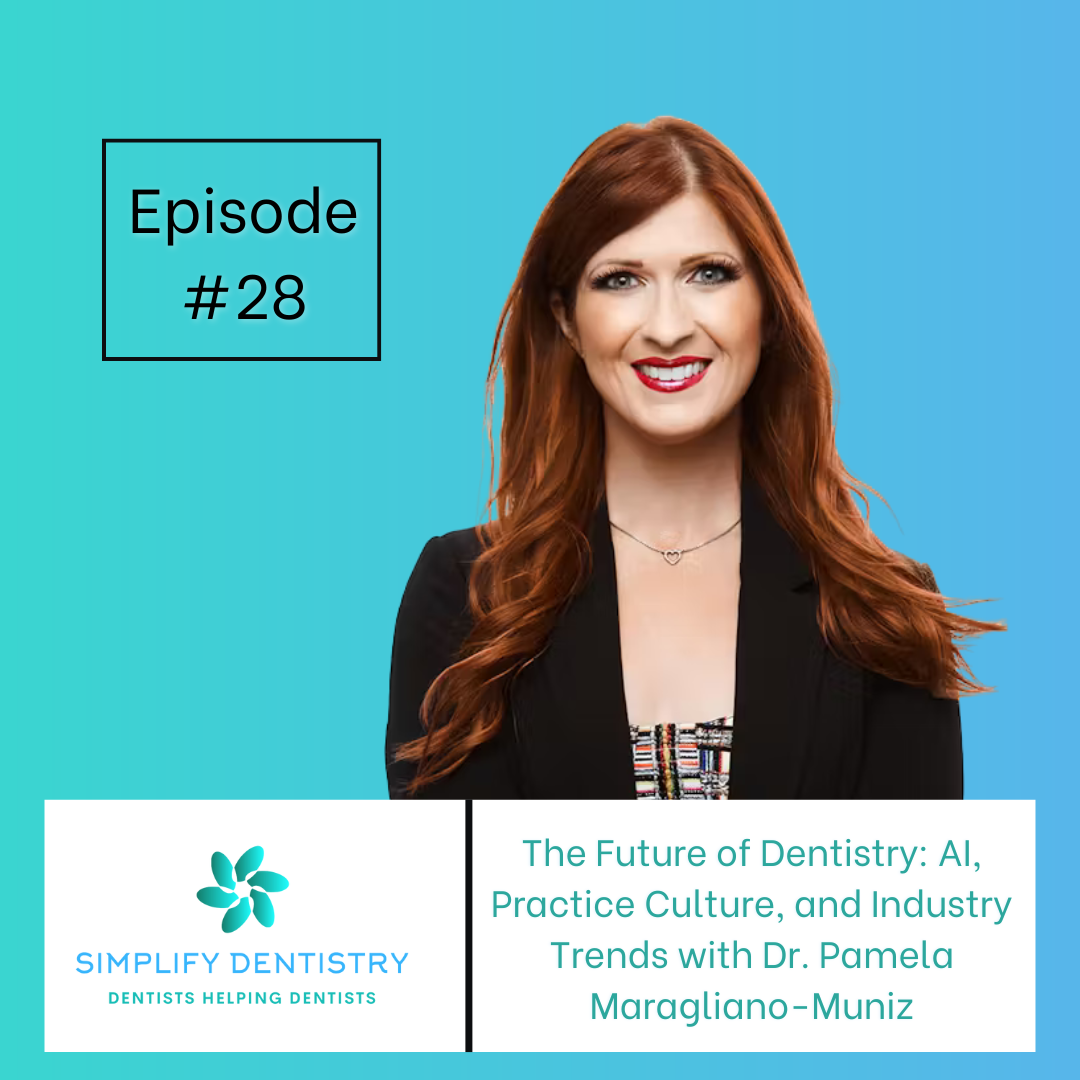
The Future of Dentistry: AI, Practice Culture, and Industry Trends with Dr. Pamela Maragliano-Muniz
Episode Description
Join Dr. Mustafa Shah-Khan and Dr. Richard Offutt as they discuss the evolving landscape of dentistry with Dr. Pamela Maragliano-Muniz, Chief Editor of Dental Economics. From AI implementation to practice culture and staffing challenges, this episode provides valuable insights into current industry trends and practical solutions for modern dental practices.
Episode Navigation
00:00 – Introduction and welcome
00:32 – Dr. Pam’s dual role as practice owner and chief editor
01:37 – Current dental industry trends
03:02 – Discussion on AI in dentistry
07:44 – Remineralization technologies
10:58 – Dental hygiene staffing challenges
14:15 – Practice culture and staff retention
22:18 – Independent practices vs DSOs
34:58 – Notable podcast guests and insights
Key Takeaways
Current Industry Trends
AI implementation remains a developing technology with both clinical and administrative applications
Staff retention requires flexibility and focus on culture
Independent practices must define their position in the market
Practice success requires both clinical and business competencies
Practice Management Insights
Create clear practice mission and non-negotiables
Invest in operational infrastructure
Focus on building the right team culture
Consider alternative scheduling models for staff satisfaction
Featured Discussion Topics
Artificial Intelligence in dentistry
Staff recruitment and retention
Practice culture development
DSO trends and independent practice strategies
Remineralization technologies
Business management competencies
Meet Our Guest
Dr. Pamela Maragliano-Muniz: Chief Editor of Dental Economics magazine and owner of a dental practice in Salem, Massachusetts. Dr. Pam brings unique insights from both clinical practice and industry leadership perspectives.
Connect With Simplify Dentistry
Website: simplifydds.com
Podcast: Available on major streaming platforms
Topics: dental AI, practice management, dental staffing, DSO trends, practice culture, dental technology, dental economics, dental practice ownership, dental industry trends, dental business management
Transcript
00:00 Speaker 1 Welcome back to the Simplify Dentistry podcast. I’m your host, Dr. Mustafa Shah-Khan, along with my co-host, Dr. Richard Offutt. It’s our pleasure to welcome today’s guest, Dr. Pamela Miragliano Muniz. Dr. Pam has extensive history in dentistry and she is currently the chief editor of Dental Economics magazine. Dr. Pam, thank you for joining us today.
00:21 Speaker 2 Thank you for having me. I’m thrilled to be here.
00:23 Speaker 1 So, Pam, tell us kind of what a little bit about what’s going on in your world, dental economics and everything you’re kind of seeing out there.
00:32 Speaker 2 Sure. So I live kind of a double life. I own a dental practice in Salem, Massachusetts. So I, I own it small practice. I’ve got 1.5 associates. So I live my life as an independent practice and then I spend the rest of my week in front of my computer working for Dental Economics magazine. So I do a lot, from planning the upcoming issue to helping to select the art for the COVID and finding contributors and all of those things. So it’s certainly keeping me busy. It’s really fun and it also is a great learning experience because I have to stay on top of the trends.
01:09 Speaker 3 And so. So what are the some of those trends? Let’s talk a little bit about that. I mean, you know, is it, is it manpower? Is it, is it spiraling costs? Is it the DSO presence? Let’s kind of drill down into some of those things.
01:23 Speaker 1 Or is it kind of even more? I mean, you guys talk about so many different things. Are you into more, you know, techniques and different systems and technology that’s coming out, or is it just kind of more focused on the operational aspects?
01:37 Speaker 2 Yeah, E. All of the above. So, yeah, so I mean, DSOS is kind of the big elephant in the room that a lot of people are still talking about. And so absolutely, that’s a conversation that comes up. Very polarizing topic. So interesting. Nonetheless. I can’t believe we’re still doing this, but post Covid life, you know, when it comes to the staffing shortages, wage demands, inflation, interest rates, that is still very much at the forefront of that conversation and obviously investing in your practice. New services, new technologies, techniques, workflows, definitely efficient workflows. Implementing AI is a topic that is getting more and more attention. Yeah, E all of the above.
02:31 Speaker 1 What. What are you hearing on the AI front? You know, are you. I mean, obviously we see overjet, we see pearl, we see Videa and things like that. And I’ve messed with it a little bit and kind of what I keep seeing Is none of it is really AI. If you think about what, what is AI? I mean, AI is machine learning and application and conditionality versus a lot of this is more, I would say it’s data aggregation and super computing. So kind of what are you seeing? Are you seeing that? Are you seeing something different?
03:02 Speaker 2 No, I completely agree with you. I think that there’s a sentiment of AI is coming. You got to be ready for it, you got to learn how to use it. I think a lot of people are using ChatGPT. Some people are using ChatGPT. I sometimes get articles that are clearly cut and pasted from ChatGPT. So certainly we’re seeing a lot of usage there. But there’s almost like two silos, if you will, for AI. It seems like there’s ways that it can improve and make workflows more efficient up at the front office area or maybe even. And this would be machine learning as far as insurance claims and different tasks from that perspective. But then also the clinical and diagnostic component as well.
03:50 Speaker 2 And the sentiment is, it’s really encouraging, but you can’t check your clinical experience and clinical diagnostic abilities out the, you know, at the door at this point.
04:03 Speaker 1 Yeah, I, I would have to say I agree. Yeah, we’ve started messing with one of them a little bit. And you know, it’s interesting, you know, some aspects are great, but some things you see like caries detection, all caries detection really is kind of a, a density meter on pixelation, you know, is really all it is, you know, so theoretically they should be taking a million X rays and kind of putting them in the system and recognizing what they are and then applying conditionality to it. That’s just not what’s occurring with it. You know, it almost be. If I had my own system and I was consulting for them, I’d be like, okay, you’re going to put these in and then on Dr. Pam’s system that’s going to look like 18 mo.
04:43 Speaker 1 And she’s also going to check, yes, that is 18 mo or no, that’s not 18 mo. So the system should learn and progress from that. And I just don’t think it is that.
04:53 Speaker 2 No, I agree.
04:54 Speaker 3 I’m sorry, there are some studies. One that was particularly of interest to me was during February, National Breast Cancer Awareness Month. There was a lot being written and it was talking about that AI alone is, you know, I think I’m going from memory here. I think the AI alone is, you know, 70% correct diagnosis doc alone 80% correct diagnosis and the two together superior to that.
05:23 Speaker 1 Sure.
05:23 Speaker 3 So. So. So I. I think what you said is very important. You can’t check it at the door. You know, you. You have these tools, but you have to be able to. You have to continue to maintain your own ability to diagnose what. What you’re seeing.
05:36 Speaker 2 Right, I agree. I also. So I tested some early different diagnostic softwares, and it was funny you’d see caries come up, like, right. Where porcelain and metal meet on a crown every time, you know, and you’re just like, obviously it’s gotta have something to do with density changes. But I also think that there is some significant value when, if you work in a practice like me where you’ve got multiple hygienists and I’m in the middle of a procedure and I have to do two or three hygiene checks, I’m legitimately concerned that I could miss something. And so I think that this technology would help raise a red flag on something that I maybe could have missed.
06:18 Speaker 2 So I feel like, from that perspective, helping to increase awareness and maybe pointing at areas that I should check out, which my hygienists already do, but it’s also nice to have something else kind of raise that red flag as well, so then I can be like, oh, yeah, let me look deeper, or something like that. So I think there’s validity to it. Is it 100% there? Probably not, but I think it’s exciting and I think it’ll get there. And so I look forward to enjoying the ride.
06:46 Speaker 1 Yeah. Maybe what we should do is we should come up with an AI company and add conditionality to it, and then we won’t do this anymore.
06:52 Speaker 2 Yeah, exactly. And I also think that, you know, a lot of us strive to be minimally invasive, and I think that being able to truly monitor if some. If an area is progressing or if your remineralization efforts are improving a lesion, it would be really cool to be able to see it dynamically, which I know is hard because humans are taking the radiograph. But it would be interesting to see if. If your efforts are actually working when you’re trying to work with different products that are intended to remineralize or repair an early lesion.
07:25 Speaker 1 Yeah. So along those lines, on the kind of remineralization aspect, you know, we talked to Rick Workman not too long ago, and Heartland is using a lot of these interproximal remineralizations. I’m not sure what they’re. What they’re called, but what Are you guys seeing on that? You know, he said, they’re saying good success, but it’s hard to say.
07:44 Speaker 2 It’s hard to say. I’ve been very interested in caries and remineralization and caries management. That’s really kind of how I entered the industry side of dentistry was after being awarded the Adult Preventive Care Practice of the Year from the ada. And so Riemann has been a priority in my practice, even though I am a prosthodontist. And there are products that work, there’s products, new products that are exciting, but I think need more time. I will tell you that I, at this juncture, love silver diamine fluoride. And I, I feel like risk management recommendations are important too. I don’t think one product is going to solve anybody’s problems without some sort of behavior management, risk management, and also at home remin as well.
08:32 Speaker 1 Yeah, we use a lot of the silver diamide fluoride and have had some good results. I guess the other stuff that they’re talking about are things that are supposed to kind of actually go in and form a matrix and kind of cause the remineralization through the matrix. So, you know, I thought it sounded interesting. And I was like, you know, if I could put that thing in number 18mo as an incipient lesion and never have to do 18mo again, I would do it all day long. So, you know, I mean, that’s kind of what we’re hoping.
09:02 Speaker 2 You know, I think that same. And I think that those technologies are extremely encouraging. The challenges, they’re so darn expensive. And so to charge what you might charge for a restoration on a tooth that you’re attempting to remineralize, that’s where I find some challenge. And that’s why I need a little more time with those products, because I want to, if I’m going to charge somebody like that, then I want to make sure that they won’t need a restoration or perhaps won’t need a restoration for maybe the same amount of time that a restoration would otherwise last. You know what I mean? So otherwise I feel like SDF is easy, it’s fast, it’s inexpensive for both us and the patient, and it’s been doing its job.
09:47 Speaker 2 So I feel like, I don’t know, I’m not sold on some of those newer technologies yet, although I have played with them, but I don’t have a full opinion of them yet. I need more research that I can read.
09:58 Speaker 3 Well, let’s shift gears for a Minute, my not being a restorative dentist, it’s. I naturally want to shift gears.
10:05 Speaker 1 You’re making him bored. I’m making him bored.
10:09 Speaker 3 We’re shifting gears, guys. We’re shifting gears. What is the, you know, we all went through the pandemic and we came out the other side and dental hygiene has been a difficult issue, it seems, since the pandemic, with a fair number of hygienists, I can’t remember the national percentage, leaving practice and not coming back for a variety of reasons, whatever those might be. So, so what do you, when you’re talking to people and you’re listening and you have your, you know, kind of your, the pulse of the profession. What, what are you hearing and seeing and what is being done about the manpower shortage in not only dental hygiene, but dental assisting and all those sorts of things? Maybe educationally. What are you seeing?
10:58 Speaker 2 Well, it’s interesting. It’s still a problem, without a doubt, and I see it on social platforms all the time. People are looking for hygienists. There are hygienists that are available, but the wage demands are sometimes prohibitive. So there’s certainly still a disconnect there. I do think that culture has become a. Not more than a buzzword. It’s really part of our practices now more than ever, than we really ever had to consider before. And I know even here in Massachusetts, they’re looking at legislation to allow foreign trained dentists to practice as hygienists without a board exam because the ADA passed.
11:37 Speaker 1 That, passed that resolution recently, didn’t they?
11:40 Speaker 2 Yes. And so I haven’t seen it. Anything come of it quite yet. But it looks like that’s, you know, something that’s coming down the pipeline to help with that. And so I don’t know if that will help normalize the wage demands or maybe hygienists will be more costly. I don’t know what that’s going to look like, and it might fragment the pay scale there, I’m not sure. But a lot of dentists need help. I, on the other hand, have a lot of hygienists in my practice, and I’m really happy and proud of that. But it’s because I’ve created a culture that’s attractive to hygienists and it’s really a culture that revolves around autonomy, letting them utilize their licenses to their maximum abilities, commitment to learning, getting them the technology and the PPE that they need, and flexibility. Everybody’s part Time.
12:36 Speaker 2 Nobody wants to work four or five days a week anymore. And so us having to be more flexible and more amenable to the needs and demands of our team, we have to do it now.
12:48 Speaker 1 So with you talking about, you know, obviously with culture and getting things that they need for our listeners, what would you say is the thing that hygienists want? What do they, what do they really. Are they looking for as far as materials and technology, or are they just looking for, you know, quality of life?
13:08 Speaker 2 All the things, yeah. So I would say your best bet is to ask them. You know, I can’t say, you know, across the board, they all want, you know, blank. But I can say that there is a push towards ergonomics and not being in pain by the end of the week. And so that might include technology, something similar to, like an airflow prophylaxis master or providing guided biofilm therapy, ergonomic loops. You know, that’s something. Saddle stools. I mean, what somebody needs could mean something different for different people. But I know my hygienists are all, definitely all go getters. They want to feel good, they want to be able to practice to the top of their abilities, and they also have a side hustle and they want to do other things, too.
13:59 Speaker 2 So I have to make sure that if this one has a lecture that we’re okay with moving patients and changing the schedule and, you know, all of those things. And these are definite things that I didn’t have to worry about in 2019 or earlier.
14:15 Speaker 1 Looks like we had a consultant on the other day, and kind of one of the things she was talking about is, you know, what are the commodities that people are looking for and is it financial or is it time? And she’s found that it’s time, which is what staff and doctors and people are looking at most. My office in the pandemic went to an 8 to 3 schedule with no lunch. People just wanted to kind of go straight through. They wanted to get in and out. And that’s what it was. After the pandemic, we came back and they’re all like, hey, I don’t want to go to five, I don’t want to take lunch. I don’t want to do any of this. I want to go 8 to 3 and get out of here.
14:46 Speaker 1 And it’s been very successful in the fact that the majority of my staff have said they wouldn’t go work 8 to 5 and have a lunch somewhere. So that’s kind of what we’re saying a little bit. And I think that feeds into the culture that you’re talking about.
15:00 Speaker 2 I think that absolutely does. And sure thing. I think, if so, all of my hygienists commute about an hour to me. And so I have some that work like, just like a schedule that you described. I’ve got some that are like, I’d rather stay till five because I’m going to be sitting in traffic anyway going home. So if you want me to work till 6, I would do that. So I think it really depends on what’s going on in their own respective homes. But just like we individualize treatment plans for our patients, we have to individualize, you know, the schedule and almost the contracts, if you will, for our team now. And it’s again, not something I ever saw when I was a hygienist or, you know, up until. Until the pandemic.
15:44 Speaker 2 But at this point, I don’t know if I’d have it any other way. I feel like they’re happier, you know, they like to come in and I. They all work together. If somebody. Absolutely. And I mean, they’ll cover for each other and some will work, you know, pick up extra hours this week. Some will, you know, do whatever they need to do. And it just sort of works now. And I think that maybe were too rigid before.
16:07 Speaker 3 When we go down that road. How do you do this? Do you. Are your hygienists compensated on an hourly rate? Are they a salary minor.
16:17 Speaker 1 Hourly.
16:17 Speaker 3 Are they hourly or they. Are they. Are they salaried or are they paid? You know, a combination of. Of guarantee plus. Plus a production incentive. Are they guaranteed? You know, what is the breakdown on the compensation that you’re seeing in. In the. When you talk about the culture and building that culture. What is it? What is the financial aspect of that look like?
16:40 Speaker 1 See, I think what. What we’re finding. And Pam, you tell us what you’re finding. I think we find that they want hourly because they want the guarantee. Nobody I’ve talked to that I’ve interviewed or had my office ever wants.
16:56 Speaker 2 A.
16:57 Speaker 1 Percentage because they just don’t want the variability in it. And you can say, well, you could make more. They’re like, I don’t care. This is what I want. I want to know what I’m getting. But they are demanding higher and higher wages and that kind of hourly compensation piece. So that’s kind of what we’re seeing. What are you saying?
17:11 Speaker 2 Same. I pay hourly. I’ve had it happen where they Came. You know, I’ve had hygienists come to me and ask me for crazy things. And, you know, and the problem is, I think some hygienists, they don’t tell the whole story, you know, and I think we all do that. You know, maybe say, oh, this happened, but, you know, maybe there’s, you know, bits that are missing from the story. And there was a hygienist on social media that was touting that they were making 75 or $100 an hour. And so my hygienist came in and was very frank. And she’s like, I’m a little embarrassed because I do all the things and I work really hard and I don’t know why I don’t make that. And I said, well, hold please. And I actually called the social media hygienist boss.
17:56 Speaker 2 I went to dental school with him. So I was like, I’m going to call him and see why he’s paying as much as he is. Because that’s a question I needed to have answered so I can have a conversation with my hygienist. If everybody else was paying that, then maybe I’m just being a cheapo. So I called him up and I said, you know, your hygienist is causing a problem in my little office. You have multiple practices. So this person could cause a riot if they don’t stop running their mouth about this without telling the whole story. And he said, okay, first of all, she’s not worth that amount of money. Number two, she. If I need her to train somebody or if I need her to do something like, she’ll, you know, we’ll step up as needed when I need her.
18:41 Speaker 2 And also, he was. He owns multiple practices, and he said, this is not a well producing practice. And so I need her to treatment plan because the doctor isn’t doing it. And so. And he was like, she also only works a couple of days a week. So if she was five days a week, I would never pay her that much. He’s like, but for a couple days a week, I don’t really care. It doesn’t really matter to me. And so I went back to my hygienist and explained that, you know, you should be making between 25 and 35% of what you collect as a clinician. So with the hourly rate that she was making well over 35%. So I physically can’t pay her much more. I mean, I do, but I. I can’t. You know, it’s not good business to do that.
19:30 Speaker 2 And so I also explained to her that a lot of hygienists that are getting these crazy hourly rates, what happens when the patient doesn’t show up? Do they have to clock out? Do they get paid per patient? Basically, I’m like, you get paid rain or shine. I said, you come in 45 minutes early. I don’t stare at the clock and only let you clock in 15 minutes before your patient. I pay you to do the job that you need to do. I said, so chances are when you do the math, you’re probably making the same amount. So don’t be embarrassed at this juncture because you know you’re getting paid more than you currently produce. And a doctor wouldn’t get that.
20:10 Speaker 1 So Dr. Offit was periodontist. And you know, obviously your model is a little different because there’s a lot more scaling, replanning and things like that. And you guys were on a hybrid, weren’t you?
20:20 Speaker 3 We did. We had, you know, the guaranteed Charlotte hourly rate, you know, kind of what that is in Charlotte, North Carolina. And then. Or a percentage, whichever was greater. And so to answer the question that you said, Dr. Pam, they, the folks knew by showing up and working what they were going to get paid, but they also knew that if they’re sitting in there working their fannies off, doing scaling, root planning all day, that it’s going to be a different day, you know, a different compensation package for them. So, and you know, when I left the practice a couple years ago, that’s where it was. I have not touched base to see, because I kind of have that out of my mind right now.
21:09 Speaker 3 But, but, you know, it was very successful and, and put a, a net, a financial net underneath them because at the very minimum, they were going to get the norm for Charlotte. And then, yet when they really worked hard and they, they pooled their patients, other words, if there were three hygienists working or two hygienists or whatever, the number was they, their production was blended across all three. So there wasn’t the, the effort to try to have one person do all the scary replaying other person. Not. So it was a blended outcome. But, but it, it took a lot of coaching to get it there. Because your point is exactly right in terms of, you know, they want to know a number. And, but that, that was just, that’s just a different twist to this, to the story in that.
22:09 Speaker 1 So, Pam. Yeah, obviously we’re seeing the DSS aren’t going anywhere. What are you seeing out of the independent practitioners? What are they doing to stay, you know, relevant? Stay independent.
22:18 Speaker 3 Stay independent. Yeah, yeah.
22:20 Speaker 2 I would say buying groups is one thing and having conversations that I have with different coaches and consultants, again, we have to kind of pivot our practices a little bit. I think the boutique practices, the ones that provide, you know, really stellar patient experiences and a great customer service, will always do really well. On the other hand, PPO practices, high volume practices, tend to do really well as well. It’s that kind of middle of the road practice that, you know, isn’t well defined. They’re going to be the ones that struggle. So I think that gives us an opportunity to kind of tweak what we’re doing to really raise the patient experience or, you know, maybe consider, you know, going the more PPO route and doing that as well. So, so I would say, again, I think this is one of the most polarizing topics.
23:14 Speaker 2 There’s so many dentists that I speak with that they are so vehemently against DSOs and ever considering partnering with a DSO. And then there’s some that are sort of practicing with the full intention of partnering with a dso, whether they realize if they can or not. So, you know, I think that independent practices, there’s also, at least here in Massachusetts, there’s groups that are trying to, you know, help to legislate for independent practices as well. I’m sure we’re not the only state doing that. And I think, you know, we just have to be mindful of our business.
23:53 Speaker 2 You know, I feel like a lot of us as dentists, we’re sort of able to just sort of get through our days, get through our months, get through our years, and maybe only look at reports at the end of the year when you’re speaking with your accountant. And, you know, we all seem to be okay, but that isn’t necessarily the case anymore. And I think again, it’s a great opportunity for us as business owners to act as such. And we should be looking at our reports and our bottom line and where we’re bleeding money and where we should cut back. And I think that we can and will be fine because I think patients, some are fine with, you know, maybe being in a practice that has a higher volume or a higher turnover.
24:33 Speaker 2 But I think for the most part, people still want to be treated as an individual and not so much as a number.
24:40 Speaker 3 You know, you touched on something that I know Dr. Chukan and I have talked about. A lot. Dr. Chukan has written articles for you all on this. And, and it’s the, it’s acquiring core competencies across the spectrum. And that’s what you’re basically saying. You know, we always, as dentists, we always focused on let’s be as good a dentist as I can be, right? Let me get as good at technical skills and let me.
25:01 Speaker 1 Clinical competency.
25:02 Speaker 3 Clinical competency, exactly. And, and exactly. That’s exactly right. And so you work really hard when you first come out of school. That’s the mission, right? You’ve got to, you’ve got to, you got to acquire skills and hone your skills and what have you. But, but then when you, when you’ve been out of practice while, and you realize, oh wow, I need to be an HR person, oh wow, I need to advise, I need to be a retirement specialist or oh wow, I need to do this, I need to do that. You know, and I, I think those points are so spot on, is that as dentists running a small business, you have to treat it as such, just as you said.
25:37 Speaker 3 And in fact we’ve had a couple of CPA, dental focused CPAs that we’ve interviewed and, and their point is exactly what you just said. I mean, just, I mean, spot specific. So, so I, I think for our listeners that’s very important is that it takes core competencies across a whole group of areas to be able to successful, Be successful. My second point on that is I think that you can run a successful practice on either end of the spectrum. Other words, I think you can be as Dr. Chukan is 100% fee for service practice and very successful practice, you know, excellent dentist, all those things.
26:18 Speaker 1 Of course I am, you know, but.
26:20 Speaker 3 You can be an excellent dentist and run a very successful practice in a PPO environment. It’s just a lot harder. It’s a lot harder because you have to manage a lot of the variables that are not issues for Dr. Chukan. You know, you have to staff different departments in your practice to manage the insurances, to manage the reimbursement, to manage all the filings and it’s easier for me.
26:45 Speaker 1 I mean there’s a limit to what you can raise fees, but when your hygienist fees are going up X percentage, it’s easier for me to pass that on to the end user, you know, ppo, you can’t do it.
26:58 Speaker 3 That’s right, that’s right. It’s all about the, it’s all about a reimbursement schedule, and that varies widely across the country. You know, and I’ve talked to Dennis in the past, different states that it’s. It’s basically dental hygiene in their practices are not a financial success. I mean, you know, it’s. The cost of. The cost of delivering that service is gotten so high and their reimbursements have stayed not flat, but. But you got to close to that.
27:26 Speaker 1 You know, if you do any restorative dentistry, you got to have it to feed.
27:29 Speaker 3 Yeah, no, I’m not saying. I’m not saying, you know, not to have it. I’m just saying is that you have to really be smart if you’re going to be in. You have to manage it very well if you’re going to be in that PPO environment.
27:41 Speaker 2 I believe I agree. And I think also we’re not all good at all of the things, you know, and I feel like. I mean, I am. I bought my practice 10 years ago, and I’m still learning things and I’m still realizing that there’s things that maybe I just missed. Having a good team around you is key. And so maybe your office manager becomes one of your trusted people in your practice. I personally, and it’s probably because of my million responsibilities, I can’t do it all myself, and I rely on her for a lot of it. But also having a great cpa, I love my financial advisor. And so having people around me that can also keep an eye on things and keep an eye on the numbers on a monthly, quarterly, yearly basis is extremely helpful.
28:29 Speaker 2 Hiring an HR company to put together your manual, at first I was too cheap, and I’m like, I could write this. If my friend sends me theirs, I’ll just tweak it for mine and what I want. And it doesn’t really fly that way. And so going to an HR conference or going to these things to, you know, broaden your expectations or broaden your knowledge base is really going to serve you well. And so, yeah, you own a practice. And I feel like I bought a practice kind of with that intention of, you know, my boss was never reading reports. My boss would come in and they’d leave. And so I’m going to do the same. Just try to produce as much as you can in a day and you’ll live to see another day.
29:07 Speaker 2 Those days are kind of behind us now, and so we have to be a lot more savvy from the standpoint of a business. And having a team around you, for me, is essential.
29:18 Speaker 1 You know, dentists are kind of cheap. You know, I mean, you said, I mean, they’re extremely cheap. They don’t want to spend any money. They don’t want to do anything, especially.
29:26 Speaker 3 Pay, especially pay money to another dentist.
29:29 Speaker 1 That’s right. That’s right. You definitely see that. But, you know, you’ll see things like when they do invest, they’ll invest in some technology and things like that. But you’re right, they don’t invest in kind of what I would say is operational infrastructure. They don’t invest in having somebody do an HR manual. They don’t invest in somebody consulting with them and how to do it. I think, you know, your point is spot on. If you do those things and you develop those things, maybe your practice can be more successful and you can overcome some of the speed bumps that we see.
30:01 Speaker 3 Yeah, you know, we’re, yeah, we’re dancing around an issue of that. What dentists like to do is to go in, show up, do teeth and leave. And you know, and as you’re.
30:13 Speaker 1 Saying, but you got to be the.
30:14 Speaker 3 CEO, but you got to run the company. That’s one of the attractive things in the DSO space.
30:20 Speaker 1 Yeah.
30:21 Speaker 3 Is that a lot of those issues are taken off of the plate that the dentist has to do, especially the, you know, the HR issues, the retirement plan issues to manage the hiring and the firing. So, so, and I’m not advocating that dentists should run out and join DSOs. That’s not, they’re not for everybody, but they are for some.
30:42 Speaker 1 Yeah.
30:42 Speaker 3 And so these very things that we’re talking about is, you know, I’m saying get competent and across all this spectrum of skill sets, whereas, you know, for some folks, they go, no, I don’t want to do that. And that’s, that’s their, their exit strategy away from having to do those things is to be part of a DSO where they go to work, they treat the patients, they go home.
31:03 Speaker 1 Yeah. It’s interesting. We had, we had a couple guys on the other day that are brothers that are oral surgeons, and they were talking about, they had built 10 offices or so, and they didn’t say they sold, but they took on equity investor, and the equity investor allows them to stay in control of the clinical decision making and the direction of it. So, you know, I guess there’s different things out there. There’s, there’s ones that allow you to do things like that and are kind of the right partners for you. And then there are some that are just going to take over the whole thing. And I think part of it is for your success, finding what makes sense. I think, you know, you’ve said, you know, people on both sides of this touch on that a little bit, if you don’t mind.
31:49 Speaker 2 So. Of course. Well, so one thing that’s interesting is that we are kind of using the term DSO and kind of like throwing it in a shoebox like it’s its own thing. It’s one thing. And a DSO is a dso and they’re all the same. And that’s not the case. There are DSOs that are private equity. There’s DSOs that are enormous, there’s smaller DSOs, there’s dentist owned DSOs. There’s almost like there’s DSOs where maybe a dentist owns it, but you still maintain a percentage of. I mean, like there’s, I mean, we’re like, what in America, the land of opportunity? There is literally something for everybody. And so the most important part is, I guess, twofold, number one, DSOs are there whether we like it or not. And I feel like, I mean, you mentioned it. I’m.
32:38 Speaker 2 It’s happened to me where I’ve been criticized for being pro dso. I’m not pro or anti dso. I just acknowledge that they’re there. And I also think that as an editor, it’s important to have a conversation and maybe open curiosity among people and be able to discuss things that maybe we don’t have in our, you know, our own personal lives, but it’s out there. So I like discussing some of the nuances with DSOs, because there are people that read dental economics that are considering a DSO as a viable exit strategy for them. What’s important is finding a DSO with the right, that’s the right fit for you. You know, everybody has different goals and everybody has different timelines on when they’d like to retire.
33:26 Speaker 2 There’s some younger dentists that have owned for maybe five years that are partnering with a larger organization because they’re still maintaining partial ownership and they have no intention on leaving. They just don’t want to deal with all of the administrative tasks that you already mentioned. Fit is everything. And so finding the right DSO is not easy. They are coaches and companies that can help with those things. But yeah, I had a friend who partnered with an enormous DSO and was counting the days until they could get out of that place. And they really, they were kind of glad to be done and glad to be done with that organization and really didn’t have a lot of positive things to say about it. But then at the.
34:14 Speaker 2 On the other hand, I know somebody in the same state, maybe a half an hour away that partnered with a different DSO and couldn’t be happier and has no intention on retiring until they boot them out. You know what I mean? So it is everything.
34:28 Speaker 1 So kind of, as we kind of wrap this up a little bit, you know, you have the dentistry and mass podcast doctor off and I were guest on and we really enjoyed it. So you get to see a lot of people who besides us did you interview? And you’re like, of course. Besides us that you were like, that’s the person that I want to listen to. That’s the person that people should reach out to. Is there anybody that is just kind of been a wow moment for you?
34:58 Speaker 2 So this might not be surprising. This is interesting though. We so a couple things we’ve recently. It hasn’t even launched yet. We recently interviewed Gordon Christensen and one of my favorite things about him is he has no filter and he will give his no holds barred opinion on any given topic. And so I think a lot of us, and I am too, you know, maybe a little guarded and don’t want to say the wrong thing and don’t want to offend all the people, but he will just say it like it is. We also had a banker on and that was really cool. He works for a transitions company now. I knew him, he was actually my banker when I bought my practice 10 years ago. And he gave a different perspective of EBITDA and individual practice ownership and transitioning to another dentist.
35:56 Speaker 2 And his perspective was, you know, if you get the golden ticket and you get to sell your practice to a DSO and you get 7 to 10 times EBITDA, that seems like this big payout. But meanwhile, you then work for X number of years at 35% of what you produce. Whatever. His point was, if you just plan to retire at that same date where you are leaving your dso, if you decided to transition to another dentist that same year, you are getting EBITDA every single year. And maybe you’re not getting this payout at the end of five or seven years. You’re getting it at, you know, your, you’re getting it kind of yearly, you know, because you’re still the business owner, it’s just a different perspective on how to look at it.
36:47 Speaker 2 And so he really opened our eyes to think about, you know, maybe we shouldn’t be always chasing that golden ticket if that’s not what’s right for your patients and your practice and that you’re not selling yourself short by transitioning to another practice owner. So that’s kind of one of our favorite things about Dentistry Unmasked is we really try to get dig deeper and have those discussions to really make you think and think about what’s going on right now. And also a different perspective that you might not share, you know, going into the conversation. So it’s been a lot of fun.
37:21 Speaker 1 That’s great.
37:22 Speaker 3 Well, you know, there we always do this and so Dr. Pam, what? We always try to have one thing or not one thing, but a thought or an idea at the end of each one of our podcasts that our listeners can go home tonight, they can go into their practice tomorrow and they can implement this, this item or this idea or sometimes it’s a philosophy. What would you say would be one takeaway that our listeners from our conversation here could go into their offices tomorrow and make a difference.
37:53 Speaker 2 Oh my gosh, I wish this wasn’t the end. I feel like this could be my entire podcast with you. I would say create a mission, decide what is non negotiable for you and your practice and write it down. It’s vulnerable. It’s freaking hard. It’s something though, that comes from your heart and your soul. And once you decide what that is and you define that, everything falls into place in your practice and be unapologetic about it. So I know when we chatted before, I know I mentioned earlier that during the pandemic I actually replaced my entire clinical team because patients weren’t getting healthier. Patients are just sort of coming in every six months and just sort of going through the motions. And I just felt like, gosh, when we reopened from the pandemic, I just want to better.
38:52 Speaker 2 And prevalence statistics are real, you know, for example, Perio, almost 50% of Americans over age 30 have periodontal disease. Look at your reports if you have like I had a practice where only 5.7% of my patients were deemed as Perio maintenance or Perio patients. I’m grossly under treating them. There are so many times that we want to invest in marketing or pay somebody to give us more engagement on social or something like that. When there are opportunities right in front of your face, in your own practice, on your own patience, and you don’t have to sell a damn thing. You just have to do the right thing. And there’s so many opportunities there.
39:36 Speaker 2 But it also starts from your heart and you have to decide what your non negotiables are and define what your practice is about so that you can get to that next step. And for me, that was, like, so practice changing. And I, I, as much as I wish nobody suffered like they did during the pandemic, having that time off for me was. It changed my whole life. And so I, I wish people would just do what I did without having to go through a pandemic to make that happen.
40:11 Speaker 1 Yeah. Well, thank you very much, Dr. Pam. It’s always a pleasure to be with you. Kind of simplified dentistry. We like to say that, you know, dentistry is hard and being on your own is hard, and we like to think that creating a community and having something where people can listen to people like you and can also ask questions and get feedback is. Is a way for dentists to succeed. And we kind of say, you know, we should all dare to make dentistry simple. And that’s kind of like what you. What you did.
40:41 Speaker 3 Yeah.
40:41 Speaker 1 You got rid of your staff and you changed things because you wanted it a different way. You know, dare to make a change, Dare to improve yourself. Dare to make it fun to go into your office. So that’s kind of what we try to do at simplify. And thank you very much for joining us. We look forward to having you again soon, and we hope you guys have a nice rest of the year.