
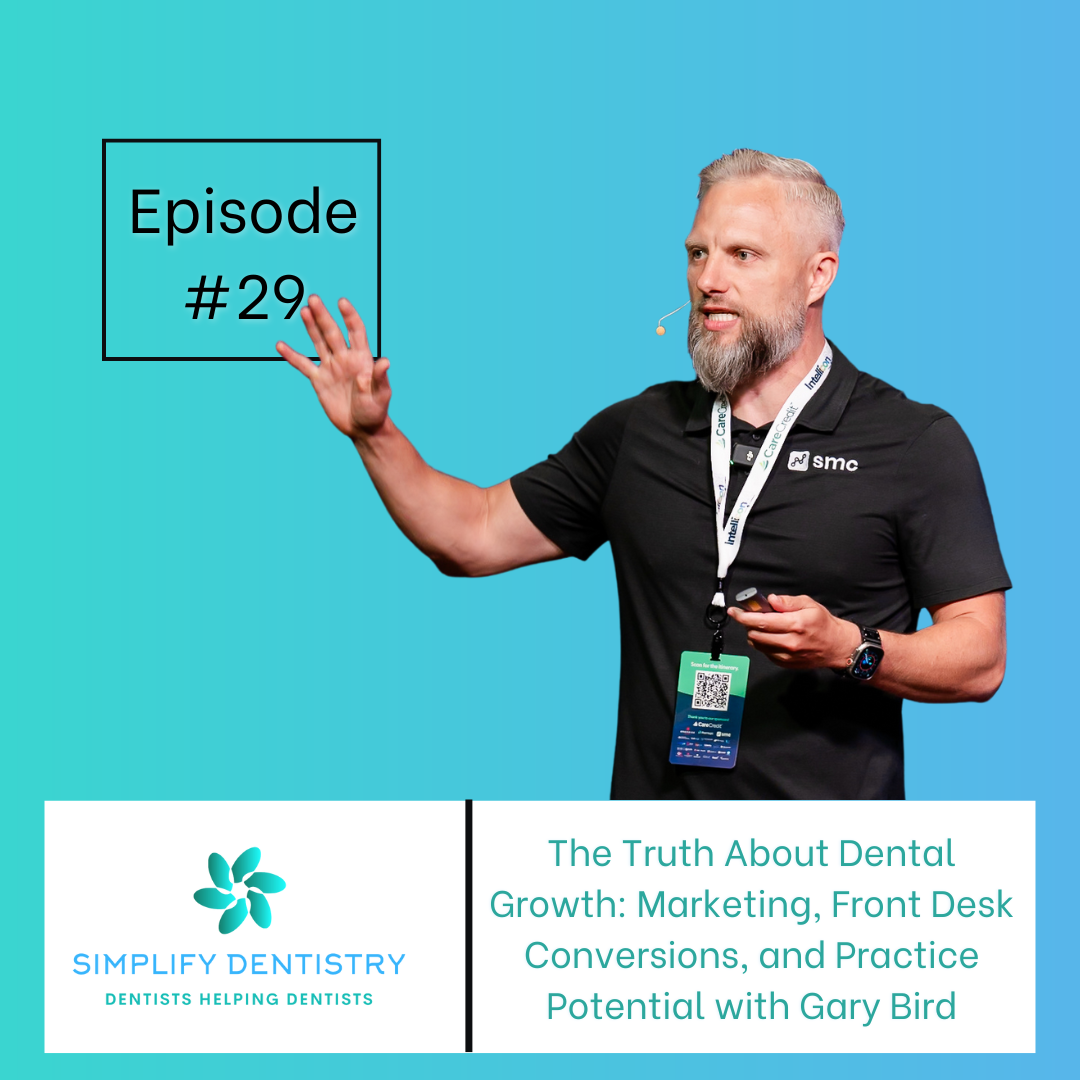
The Truth About Dental Growth: Marketing, Front Desk Conversions, and Practice Potential with Gary Bird
Episode Description
Join Dr. Murtuza Shah-Khan and Dr. Richard Offutt as they sit down with Gary Bird, founder of SMC National and host of Dental Marketing GOAT. In this no-fluff conversation, Gary breaks down the real barriers that hold dental practices back from growth—from marketing missteps to front desk inefficiencies. Learn how to convert more leads, improve patient experience, and think like a modern dental business.
Episode Navigation
00:00 – Welcome and guest intro
01:45 – Why most dental marketing fails
04:05 – Referral patients vs. marketing patients
08:00 – Breaking through the dental “growth ceiling”
10:00 – Front desk: capability vs. capacity
14:00 – How to review call “game tape”
18:30 – Training for pricing and phone conversions
21:00 – Turning insurance calls into booked appointments
25:20 – Simplifying your marketing strategy
27:45 – Final takeaways and where to connect
Key Takeaways
Dental Marketing Myths
Most practices lose a majority of their marketing ROI at the front desk
Referral patients come in with built-in trust—marketing patients don’t
Practice owners often underestimate how many calls they miss or mishandle
Fixing the Front Desk
Review recorded calls for training and accountability
Scripts don’t mean robotic—they create confidence
Pricing questions are not objections—they’re opportunities to connect
Marketing without conversion systems is just expensive hope
Featured Discussion Topics
Dental marketing strategy
Referral vs. marketing patients
Front desk performance
Practice growth bottlenecks
Call conversion and scripting
Business systems for dental teams
Meet Our Guest
Gary Bird is the founder and CEO of SMC National, a dental marketing agency helping group practices scale with smart strategy and strong conversion systems. He’s also the host of Dental Marketing GOAT and a frequent voice in national dental business conversations.
Connect With Simplify Dentistry
Website: simplifydds.com Podcast: Available on all major platforms
Topics: dental marketing, front desk training, dental growth strategy, practice conversion, patient acquisition, call scripting, practice management, referral patients, dental business systems
Transcript
Murtuza Shah-Khan (00:30.456)
Well, Gary, thanks again for joining us, Look forward to having a great conversation.
Gary Bird (00:37.582)
That’s awesome.
Gary Bird (00:43.992)
Absolutely. Yeah. I’m excited to talk about dental marketing and growth and whatever else we jump into today. I love your guys show. I’ve been watching it. So I’m excited to have this conversation.
Murtuza Shah-Khan (00:53.856)
Awesome. A little catch up for everybody else. Rick and I were lucky enough to meet Gary about six months ago, I guess in January, at a dental pod fest meeting and that was great. Got to talk to Gary, got to learn kind of the ins and outs and learn how little we know about dental marketing and as a practice owner, how little I know about dental marketing. So it’s good to lean on guys that actually know what they’re talking about and know how to do what they’re talking about too. So thanks again.
So we’ll jump right in, Gary. One big thing we’ve talked about before, you and I, and I think one thing will be good for our guests is kind of the do’s and don’ts for dental marketing, what you’ve seen in your time with what dentists do well, what they don’t do well, and what they can do to actually get the good result.
Richard Offutt (01:31.789)
Gary, tying into that, what are the A, B, and C? I mean, what are the have-tos for?
Gary Bird (01:46.662)
Yeah, so nothing is what it seems in dental marketing and growth. Okay, so I’ll start there. So the first thing that is most important for a dentist to understand is that most marketers do not understand dental and most dentists do not understand marketing, which is if you start there, then it’s like, okay, well, how do we solve that then? And the number one thing that I hear from dentists, the biggest frustration that I sense from them is that
They all say, I just want quality patients, Gary. If you send me quality patients, then everything’s going to be fine. But how do you define quality patients? Right. And so it’s like, well, I kind of want a patient just to roll into my office, money spilling out of their pocket and say yes to everything. And I’ll be happy. The problem with that is, that a quality patient like that only comes through patient referrals or doctor referrals. So the reason that you get certain patients that come into your office that just say,
man, yes, this is awesome, I’m ready to go, is because someone referred them. Someone actually did the marketing and the sales for you already. And so you’re just doing dentistry and that’s amazing. And let me be clear, every single business loves referrals. I love referrals. When a dentist goes and tells one of their dental friends, go work with Gary, it’s the easiest sales process. There’s not a lot of questions. They’re just like, yeah, just do what you did for them, for me. And so it makes it really, really easy. However,
marketing patients are not that way. Marketing patients are actually the worst kind of patients that you can get on the trust factor. Why? Because they’re doing about two minutes of research on you before they call your office. so patient referrals will call your office if you don’t answer. If you don’t know how to answer their questions, they’ll still schedule. If you schedule them three weeks out, they’ll still show up. If you present the whole treatment plan, the whole shebang, and it’s way more than they can afford,
They’re still going to buy some treatment from you, even if you don’t have good financial options for them to pick from. Marketing patients are not that way. If you don’t answer your phone, they’re calling the next office. If you don’t know how to answer their questions on the phone, they’re going to call the next office. If you schedule them three weeks out, they’re going to no show. And then if you come in and you give them, if they come in with tooth pain or a particular issue that you want them to treat, they’re not going to probably do that with you if you’re going to present the whole thing, right? If you’re going to give them a whole
Gary Bird (04:07.61)
complex treatment plan right when you meet them the first time. So there are much different kinds of patients. So people often ask, well, why should I market then if that’s the case? Well, you have to learn a new skillset. Your office, is. The office has to learn how to pick up the phone, how to convert on the phone, how to present treatment to them. The beautiful thing is, is if you want to grow, the marketing patients, once you get them to come in and accept some treatment and re-care with you,
then they’ll start referring you more patients. And then now you get the high trust or the quality patients that you want, start to really compound for your office. And that’s where real growth happens. The problem is, that patient referrals are not scalable. Meaning, if you go, man, I need 20 more patient referrals next month, you’re probably not gonna be able to make that happen. Marketing is scalable. You can get 20 more or 40 more next month or hire an associate and fill their schedule next month.
And you have to, there’s a lot of things that you have to learn in between there. So that’s where I would say the biggest rub is in dental and why dentists get so frustrated with dental marketing.
Richard Offutt (05:18.233)
So what’s so interesting there to me is that you’re saying that, okay, patients that come to my practice because of marketing initially have lower trust, lower dental requests and whatever.
But then as you’re saying, once you treat them, you convert them and then they become the hyper-referrer, if you will, that’s kind of a made up word, but they become the person that is talking all about you everywhere. That’s such an interesting thing. I hadn’t heard that. Why do you think that happens?
Gary Bird (05:59.43)
Uh, happens because it’s human nature, right? Like if you do a good job and you take care of me and then I’m going to, I’m going to tell my wife or my, husband or my kids to come to you. So that one marketing patient turns into three, four or five new patients. It’s already been happening in everybody’s practice. The problem is, is that most people’s marketing is doing nothing. So, uh, this is the glass ceiling effect that I call it. And this is the majority of the dental industry. So.
you’re spending $5,000 a month on marketing, you get about 20 to 30 new patients a month and you look at all your dashboards and it shows everything’s at like 90 % or higher retention and collections and all those kinds of things, but you never grow. Well, that’s not possible. Something’s extremely broken. You should be full, like within a year, you should have to turn off your marketing and not have room to put anywhere, any other new patients.
But that’s not what’s actually happening in most offices. And the reason for that is you’re spending that $5,000 on marketing. 35 % of it is going down the drain because you didn’t answer your phone during normal business hours. That’s the industry average of missed calls. Those people never come back. You can’t get them back. The average phone conversion for a marketing new patient is 50%. That’s average. Most offices don’t realize that. They say, no, we’re great on the phone. They’re great at patient referrals.
Not with marketing patients though. Just so you know, patient referrals converted at about 100%, while marketing converts at 50. Gives you about a blended ratio of about 75%, that’s what people look at. And then from there, the average time to appointment for the average dental office is over two weeks. It’s like it floats between two and three weeks. That’s gonna put your no-show rate at about 30 % for marketing new patients. When you add all those holes up,
That means you’re losing about 80%, 85 % of your marketing dollars down the drain before they even get to your front door. And that’s not in your PMS. It’s not in any of your analytic dashboards. None of those stats I just gave you are anywhere. You might be able to cobble them together if you have a couple of different things. We use a platform called Trackable. Most people don’t use a single platform that tracks top of funnel like that.
Murtuza Shah-Khan (08:07.415)
Mm-hmm.
Richard Offutt (08:15.913)
.
Gary Bird (08:19.116)
So most people are sitting there looking at it going, man, why am I not growing? I don’t get it. I’m getting, you know, these new patients and I just never grown. What’s actually happening is you’re getting mainly patient referrals that are making it into your office. You’re losing almost all of your marketing before it gets there. The ones that are coming in, you’re not, you’re, you’re not, they’re not accepting any treatment. They leave, they go to another office and you’re barely covering attrition or you’re actually with inflation now.
you’re probably shrinking from a revenue standpoint and a profit standpoint. I should say from a profit standpoint. And so you just end up in a really bad spot and it just feels like nothing’s working. But in reality, your top of funnel is just absolutely just leaking out the side.
Richard Offutt (09:05.866)
So Gary, job one, answer the phone.
Gary Bird (09:09.061)
Yes.
Murtuza Shah-Khan (09:10.424)
You
Gary Bird (09:11.541)
I know, it’s groundbreaking.
Richard Offutt (09:14.568)
Well, you could take that one to the bank, Dr. Shah-Khan.
Murtuza Shah-Khan (09:17.432)
Yeah, I mean, that’s one of those things that we talk about in my office, too. Like I have kind of, you know, kind of a bare bones office that I took over a while back. it’s, you know, one lady up front. You know, if one of the hygienists is open, she’ll help out up front. But, you know, there are tons of missed calls because you’re on the call with one patient, somebody else calls. They do that. You know, you’re missing existing patients. You’re missing new potential new patients. But.
You know, the data-driven stuff, I’m a numbers junkie, so hearing you throw out those numbers or stuff, it’s stuff I’ve never heard, which is great, because like you’re saying, it’s not trackable in your patient management software. I mean, it’s eye-opening and also disheartening at the same point.
Richard Offutt (09:59.437)
So Gary, top of funnel is where you’re saying the hemorrhaging is.
Gary Bird (09:59.598)
It is
Gary Bird (10:05.656)
Exactly. And the reason for that is that practices are run by dentists and dentists are bottom of funnel minded naturally, both because they’re treating the patients. So they’re just focusing on the patients in front of them. But also most dentists would rather save a hundred dollars than make an extra thousand dollars. they’re top line, top thinking, like growing the top line and those kinds of things is not the natural default position for a dentist. Nor do we probably want it to be. We want our dentist to be more conservative and
and think about restoring the tooth and those kinds of things, right? So they’re naturally thinking that way. You have to almost turn off that part of your brain as a dentist and start thinking top line and growth and thinking about the top of the funnel. The patient journey before the patient gets to your office is really the key.
Richard Offutt (10:52.21)
So when you go into a practice and you realize that the doc is the problem, what do you do?
Gary Bird (11:01.2)
So I wouldn’t phrase it that way. wouldn’t say the doctor is the problem. would say that the dentist is preventing their team from excelling. I would go that far. So there’s a couple of different things. there’s, first of at the front desk, let’s start there. So do we have a capacity issue or a capability issue? So that’s the first thing that we’re gonna wanna look at. And a lot of times it’s a capacity issue. I can train, I could train my.
Richard Offutt (11:03.804)
Maybe, okay, I was harsh. I was being harsh, I’m sorry.
Murtuza Shah-Khan (11:06.2)
You
Gary Bird (11:28.55)
16 year old daughter to answer the phones at a dental office and convert the majority of the marketing patients coming in. It’s not hard. It’s to your point earlier, it’s like most of the calls are coming in the morning at lunchtime in an afternoon. Do you have people to answer your phones? If not, we have to figure that out. And if you’re also having a multipurpose front desk person, cannot have them doing like a million different jobs and answering the phones.
Richard Offutt (11:51.88)
.
Gary Bird (11:56.344)
As an example, checking patients out, checking patients in, like you’re going to lose opportunities and you won’t grow. The other tricky part about the front desk, and this falls back on the doctor as well, is that it’s usually the lowest paid position in the office. It’s usually the youngest person in the office. And what happens if someone’s really good at the front desk? What do you do? You instantly promote them. you’re going to be a treatment coordinator. You’re going to do AR now. You’re going to do insurances. So you always have the lowest paid.
least experienced person in your office at the front desk. And if they have any skill, then you move them. This is why a lot of offices never grow is because you actually just cut off your top of funnel and you’re constantly changing it. And that’s a big problem. that, that I would say that ownership does fall on the, the, the dentist on the flip side. I do have some offices that the, do a really good job of answering the phone, physically picking up the phone, but they struggle with accountability to the
Richard Offutt (12:29.895)
Okay.
Gary Bird (12:51.984)
to the front desk of holding them accountable to following the simple scripting. And when you do that, you’re just not going to grow that way either, because you’re going to lose half of your new patients from conversion issues. so the only way to really fix that is to take the actual calls, sit down with your front desk person and say, hey, Susan, let’s listen to these together. Why aren’t you following the scripting? Once you hold them accountable like that, they will start to listen to you.
Richard Offutt (13:03.091)
.
Gary Bird (13:19.846)
But a lot of, doctors that just are newer to leadership and accountability and things like that, it’s just uncomfortable. You know what I mean? No one likes doing that. I didn’t like doing it when I first started as a business owner. Now we review sales. Like I record every call in my company, like every call. Sales calls, onboarding calls, marketing launch calls, maintenance calls, all the recurring calls. And we review them. Like we go in and we watch them and we go, okay, let’s talk through this. What could we do better? How is a better way to approach it?
And it really helps people. It’s game tape, right? Like how does Tom Brady get super good? Watches a lot of game tape. So that’s what you have to do with your front desk if you want them to improve.
Richard Offutt (13:54.499)
Yeah.
Richard Offutt (14:00.134)
So study, study, study, Tape.
Murtuza Shah-Khan (14:00.28)
So are you doing that with your clients, Gary? Are you having them record their calls so you all can review it together? Okay. Okay.
Gary Bird (14:08.742)
Oh, we, won’t work with somebody if I don’t record their calls. Cause I already know that it’s going to be a huge issue. Yeah. So I, every once in a while I’ll have a doctor like, I don’t know if I want you listening to my calls. I’m like, well, then I can’t, we’re not going to be able to work together. There’s, there’s two, it’s too big of a hole. It’s, it’s, it represents too big of a pie. You, uh, to do that blindly.
Richard Offutt (14:30.63)
That’s interesting. Front desk scripting for the calls, practicing the script is key to conversion. Is that fair?
Gary Bird (14:45.382)
Yeah. And also not, not inserting your personal opinion. said earlier, like it went, and when it’s the dentist’s fault. So one of the things that I see that dentists do inadvertently is that they’ll complain about patients that come in and, they say it out loud in front of their team and their team begins to weed out those patients. And that, that is a, once that starts happening, you’re cooked. So as an example, if someone calls in and says, do you take my insurance? And you’ve roasted that insurance in front of a.
that team member, they’re gonna weed out all those insurance patients. If you say, why’d you schedule this kind of patient at this time for this kind of treatment and da-da-da-da-da? Like, they’ll just start weeding those people out or not putting them on the schedule until later and then they no-show. There’s all these little things. Like, if you complain a lot about no-shows, your team will start to delete the people from their schedule so they don’t show up in your no-shows. And you don’t even know that it just looks like there was a gap in your schedule. You’re like, I thought there was a patient later today, but…
It’s not showing up. That’s why everybody has these amazing numbers. It’s because teams will just delete people right out of your schedule and then it doesn’t count as a no show. It’s problem solved. Doctors not going to complain now. And so it’s like, how do I get clarity with my team and get them on board and get them to realize like, we got to open the top of the funnel if we’re going to grow. And then we’ll dial in quality and those kinds of things, but we’ll do it in a two-way conversation, not me putting governors on the phone.
Those are the kinds of things I see happen all the time. And to your point, yes, you got to listen to game tape and you got to have conversations with them. We, what I do, if I really want to get it, if a dentist refuses to hold their team accountable, what I trained my team to do is don’t give them stats. Don’t say you’re only converting at 50%. Take a call where their team absolutely dropped the ball. Take it and send them that one call and say, Hey, listen to this when you have a second.
And then they’ll get mad and then they’ll actually start to do stuff. You know what mean? They need to hear it more than just see the percentages. So that is the way to get movement and get people to actually act on making changes at the front desk.
Richard Offutt (16:56.112)
You know, Gary, it’s interesting that you say that about the call with the insurance. you know, Charlotte is a big banking town and I was, I was doing some surgery for one of the, the CEOs of one of our, big banks and who also knew personally. And in, in he’s, mean, he said to me, goes, Hey, Rick, just file my insurance and tell me what I owe you.
So if my office had said, you know, we don’t do this or we don’t do that, or we do this or we do that, you know, here’s a guy that could do whatever he wanted. He goes, hey, file it and then just tell me what I, you know, type of thing. So it’s, it’s interesting. It’s interesting on the languaging, right?
Gary Bird (17:31.01)
It is like, I’ll give you an example. Everybody, Dentists, all Dentists hate a lot of their insurances, right? But what’s the first question that you train your front desk to ask every single patient? Do you have insurance? Yeah. So it’s like, well, I don’t want to be insurance driven. Why are you talking about it so much then? Like, why aren’t you focusing on why the patient wants to come in and wants help?
Richard Offutt (17:41.7)
Yeah, do you have insurance?
Murtuza Shah-Khan (17:43.02)
Yeah.
Murtuza Shah-Khan (17:50.029)
Mm-hmm.
Gary Bird (17:53.722)
Well, cause if it’s this insurance and we’re only going to get this big of a rebate, it’s like we’re stepping over, we’re stepping over dollars to pick up pennies a lot of the times. And we don’t, we don’t realize it. And then you’re training these habits into your team and you can, I’ve seen people that never overcome it. Like they just are stuck.
Murtuza Shah-Khan (18:11.522)
So you’re coaching people there’s an old Frank Spear book about how he looked at practice management and stuff and he talks about kind of sliding patients into different categories in a way like the emergency patient, the new patient, the one problem patient. Are you having those conversations with your clients on strategies on answering the phone that way?
Gary Bird (18:32.824)
No, it’s even, I mean, with a doctor, a doctor can handle those kinds of complexities in the op and a treatment coordinator can, but the front desk is far simpler. It’s, do I have the pleasure of speaking with? Let’s like figure out what you need. And then, and then from there, it’s like, let’s get you in. Now that the one that really messes people up, there’s two questions. There’s cause there’s only four different kinds of questions that patients really ask. Most of them are easy. Like, do you do this treatment? It’s yes or no. Right.
Richard Offutt (18:40.712)
Okay.
Gary Bird (19:02.374)
And then, uh, uh, when’s your next availability? That one’s easy. And then the hard one is how much, how much is this? This is the one that messes dentists up because dentists typically train their team. Do not answer this question. The problem is, , if you literally use that scripting, we were not allowed to give pricing over the phone. You lose a hundred percent of those patients. No one’s, no one’s coming to you on the flip side. If you start to give pricing, now you’re diagnosing over the phone and you just like, how much is an implant? Oh, it’s.
$4,000 $5,000. Yeah, except when it’s not, you know what mean? And do they need an implant? Do they need jaw surgery? Like there’s all these complexities. that makes me, I’m not a clinician, but that makes me nervous giving prices over the phone. So if you’re not supposed to give the pricing and you can’t give the pricing, then what’s the answer? Well, the answer is education. So if someone calls in and says, hey, how much is an implant? Sure, I’d love to get that to you. Tell me a little bit about the problem. Is the tooth impacted? I don’t know.
Richard Offutt (19:40.8)
Okay.
Mm hmm.
Gary Bird (20:01.126)
How many roots does the tooth have? I don’t know. Well, you know what? Without that information, no one’s gonna be able to give you accurate pricing. So let’s do this. Let’s get you in for a free consultation. Doc will take a look at it. We’ll tell you exactly what’s going on, what the cost is, what works better for your morning or afternoons. That’s it. That works for everything. Hey, how much is a filling? How many surfaces is it on? Right? Like it works for every single kind of treatment. We actually have a cheat sheet that we give our clients for this. It’s so easy. It converts almost everybody. There is a small group that will push you and say,
Okay, well, just give me a range and then you just give them a monster. Yeah, if it’s a simple thing, it could be a thousand bucks. It could go all the way up to tens of thousands of dollars. There’s no way to tell you that. It’s like saying, how much is it to fix my car? It’s making this noise. It’s like, yeah, okay. So those are the tricky ones. Now the other one that’s really, really tricky is do you take my insurance? And the reason this is tricky is insurances make
everything complex on purpose. It’s a feature, not a bug in their business model. Everything’s really confusing. So the best thing to do is just make the insurance the bad guy and just say, it doesn’t matter what your model is, is just say, we have lots of patients that have that insurance here. Let’s get you in. We can take a look and figure everything out for you. If someone’s like, well, I don’t know, and you don’t want to make them mad and they come in and whatever, then just say, we can do a complimentary benefits check for you and figure out what you need and tell you exactly what’s going on.
Richard Offutt (21:01.859)
.
Gary Bird (21:29.562)
That’s like a secondary thing that you can do. If you say, we don’t take any insurances or we’re out of network with all insurances, you will literally lose every one of those patients. You will not convert. No one’s going to be like, you’re telling them, no, please don’t come in. That’s the scripting that you’ve given them. So you might as well not even market at that point. You should just go figure out how to get doctor referrals and patient referrals at that point.
Richard Offutt (21:55.284)
Gary, is your mindset the come on down sort of mindset? Patients on the phone, they’ve got this issue and the front desk is, come on down, let’s figure it out. Is that sort of the gist of it?
Gary Bird (22:08.73)
If your marketing is set up correctly, why would it? Yeah, exactly. Let’s get you in and figure it out. because they’re either calling for a, there’s only three ways into a dental office. It’s there’s hygiene. I want to get my teeth clean. I get my teeth cleaned every six months. My dentist just closed down. I just moved from another area or whatever. Right. There’s so that’s just like routine. That’s simple. Right. That’s typically insurance driven as well. So it’s even simpler. It’s like my insurance pays for my cleaning. So just want to get it done.
That’s huge. Those are great kinds of patients. If you can just get that person in and get their teeth cleaned and get them to come back, that’s three to four patient referrals right there over the next couple of months, like slam dunk. That’s one kind of patient. The other kind of patient is problem driven. So they’re calling about my tooth hurts. I want my teeth to look better. I want aligners. I want implant. want this kind of things. Those are just coming in through an exam and x-ray or consultation. Those are the only ways that patients come in.
And you got to have availability for them. And you need to know that if you’re marketing for those or not, those are all different kinds of patients. They’re driven by different ways and they’re there. You have to have availability for them. Uh, a hygiene patient, if you put them out six months, they’re not going to, they’re going to no show. They’re going to end up, they’ll schedule with you and then they’ll call other offices and then they’ll schedule there and they’ll forget to tell you. And then you’ll get a no show and then you’ll be mad when you wasted money and time.
emergencies or problem focused people, you need to get them in in like 72 hours minimum for an emergency, a true like, I’m in pain. You need to get them in same day, next day. And those are, there’s tons of opportunities like that. I’ll give you an interesting little thing, a project I’ve been working on. I work with a dentist in Texas, small, medium, small town, not a big city. It’s a suburb of a big city though. And
Richard Offutt (23:58.785)
Yeah.
Gary Bird (24:06.138)
They are, they could do, they do after hours. So they only do after hours. So they start from six and they go to midnight. And they, we’ve been testing different things like how many new patients can we drive for them? And they’re all new patient driven, right? Like people come in, get their problem fixed and never come back there. So it’s not a hygiene recurring model. It’s a one time model. In their market, I think we could drive 200 new patients just on the weekends.
with problems, people with problems. 200, because there’s that many people who are like, I’m in pain, I need to get this taken care of right now, I might as well just get it done. And then they come in and they get whatever other work done they need. So there’s, in every market, there’s tons of opportunity. That’s probably the other big thing is that most dentists think there’s not enough new patients. There’s an abundance of new patients. There’s actually not enough providers in most markets.
Murtuza Shah-Khan (25:02.796)
Interesting. Gary, one big question I always like to ask our guests is, we’re Simplified Dentistry, so how do you make dentistry simple? What’s a quick tidbit on how with marketing you can make dentistry more simple for dentists?
Gary Bird (25:20.368)
Ooh, was a good question. How do you make it more simple?
Murtuza Shah-Khan (25:24.248)
Mm-hmm.
Gary Bird (25:26.18)
outsource it to somebody who knows what they’re doing. Yeah. You could figure it out. Like dentists are super smart. They can figure it out if you put your energy into it. I bet you I could figure out how to do some of my own dentistry too.
Murtuza Shah-Khan (25:28.684)
That’s what I was looking for. Nice.
Murtuza Shah-Khan (25:40.408)
Some YouTube videos, some Holiday Inn Express, that’ll work out great.
Gary Bird (25:41.914)
but there’s gonna be a lot of pain.
Richard Offutt (25:42.544)
Okay.
Gary Bird (25:45.99)
Yeah, exactly. Like I could go watch a YouTube video and figure out some of my own dentistry, but it’s going to be very painful and there’s going to be a lot of carnage along the way. So that’s how I feel about dentists doing their own marketing. You got to use your time, unless you love marketing. If you love marketing, like when I say you love it, you would do it for free to help your friends every weekend for a couple months. If you love it like that, then do your own marketing. But if you don’t love it,
Richard Offutt (25:56.752)
Okay.
Gary Bird (26:14.704)
then you should be outsourcing it to somebody and don’t outsource it based on caught. Like this is the biggest mistake I have is like, I need marketing $2,000 worth. Well, it’s like me going into the dentist saying I need dentistry $500 worth. Like really big mistake if you approach a dentist with that kind of attitude because you’re not gonna get the outcome that you want. Same thing with marketing. You should start at the end. What are you trying to accomplish?
Richard Offutt (26:25.936)
.
Gary Bird (26:40.996)
And if you start with, I just want to build a website, then you’re just going to get a website. But if your real end goal is to actually get more new patients, you need to start with that. And then you’re going to learn really quickly if they know what they’re talking about or not. When you say, I need 20 more new patients. What is that going to take? And if they come back to you and they’re just like give you their standard package, they have no idea if it’s going to drive you new patients or not.
Richard Offutt (26:55.888)
Gary Bird (27:06.288)
But if they come in and they start to break down, okay, well, what’s your cap going to be? What’s your cost per lead going to be? What’s your phone conversion look like? What’s your capacity look like? Now they’re having conversations with you to actually help you get to your goal. If they’re not talking through that, it’s a coin flip. If they’re going to be able to drive you the opportunities that they want, and if they’re going to be able to tell you where your holes are at.
Richard Offutt (27:27.602)
Murtuza Shah-Khan (27:45.112)
Yeah, thanks again, Gary. And Gary, if any of our listeners want to get in touch with you, what’s the best way to do that?
Gary Bird (27:46.84)
Absolutely.
Gary Bird (27:50.926)
You can find me on Facebook arguing with dentists at The Gary Bird and I’m pretty active on there. And I have a, that’s my social media handle, the Gary Bird, or you can go to our company website, smcnational.com.
Murtuza Shah-Khan (28:05.152)
Awesome, Gary, thanks again, man, really enjoyed it.
Richard Offutt (28:07.673)
Thanks, Gary.
Gary Bird (28:07.846)
You guys are awesome. Thanks for having me on.